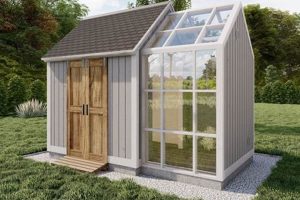
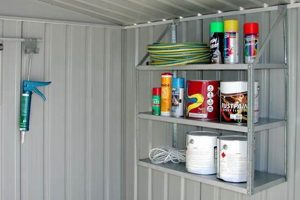
Illumination systems powered by photovoltaic technology provide a means to brighten outbuildings such as potting spaces or storage units without relying on mains electricity. These systems typically consist of a solar panel, a rechargeable battery, and a light source, offering an alternative to traditional wired electrical setups. A typical application might involve installing a panel on the shed roof to capture sunlight, which then charges the battery to power an internal LED lamp.
Adopting this type of lighting contributes to energy conservation and reduces carbon footprint, aligning with sustainable practices. Historically, reliance on kerosene lamps or extension cords for shed illumination presented safety hazards and operational limitations. These self-contained systems offer a safer, more convenient, and often more cost-effective solution, eliminating the need for trenching and wiring, and reducing dependence on utility grids.
The subsequent sections will explore the various components involved in these systems, including panel types, battery technologies, and lighting options. Factors influencing system selection, installation considerations, and maintenance tips will also be examined to assist in making informed decisions.
Optimizing Shed Illumination
Effective employment of photovoltaic-powered illumination hinges on careful planning and execution. The following guidelines offer critical insights for system selection, installation, and ongoing maintenance.
Tip 1: Panel Sizing: Accurately calculate the shed’s daily lighting requirements to determine the appropriate panel wattage. Undersized panels will result in insufficient battery charging, while oversized panels may represent an unnecessary expense.
Tip 2: Battery Capacity: Select a battery with adequate amp-hour (Ah) capacity to sustain lighting throughout periods of reduced sunlight. Lead-acid, lithium-ion, and nickel-metal hydride (NiMH) batteries are common choices, each with varying lifecycles and performance characteristics.
Tip 3: Lighting Efficiency: Prioritize light-emitting diode (LED) fixtures due to their high luminous efficacy and low energy consumption. Consider the desired light output (lumens) and color temperature (Kelvin) to suit the shed’s intended use.
Tip 4: Panel Placement: Optimize panel orientation and tilt angle to maximize solar irradiance capture. South-facing placement (in the Northern Hemisphere) with an angle approximating local latitude generally provides optimal performance. Obstructions from trees or buildings must be minimized.
Tip 5: Wiring and Connections: Employ appropriately sized wiring and secure connections to minimize voltage drop and ensure safe operation. Weatherproof connectors and conduit should be utilized for external wiring to protect against environmental damage.
Tip 6: Charge Controller Integration: Install a charge controller to regulate battery charging and prevent overcharging, which can significantly reduce battery lifespan. Pulse-width modulation (PWM) and maximum power point tracking (MPPT) controllers offer varying levels of efficiency.
Tip 7: Routine Maintenance: Periodically inspect panels for dirt and debris, cleaning them as needed to maintain optimal performance. Battery terminals should be cleaned and tightened to prevent corrosion. Battery electrolyte levels (if applicable) should be checked and replenished.
Proper implementation of these considerations ensures reliable and efficient operation. Adhering to these guidelines maximizes system longevity and minimizes the need for future repairs or replacements.
The subsequent section will address common troubleshooting issues, offering solutions to potential problems encountered during system operation.
1. Panel placement

Optimal panel positioning is a critical determinant of the performance of photovoltaic lighting for garden sheds. Inadequate placement significantly compromises the system’s ability to harness solar energy, leading to reduced illumination or system failure.
- Orientation and Azimuth
Panel orientation dictates the direction the panel faces. In the Northern Hemisphere, a south-facing orientation generally maximizes sunlight exposure throughout the year. The azimuth angle, or the horizontal angle relative to true south, should ideally be 0 degrees. Deviations from this ideal, such as east or west-facing placements, reduce the panel’s exposure to direct sunlight, particularly during peak hours. Real-world scenarios often necessitate compromises due to obstructions, requiring careful evaluation of available sunlight at different times of day.
- Tilt Angle and Latitude
The tilt angle refers to the angle at which the panel is inclined relative to the horizontal plane. An optimal tilt angle approximates the local latitude, maximizing solar energy capture year-round. For example, a location at 40 degrees latitude typically benefits from a panel tilt angle of approximately 40 degrees. Seasonal adjustments to the tilt angle can further optimize performance, although this is often impractical for garden shed applications. Fixed tilt angles represent a balance between summer and winter solar conditions.
- Shading and Obstructions
Shading, whether from trees, buildings, or other structures, significantly reduces panel output. Even partial shading can disproportionately diminish performance, as photovoltaic cells are often interconnected in series. Careful assessment of shading patterns throughout the day and year is crucial. Mitigation strategies include trimming vegetation, relocating the panel, or employing bypass diodes within the panel to minimize the impact of shaded cells. The absence of shading is paramount for reliable operation.
- Mounting and Stability
Secure and stable mounting ensures the panel maintains its optimal orientation and tilt angle over time. Wind loads, snow accumulation, and other environmental factors can exert significant stress on the mounting structure. Robust mounting hardware and proper installation techniques are essential to prevent panel displacement or damage. Regular inspections are advisable to ensure continued stability and alignment.
Effective panel placement integrates orientation, tilt, shading considerations, and mounting stability to maximize energy capture for photovoltaic lighting in garden sheds. Suboptimal placement invariably diminishes system performance, necessitating careful evaluation and mitigation of potential challenges.
2. Battery capacity

Battery capacity is a fundamental determinant of the autonomy and reliability of photovoltaic lighting systems used in garden sheds. It quantifies the amount of electrical energy the battery can store and subsequently deliver. Insufficient capacity leads to premature depletion and compromised lighting duration, particularly during extended periods of overcast weather or high usage. Adequate battery capacity, conversely, ensures consistent illumination regardless of transient environmental conditions. For instance, a shed requiring 4 hours of daily lighting at 10 watts necessitates a battery capable of delivering at least 40 watt-hours, accounting for system inefficiencies and depth of discharge limitations.
The selection of battery capacity involves careful consideration of several factors. Lighting load, expressed in watts or equivalent amperage, directly dictates the energy consumption rate. Daily insolation, representing the amount of solar energy received at the panel location, influences the battery charging rate. Battery technology, such as lead-acid, lithium-ion, or nickel-metal hydride, affects energy density, lifespan, and charging characteristics. Depth of discharge (DoD), which denotes the percentage of battery capacity that can be safely discharged without compromising lifespan, further influences the usable energy reserve. For example, lithium-ion batteries typically tolerate higher DoD compared to lead-acid batteries, allowing for greater utilization of the available capacity.
Optimizing battery capacity necessitates a balanced approach that considers both initial cost and long-term performance. Undersizing the battery results in frequent cycling and accelerated degradation, leading to premature replacement. Oversizing the battery increases initial expenditure without necessarily providing commensurate benefits, especially if the solar panel cannot adequately replenish the stored energy. Proper estimation of lighting requirements, accounting for seasonal variations and anticipated usage patterns, coupled with careful selection of battery technology and charge controller settings, ensures a photovoltaic lighting system with appropriate battery capacity, fostering reliable and sustainable illumination of garden sheds.
3. LED Lumens

Luminous output, quantified in lumens, is a critical parameter when integrating light-emitting diode (LED) technology within photovoltaic-powered illumination for garden sheds. The lumen value directly correlates to the perceived brightness of the light source. Inadequate lumen output renders the lighting system ineffective for intended tasks, while excessive output may result in unnecessary energy consumption and potential glare. Proper selection of LEDs with appropriate lumen ratings is therefore essential for optimizing functionality and efficiency.
The required lumen output is dictated by the shed’s dimensions, surface reflectivity, and intended use. A small storage shed with light-colored walls may require significantly fewer lumens than a larger workspace with darker surfaces. For example, a 100 square foot shed used primarily for storage might be adequately illuminated by a 800-1000 lumen LED fixture. Conversely, a similarly sized shed used as a workshop could necessitate 2000 lumens or more to provide sufficient task lighting. Selection also relies on LED efficacy, measured in lumens per watt; higher efficacy LEDs deliver more light output for a given power input, extending battery runtime in solar-powered applications.
Precise matching of lumen output to application requirements, alongside careful consideration of LED efficacy, ensures effective and energy-conscious photovoltaic illumination of garden sheds. An informed understanding enables system design that balances functional needs with energy conservation, maximizing the utility and sustainability. Challenges include accurately estimating lighting needs and accounting for lumen depreciation over the LED’s lifespan. This understanding is vital to realizing the full potential of stand-alone solar-powered lighting solutions.
4. Wiring Gauge

Wiring gauge represents a critical parameter in photovoltaic-powered lighting systems for garden sheds, directly influencing system performance and safety. Inadequate wiring gauge introduces excessive resistance, leading to voltage drop and reduced power delivery to the LED fixtures. This manifests as dimmer lighting, inefficient battery utilization, and potential overheating of the wires. Conversely, appropriately sized wiring minimizes voltage drop, ensuring optimal light output and extending system lifespan. For instance, connecting a 12V LED lamp drawing 2 amps over a 20-foot distance with 20 AWG wire will result in a noticeable voltage drop, dimming the lamp; using 14 AWG wire for the same application will minimize this voltage drop.
The selection of appropriate wiring gauge necessitates careful consideration of several factors. Amperage requirements of the lighting circuit, circuit length, and allowable voltage drop are primary determinants. Higher amperage and longer wire runs demand thicker wiring (lower AWG number) to minimize resistance. Industry standards and electrical codes provide guidance on selecting appropriate wiring gauges for specific applications, incorporating safety margins to prevent overheating. Furthermore, environmental conditions, such as temperature and humidity, can influence wire conductivity, necessitating adjustments to gauge selection in extreme climates. The National Electrical Code (NEC) offers tables that specify ampacity ratings for different wire gauges under various conditions.
Effective implementation of proper wiring gauge ensures reliable and efficient operation of photovoltaic lighting in garden sheds. Neglecting this critical aspect can compromise system performance and pose safety hazards. Proper application guarantees the delivery of sufficient power to the LED fixtures, maximizing their brightness and lifespan. This knowledge contributes to informed system design that balances functionality, safety, and cost-effectiveness, thus harnessing maximum solar potential for reliable, standalone lighting solutions.
5. Charge controller
A charge controller is an indispensable component within photovoltaic lighting systems for garden sheds, mediating the energy flow between the solar panel array and the battery storage. Its primary function is to regulate battery charging, preventing overcharge and extending battery lifespan, thereby ensuring reliable and sustained illumination.
- Overcharge Prevention
Excessive charging voltage can damage batteries, causing overheating, electrolyte boiling, and reduced capacity. Charge controllers employ various techniques, such as pulse-width modulation (PWM) or maximum power point tracking (MPPT), to regulate the charging current and voltage, preventing overcharge. For instance, a 12V lead-acid battery, if charged at 15V without control, will be damaged. The controller ensures the voltage remains within the safe charging range (e.g., 13.8V), protecting the battery.
- Deep Discharge Protection
Completely depleting a battery’s charge, known as deep discharge, can also shorten its lifespan. Charge controllers often incorporate low-voltage disconnect (LVD) features that automatically disconnect the load (lighting) when the battery voltage drops below a predetermined threshold. This prevents deep discharge, preserving battery health. Example: Without LVD, an over-night drain will destroy a lead acid battery.
- Temperature Compensation
Battery charging characteristics vary with temperature. Charge controllers equipped with temperature compensation adjust the charging voltage based on the battery temperature, optimizing charging efficiency and preventing damage. For instance, cold temperatures require slightly higher charging voltages than warm temperatures to achieve full charge. Controllers with external temperature sensors allow precise adjustments based on current conditions. Correcting for this temperature variance is critical for the longevity of the battery system. A temperature probe may adjust the charging rate depending on external temperature, lengthening life of the battery.
- Load Management
Some charge controllers offer load management features, enabling control over the lighting system’s operation. This can include timers, dimming capabilities, or automatic on/off switching based on ambient light levels. Load management helps conserve energy and tailor the lighting to specific needs. An example includes using a timer to switch lighting on at dusk and off at a pre-set time to minimize energy consumption. This improves overall battery and system life.
Integrating a charge controller within photovoltaic lighting for garden sheds ensures optimal battery performance, extending lifespan and delivering sustained illumination. Neglecting this crucial component risks battery damage and system failure, underscoring the importance of its inclusion in any properly designed solar-powered shed lighting solution.
Frequently Asked Questions
The following addresses common inquiries regarding solar-powered lighting solutions for outbuildings. Understanding these points facilitates informed decision-making and effective system implementation.
Question 1: What panel size is required to power a standard garden shed lighting system?
The necessary panel wattage depends on the shed’s average daily lighting requirements. An energy audit is recommended to determine power consumption based on light fixture wattage and usage duration. Generally, a 20-watt to 100-watt panel is sufficient for typical garden shed applications, contingent upon battery capacity and lighting load.
Question 2: Which battery type is most suitable for solar-powered shed lighting?
Lead-acid, lithium-ion, and nickel-metal hydride batteries are all viable options, each offering distinct advantages and disadvantages. Lead-acid batteries are cost-effective but have shorter lifespans and lower depth-of-discharge tolerance. Lithium-ion batteries offer higher energy density and longer lifespans but are more expensive. Nickel-metal hydride batteries provide a balance between cost and performance.
Question 3: How can the runtime of a solar-powered shed lighting system be maximized?
Maximizing runtime involves several strategies. Employing energy-efficient LED fixtures reduces power consumption. Optimizing panel placement to maximize sunlight exposure ensures efficient battery charging. Selecting a battery with sufficient capacity provides ample energy storage. Minimizing parasitic loads, such as inverters or other electronic devices, further extends runtime.
Question 4: Is a charge controller necessary for solar-powered shed lighting systems?
A charge controller is essential for regulating battery charging and preventing overcharge, which can significantly reduce battery lifespan. Charge controllers also prevent deep discharge and may offer temperature compensation features. Its inclusion is paramount for reliable and sustained system operation.
Question 5: What wiring gauge should be used for connecting the solar panel, battery, and light fixtures?
The appropriate wiring gauge depends on the amperage requirements of the lighting circuit and the length of the wire run. Thicker wiring (lower AWG number) is necessary for higher amperage and longer distances to minimize voltage drop. Industry standards and electrical codes provide guidance on selecting appropriate wiring gauges.
Question 6: What maintenance is required for solar-powered shed lighting systems?
Routine maintenance includes periodically inspecting panels for dirt and debris, cleaning them as needed to maintain optimal performance. Battery terminals should be cleaned and tightened to prevent corrosion. Battery electrolyte levels (if applicable) should be checked and replenished. Regular monitoring of battery voltage ensures proper system operation.
Proper attention to these frequently asked questions ensures efficient, reliable, and safe utilization of photovoltaic lighting systems in garden sheds. Addressing these key concerns promotes optimized system performance and longevity.
The following section delves into potential challenges and limitations associated with implementing solar solutions, offering insights into mitigating these obstacles.
Solar Lighting for Garden Shed
This exploration of illumination solutions for outbuildings has highlighted the critical components, installation considerations, and maintenance practices essential for realizing effective system deployment. Maximizing performance requires judicious panel placement, appropriate battery selection, efficient lighting fixtures, and adherence to safety guidelines.
The adoption of photovoltaic technology represents a pragmatic step toward energy independence and reduced environmental impact. Prioritizing informed decision-making and meticulous execution ensures reliable, cost-effective, and sustainable illumination for auxiliary structures, contributing to a more resource-conscious future.