



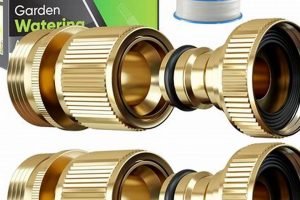
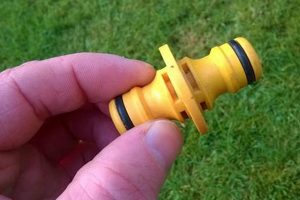
This component is a fitting designed to attach to a garden hose, featuring external threads that allow it to be screwed into a corresponding female-threaded connection. Its primary function is to create a secure and leak-proof joint, enabling the connection of the hose to various water sources or accessories, such as sprinklers, nozzles, or other hoses. A typical example involves connecting the hose to an outdoor faucet.
The utility of this type of fitting lies in its ability to facilitate efficient water delivery for gardening, landscaping, and other outdoor tasks. Its standardized threading ensures compatibility across a wide range of equipment. The development of such connectors has streamlined water management practices, replacing less reliable and more cumbersome methods of joining hoses and water sources. Early iterations of these fittings were often made of brass, prized for its durability and resistance to corrosion, though modern versions frequently incorporate plastic or a combination of materials.
The following discussion will delve into the materials used in the construction of these connectors, examine common types and sizes, and explore best practices for installation and maintenance to ensure optimal performance and longevity.
Essential Usage and Maintenance Guidelines
The following tips provide practical guidance to maximize the lifespan and performance of the fitting. Proper installation and regular maintenance are crucial for preventing leaks and ensuring reliable water flow.
Tip 1: Inspect Before Use: Prior to each connection, visually examine the fitting for any signs of damage, such as cracks, deformation, or worn threads. Damaged components should be replaced immediately to prevent leaks and potential water wastage.
Tip 2: Ensure Proper Thread Alignment: When attaching the component, carefully align the threads to avoid cross-threading. Cross-threading can damage both the fitting and the mating connector, leading to leaks and premature wear.
Tip 3: Apply Thread Seal Tape: To create a watertight seal, apply thread seal tape (also known as Teflon tape) clockwise around the threads before connecting. Two to three wraps of tape are typically sufficient. This helps fill any microscopic gaps between the threads.
Tip 4: Avoid Overtightening: Tighten the connection until snug, but avoid overtightening. Overtightening can damage the threads or the fitting itself, especially in the case of plastic fittings. A wrench may be necessary for a secure connection, but apply moderate force.
Tip 5: Protect from Extreme Temperatures: Prolonged exposure to extreme temperatures, particularly freezing conditions, can cause the material to become brittle and prone to cracking. Disconnect and store hoses indoors during freezing weather to prevent damage.
Tip 6: Store Properly When Not in Use: When not in use, store hoses and their associated fittings in a cool, dry place, away from direct sunlight and extreme temperatures. This helps prevent degradation of the materials and extends the lifespan of the component.
Tip 7: Regularly Clean the Threads: Periodically clean the threads of the fitting with a brush to remove any dirt, debris, or mineral buildup. This ensures a clean and secure connection each time the hose is used.
Adhering to these guidelines will contribute to a longer-lasting, leak-free connection, resulting in efficient water usage and reduced maintenance needs.
The subsequent sections will explore common problems and troubleshooting techniques related to garden hose connections.
1. Thread Size Standard

The consistency of thread size is paramount to the functionality and interchangeability of fittings. Within garden hose systems, adhering to established standards ensures compatibility between various components, most notably between the hose and its terminal connectors.
- National Pipe Thread (NPT)
In North America, the most prevalent thread standard is the National Pipe Thread (NPT). This tapered thread design creates a tight seal as the fitting is tightened. Deviations from NPT specifications can result in leaks or incompatible connections, hindering the ability to connect hoses to faucets or attachments effectively.
- Garden Hose Thread (GHT)
Within the NPT family, Garden Hose Thread (GHT) is the specific standard used for garden hoses. Characterized by its 11.5 threads per inch (TPI) and 3/4-inch diameter, GHT on fittings enables secure attachment to garden hose nozzles, sprinklers, and other accessories. A mismatch in GHT dimensions or TPI can prevent proper connection and lead to water leakage.
- Interoperability and Compatibility
Strict adherence to thread standards allows for interoperability. A fitting that deviates from the standard may not properly mate with other components. For example, attempting to connect a non-GHT fitting to a standard garden hose will likely result in a loose connection or the inability to connect at all, rendering the system unusable.
- Global Variations
While GHT is common in North America, other regions may utilize different thread standards. For example, some European countries employ British Standard Pipe (BSP) threads. Using fittings designed for a different standard necessitates the use of adapters, which can introduce additional points of failure and reduce the overall reliability of the connection.
In summary, the thread size standard of a fitting dictates its compatibility with other components in a garden hose system. Deviation from the GHT standard, or a lack of understanding regarding global variations, can significantly impact the functionality and efficiency of any watering setup. Proper identification and adherence to thread standards are therefore crucial for successful connection and leak-free operation.
2. Material Durability

Material durability is a critical factor influencing the lifespan, performance, and reliability of a garden hose fitting. The selection of robust materials directly correlates with the component’s ability to withstand environmental stressors, physical strain, and prolonged use, ultimately determining its long-term effectiveness.
- Resistance to Environmental Degradation
External fittings are routinely exposed to ultraviolet (UV) radiation, temperature fluctuations, and moisture. Materials such as brass and certain engineered plastics are inherently resistant to degradation from these factors. Brass forms a protective oxide layer that inhibits corrosion, while UV-stabilized plastics resist embrittlement and cracking under prolonged sun exposure. The choice of material directly affects the fitting’s ability to maintain its structural integrity and prevent leaks over time.
- Mechanical Strength and Impact Resistance
Garden hoses and their fittings are often subjected to mechanical stresses, including tensile forces during use and impact from accidental drops or being stepped on. Fittings constructed from materials with high tensile strength, such as stainless steel or reinforced nylon, are less likely to deform or fracture under these conditions. This mechanical resilience ensures a secure connection and prevents catastrophic failures that could lead to water loss or property damage.
- Chemical Inertness and Corrosion Resistance
Water sources can vary in chemical composition, and some may contain corrosive elements that can degrade certain materials. Fittings made from materials that are chemically inert, such as polypropylene or certain grades of stainless steel, resist corrosion from these substances. This is particularly important in areas with hard water or where fertilizers or other chemicals are used in conjunction with the hose, as corrosion can weaken the fitting and compromise its seal.
- Abrasion Resistance and Wear
The threads of a fitting are subject to abrasion and wear as they are repeatedly connected and disconnected. Materials with high abrasion resistance, such as brass or hardened plastics, maintain their thread integrity for a longer period. This prevents the threads from becoming stripped or deformed, which can lead to leaks and make it difficult to achieve a secure connection. The selection of abrasion-resistant materials contributes to the overall longevity and reliability of the fitting.
In conclusion, the material composition of the fitting directly influences its ability to perform reliably under a range of environmental and mechanical conditions. Choosing fittings constructed from durable, corrosion-resistant, and mechanically strong materials is essential for ensuring long-term performance and minimizing the risk of leaks, failures, and the need for frequent replacements.
3. Connection Security

The secure connection afforded by the garden hose fitting is paramount to efficient water conveyance. The fitting’s design, incorporating standardized threads, aims to establish a firm and watertight seal when mated with a corresponding female connector. A compromised connection, resulting from damaged threads, mismatched sizing, or inadequate tightening, directly leads to water leakage, reduced water pressure, and potential resource wastage. For example, in agricultural settings, a leaking connection in an irrigation system can cause uneven water distribution, impacting crop yield and increasing water consumption.
Several factors contribute to connection security. The material composition of the fitting, particularly its resistance to deformation and corrosion, directly affects its ability to maintain a secure seal over time. Thread seal tape, applied correctly, enhances the seal by filling microscopic gaps between the threads, preventing water seepage. Furthermore, proper installation practices, including avoiding cross-threading and over-tightening, are crucial for preserving the integrity of the connection. Failure to adhere to these practices can lead to premature wear, thread damage, and ultimately, connection failure.
In conclusion, the garden hose fitting plays a critical role in ensuring connection security within water distribution systems. Understanding the factors that influence connection integrity, and implementing appropriate installation and maintenance practices, are essential for minimizing water loss, maximizing water pressure, and achieving efficient water usage across various applications. The challenge lies in consistently adhering to best practices to mitigate the long-term risks associated with compromised connections.
4. Leak Prevention

Effective management of water resources hinges on the ability to prevent leaks in distribution systems. The garden hose fitting, as a critical component in connecting hoses to water sources and accessories, plays a central role in minimizing water loss and maintaining system efficiency. The following discussion outlines key aspects of leak prevention directly related to the performance and maintenance of these connectors.
- Thread Integrity and Sealant Application
The condition of the threads on the fitting directly impacts its ability to create a watertight seal. Damaged, corroded, or worn threads provide pathways for water to escape. Proper application of thread seal tape (Teflon tape) around the threads prior to connection is essential. This tape fills microscopic gaps and imperfections, creating a barrier against water leakage. Inadequate or improper sealant application significantly increases the risk of leaks, leading to water wastage and reduced system pressure. For instance, re-applying the tape after several uses is a good practice.
- Material Compatibility and Resistance to Degradation
The material from which the fitting is constructed influences its resistance to environmental degradation and chemical corrosion. Fittings made from brass or certain engineered plastics exhibit greater resistance to these factors compared to less durable materials. Corrosion or degradation can weaken the fitting, compromising its ability to maintain a tight seal and leading to leaks. In areas with hard water or exposure to fertilizers, selecting fittings made from corrosion-resistant materials is crucial for preventing leaks and extending the lifespan of the connection.
- Proper Tightening and Avoidance of Cross-Threading
Achieving a secure, leak-free connection requires proper tightening of the fitting. Over-tightening can damage the threads, while under-tightening may not provide a sufficient seal. Cross-threading, which occurs when the threads are not properly aligned during connection, can also cause irreparable damage and lead to leaks. Careful alignment and application of appropriate torque are essential for preventing these issues. Using a wrench for final tightening, while avoiding excessive force, can help ensure a secure and leak-free connection.
- Regular Inspection and Maintenance
Regular inspection of the fitting for signs of damage, corrosion, or wear is vital for leak prevention. Any damaged fittings should be replaced promptly. Periodic cleaning of the threads to remove dirt, debris, or mineral buildup can also help maintain a secure connection. Ignoring these maintenance steps can lead to gradual degradation of the fitting and an increased risk of leaks over time. For example, before winter storage, removing the fitting, cleaning it, and storing it indoors can extend its service life and prevent freezing damage.
In summary, effective leak prevention related to fittings requires attention to thread integrity, material compatibility, proper tightening techniques, and regular maintenance. By implementing these measures, one can significantly reduce water wastage, maintain system pressure, and ensure the efficient operation of any water distribution system relying on the use of these components.
5. Application Versatility

The inh
erent adaptability of the fitting stems from its standardized thread design and material options, enabling integration across diverse watering systems and equipment. Its compatibility with various hose diameters and nozzle types fosters widespread usage, ranging from residential gardening to commercial landscaping. A fitting with broad applicability reduces the need for specialized connectors, streamlining inventory and simplifying system maintenance. The capacity to interconnect disparate components within a watering system, such as joining a standard hose to a pressure washer or a drip irrigation system, is a direct consequence of this design.
Real-world examples highlight the fitting’s practical significance. In residential settings, it allows homeowners to easily connect hoses to sprinklers, nozzles, and sprayers for lawn and garden care. Agricultural operations benefit from its ability to integrate hoses with irrigation systems, ensuring efficient water distribution to crops. Construction sites utilize fittings for dust suppression and equipment cleaning, demonstrating its utility beyond traditional gardening applications. Emergency services employ these connectors in firefighting and water transfer operations, underscoring its crucial role in time-sensitive situations. The fitting’s adaptability extends to industrial processes where water is used for cooling or cleaning, reinforcing its versatility across sectors.
In conclusion, the broad applicability of the fitting is a direct result of its standardized design and robust construction, facilitating seamless integration across diverse water management systems. Overcoming challenges such as varying water pressures and environmental conditions relies on selecting appropriate fitting materials and adhering to proper installation practices. The fitting’s versatility directly contributes to efficient water usage, resource conservation, and effective performance across residential, commercial, and industrial contexts. This adaptability underscores its importance as a foundational component within modern water management practices.
Frequently Asked Questions
The following questions address common inquiries regarding the purpose, selection, maintenance, and potential issues associated with this fitting.
Question 1: What is the primary function of a garden hose component featuring external threads?
The primary function is to provide a standardized connection point for attaching a garden hose to a water source or other accessories. The external threads allow it to be screwed into a corresponding female-threaded connector, forming a secure and leak-resistant joint.
Question 2: What thread standard is typically employed in these fittings?
In North America, the Garden Hose Thread (GHT) standard, characterized by its 3/4-inch diameter and 11.5 threads per inch, is the most common. This standard ensures interchangeability among hoses and accessories.
Question 3: What materials are commonly used in the construction of these components, and what are their relative benefits?
Common materials include brass, plastic (such as polypropylene), and stainless steel. Brass offers durability and corrosion resistance, plastic provides a lightweight and cost-effective option, and stainless steel combines strength with corrosion resistance for demanding applications.
Question 4: How should the fitting be properly installed to prevent leaks?
Proper installation involves ensuring thread alignment, applying thread seal tape (Teflon tape) clockwise around the threads, and tightening the connection until snug, avoiding over-tightening. A wrench may be necessary, but excessive force should be avoided to prevent damage.
Question 5: What are common signs of a failing and how should such failures be addressed?
Common signs include visible cracks, deformed threads, leaks at the connection point, and difficulty in achieving a secure seal. Damaged components should be replaced immediately to prevent water wastage and potential property damage.
Question 6: How does environmental exposure impact the lifespan of the fitting, and what measures can be taken to mitigate these effects?
Prolonged exposure to UV radiation, temperature extremes, and moisture can degrade the material over time. Storing hoses and fittings in a cool, dry place away from direct sunlight when not in use can help extend their lifespan. Additionally, disconnecting hoses and storing them indoors during freezing weather prevents damage from ice expansion.
Adhering to proper installation, maintenance, and storage practices is essential for maximizing the lifespan and performance of these fittings and ensuring efficient water management.
The next section will provide a glossary of technical terms associated with garden hose fittings.
Conclusion
This exploration of the “garden hose male connector” has underscored its critical role in water conveyance systems. From its standardized thread design ensuring compatibility to the selection of durable materials that withstand environmental stressors, each aspect contributes to its functionality and longevity. The proper installation and maintenance, including thread sealant application and protection from extreme temperatures, are essential for preventing leaks and optimizing performance. The versatility of the fitting across residential, commercial, and industrial applications reinforces its ubiquity in water management practices.
Recognizing the significance of this fundamental component encourages responsible water usage and resource conservation. By understanding the principles outlined herein, individuals and organizations can promote efficient water distribution and minimize the environmental impact associated with water loss. Continuous improvement in fitting design and material science will further enhance its reliability and contribute to sustainable water management solutions in the future.
![Best 2 Inch Garden Hose For [X] & Reviews | The Ultimate Gardening Guide: Grow a Thriving Garden Year-Round](https://MyGardenPatch.com/wp-content/uploads/2025/07/th-5631-300x200.jpg "Best 2 Inch Garden Hose For [X] & Reviews The Ultimate Gardening Guide: Grow a Thriving Garden Year-Round")