



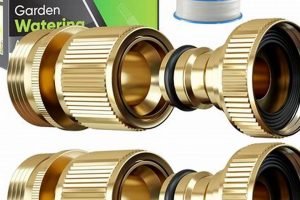
A coupling designed with internal threads to connect to a component featuring external threads, commonly found in irrigation or water delivery systems, facilitates the secure attachment of a garden hose to a spigot or another hose. These connectors come in various materials, including brass, plastic, and aluminum, selected for their durability and resistance to corrosion. An instance of its application is when linking a standard garden hose to an outdoor faucet.
The value of such a fitting lies in its ability to create a leak-proof connection, preventing water wastage and maintaining consistent water pressure. Historically, these fittings have evolved from simple, manually tightened connections to more sophisticated designs incorporating features like quick-connect mechanisms. Their use improves efficiency in watering gardens, washing vehicles, and performing other outdoor tasks requiring a reliable water source.
The following sections will delve into the specifications of various types, appropriate materials for different applications, installation best practices, and troubleshooting common issues, offering a detailed guide to selecting and using the correct fitting for optimal performance.
Essential Usage Recommendations
The following recommendations address critical aspects of selection, installation, and maintenance, maximizing the performance and lifespan of your water delivery setup.
Tip 1: Material Selection: Evaluate environmental conditions and water quality before selecting the fitting material. Brass fittings offer superior durability for frequent use and resistance to high water pressure, whereas plastic options are suitable for less demanding applications.
Tip 2: Thread Compatibility: Verify the thread type and diameter match the spigot or component being connected. Mismatched threads can lead to leaks or damage. National Pipe Thread (NPT) and Garden Hose Thread (GHT) are common standards; ensure compatibility before installation.
Tip 3: Proper Tightening: Avoid overtightening, which can strip threads or crack plastic fittings. Hand-tightening followed by a quarter-turn with appropriate tools is often sufficient. Apply Teflon tape to threads for a secure, leak-proof seal.
Tip 4: Regular Inspection: Periodically inspect for signs of wear, cracks, or corrosion. Replace damaged fittings immediately to prevent leaks and maintain consistent water pressure.
Tip 5: Storage Practices: When not in use, store fittings in a dry location away from direct sunlight to prevent degradation of materials. Disconnecting the fitting from the hose and spigot can also prolong its lifespan.
Tip 6: Washer Integrity: Inspect and replace washers regularly to maintain a watertight seal. Worn or damaged washers are a common cause of leaks and can easily be replaced.
Adhering to these guidelines ensures a secure, efficient, and long-lasting connection, minimizing water wastage and optimizing irrigation or cleaning tasks.
The article will now proceed to common issues, offering solutions and advanced applications.
1. Thread Compatibility

Thread compatibility is a fundamental requirement for the functional utility of any connection. When dealing with water systems, this is even more vital. It ensures a secure, leak-proof attachment between the adapter and the water source. Without proper thread matching, leaks and potential water damage can occur. An example of this is trying to connect a GHT adapter to an NPT spigot, which inevitably results in an incompatible connection and water loss. The selection of the correct fitting type for the application is paramount to maintaining efficient water delivery.
Incorrect thread types, whether due to diameter or thread pattern, prevent proper engagement and sealing, leading to immediate functionality issues. It also risks damage to the threads of both the adapter and the receiving component. A practical application of this understanding is ensuring proper sealing in a garden watering system, which prevents water wastage. An example is a home-owner ensuring that their NPT threaded adapter is connected to their NPT water spigot, and the GHT adapter is connected to the GHT garden hose.
Understanding thread compatibility is integral for reliable connection in water systems. Prioritizing correct thread matching prevents complications such as leaks, pressure loss, or equipment damage. Proper implementation is essential for optimal water use.
2. Material Durability

Material durability is a critical factor determining the operational lifespan and reliability of a connector. Its selection directly impacts the connector’s ability to withstand environmental stressors, physical strain, and chemical exposure encountered in typical garden and irrigation applications. The longevity and consistent performance of a water delivery system are directly correlated with the inherent robustness of the connector’s construction.
- Corrosion Resistance
The ability to resist corrosion from water, soil, and fertilizers is paramount. Brass and certain plastics are inherently more resistant to corrosion than other materials. The gradual degradation of a connector due to corrosion can lead to leaks, reduced water pressure, and eventual failure, necessitating replacement. For example, a brass connector will typically outlast a zinc connector in a high-humidity environment.
- Pressure Tolerance
Material strength dictates the fitting’s capacity to endure water pressure fluctuations. High-pressure situations, particularly in municipal water systems, can place significant stress on the connector. Materials such as reinforced plastic and brass offer superior pressure tolerance compared to standard plastics, mitigating the risk of bursting or cracking. Consistent exposure to high pressure without adequate material strength may result in system failure.
- UV Degradation
Prolonged exposure to sunlight can degrade certain materials, especially plastics, leading to brittleness and cracking. UV inhibitors can be added to plastic formulations to improve resistance, but material selection should still consider the environmental exposure. Connectors installed in direct sunlight require more robust materials or UV protection to prevent premature failure. For instance, black ABS is typically more resistant to UV degradation than clear PVC.
- Impact Resistance
Connectors are susceptible to physical impacts from accidental contact with tools, equipment, or foot traffic. Materials with high impact resistance, such as brass or durable plastics, are better suited for environments where physical damage is a concern. The ability to withstand impacts without cracking or breaking ensures continued operation and prevents leaks. Heavy-duty applications, such as const
ruction sites, necessitate the use of impact-resistant connectors.
In summary, the choice of material plays a pivotal role in determining the overall performance and lifespan of a connector. Considering factors such as corrosion resistance, pressure tolerance, UV degradation, and impact resistance ensures a reliable and long-lasting connection. Careful material selection based on the intended application and environmental conditions optimizes water usage and reduces the need for frequent replacements.
3. Seal Integrity

Seal integrity, concerning a connection, is paramount to its effective operation. Within the context of a connection, it refers to the ability of the connection to maintain a watertight barrier, preventing leakage. This is primarily achieved through the compression of a washer or gasket between the fitting and the mating component. A compromised seal directly translates to water wastage, reduced water pressure, and potential damage to surrounding areas due to constant water exposure. For example, a garden hose connected to an outdoor faucet relies entirely on the washer within the component to prevent water from escaping at the connection point, thus maintaining the required pressure and volume for effective watering.
The critical role of seal integrity extends beyond mere prevention of leaks. It is directly linked to the efficiency of water usage and the sustainability of resources. In irrigation systems, a compromised seal leads to uneven water distribution, resulting in some plants receiving too much water while others suffer from insufficient irrigation. This not only affects plant health but also increases water consumption. Moreover, consistent leaks can cause erosion and create breeding grounds for pests, compounding the initial problem. The appropriate application of thread sealants like Teflon tape in conjunction with intact washers contributes to a reliable, long-lasting seal, thereby optimizing water usage.
In conclusion, seal integrity is an indispensable element in the context of a fitting. Its significance lies in its direct impact on water conservation, pressure maintenance, and the prevention of property damage. Regular inspection and replacement of washers, coupled with proper installation techniques, are critical steps in ensuring robust seal integrity and maximizing the lifespan of a water delivery system.
4. Pressure Resistance
The pressure resistance capability is an integral characteristic that directly influences the operational reliability and safety of a female component designed for water hose connections. This capacity refers to the fitting’s ability to withstand internal water pressure without deformation, leakage, or catastrophic failure. A fitting lacking adequate pressure resistance risks bursting under normal operating conditions, potentially causing property damage and posing a safety hazard. For instance, a plastic fitting connected to a high-pressure municipal water line must possess sufficient structural integrity to prevent rupture.
The material composition and design geometry dictate the pressure resistance of a fitting. Brass fittings, owing to their inherent strength and ductility, typically exhibit superior pressure resistance compared to plastic alternatives. Similarly, fittings with thicker walls and robust threads are better equipped to withstand internal pressure. Incorrectly rated or installed fittings can become points of failure in a water distribution system, causing significant water loss and necessitating costly repairs. The selection of a fitting with appropriate pressure resistance is, therefore, crucial for maintaining a safe and efficient water delivery system. A real-world example includes the selection of a brass fitting for a pressure washer connection, where high water pressure is the norm.
In summary, the pressure resistance of a female water hose fitting is a critical attribute directly correlated to its performance, safety, and longevity. The careful consideration of material selection, design, and application-specific pressure requirements is essential for ensuring a reliable and leak-free connection. Neglecting this aspect can lead to system failures, water wastage, and potential safety risks, underscoring the practical significance of understanding pressure resistance in the context of these components.
5. Connection Security

Connection security, in the context of a female component used with water hoses, refers to the reliability and stability of the physical attachment between the fitting and its mating component. It directly impacts the overall performance and safety of water delivery systems, preventing unintended disconnections that can result in water loss, property damage, and potential injury.
- Thread Engagement Depth
The depth to which the threads of the fitting engage with the mating component is a critical factor in ensuring a secure connection. Insufficient thread engagement can lead to instability and a higher risk of disconnection, particularly under pressure or physical stress. Adequate thread depth provides a stronger mechanical bond, distributing the load and preventing premature failure. An example would be ensuring at least five full threads are engaged when connecting to a spigot to withstand water pressure.
- Locking Mechanisms
Some fittings incorporate additional locking mechanisms, such as collars or clamps, to enhance connection security. These mechanisms provide a supplementary layer of protection against accidental disconnections, particularly in applications where the fitting is subjected to vibration or frequent movement. The use of a hose clamp on the barbed end of an adapter connecting to a hose exemplifies this, preventing the hose from slipping off.
- Material Compatibility
The compatibility of materials between the fitting and the mating component affects the friction and adhesion between the connected surfaces. Dissimilar materials can lead to galvanic corrosion or reduced grip, weakening the connection over time. Choosing compatible materials, such as brass-on-brass or plastic-on-plastic, minimizes these risks and maintains a secure connection. Avoid directly connecting aluminum fittings to brass fittings in wet environments to prevent galvanic corrosion weakening the connection.
- Proper Installation Torque
Applying the correct torque during installation is crucial for achieving a secure connection without damaging the threads or compromising the seal. Overtightening can strip the threads or crack the fitting, while undertightening can result in a loose connection prone to leakage and disconnection. Using a torque wrench to achieve the manufacturer-recommended torque value ensures optimal connection security. For instance, a plastic fitting that is over-tightened can easily crack rendering the water tight seal useless.
These facets collectively contribute to the overall connection security of a female adapter. Prioritizing these aspects during selection and installation optimizes the reliability and longevity of water delivery systems, preventing costly repairs and ensuring efficient water usage. It underscores the importan
ce of selecting components designed for the specific application and adhering to best practices for installation and maintenance.
Frequently Asked Questions
The following addresses prevalent inquiries concerning female garden hose adapters, providing clarity on their selection, application, and maintenance.
Question 1: Are all female garden hose adapters universally compatible with every spigot?
No, adapters adhere to varying thread standards, most commonly Garden Hose Thread (GHT) and National Pipe Thread (NPT). Mismatched threads will not create a secure, leak-proof connection. Verification of thread type and diameter on both the adapter and the spigot is essential prior to installation.
Question 2: What materials are most suitable for a female garden hose adapter?
Brass, plastic, and aluminum are common materials. Brass offers superior durability and corrosion resistance, advantageous for frequent use and high-pressure applications. Plastic provides a cost-effective option for light-duty tasks. Aluminum offers a balance of lightweight and moderate corrosion resistance but is susceptible to galvanic corrosion when in contact with dissimilar metals.
Question 3: How can leaks be prevented at the adapter connection?
The application of Teflon tape to the threads creates a tighter seal. Ensuring the washer is in good condition and properly seated is also critical. Overtightening can damage the threads; hand-tightening followed by a quarter turn with a wrench is generally sufficient.
Question 4: How frequently should a female garden hose adapter be replaced?
Replacement frequency depends on material, usage, and environmental conditions. Adapters exhibiting cracks, corrosion, or stripped threads should be replaced immediately. Regular inspection can identify potential problems before failure occurs. Brass fittings, properly maintained, can last for several years, while plastic fittings may require more frequent replacement.
Question 5: Can a female garden hose adapter be used with hot water?
The suitability for hot water depends on the adapter’s material. Certain plastics may deform or degrade under high temperatures. Brass adapters are generally more resistant to heat. The manufacturer’s specifications should be consulted to determine the maximum operating temperature.
Question 6: What is the purpose of different types of female adapters (e.g., swivel, quick-connect)?
Swivel adapters allow the hose to rotate freely, preventing kinks and tangles. Quick-connect adapters facilitate rapid attachment and detachment of the hose. The specific application dictates the most appropriate type. For example, a swivel adapter is beneficial when maneuvering a hose around obstacles, while a quick-connect adapter is useful for frequently changing attachments.
In summary, selecting the correct type, material, and employing proper installation techniques ensures optimal performance and longevity for these integral components.
The next section will delve into advanced applications and innovative technologies in water hose connections.
Conclusion
The preceding discussion has comprehensively explored the female garden hose adapter, encompassing its functionality, material considerations, thread compatibility, and maintenance requisites. A thorough understanding of these aspects is essential for ensuring efficient and reliable water delivery in various applications. Recognizing the nuances of material selection, proper installation, and preventative maintenance practices directly impacts the longevity and performance of these integral components.
Optimal selection and conscientious utilization of the female garden hose adapter remain pivotal for sustainable water management and minimizing potential system failures. A continued focus on innovative materials and connection technologies promises enhanced performance and durability, further solidifying its role in both residential and industrial settings. Consistent adherence to best practices guarantees efficient and effective water usage, safeguarding resources and promoting long-term operational efficiency.
![Best 2 Inch Garden Hose For [X] & Reviews | The Ultimate Gardening Guide: Grow a Thriving Garden Year-Round](https://MyGardenPatch.com/wp-content/uploads/2025/07/th-5631-300x200.jpg "Best 2 Inch Garden Hose For [X] & Reviews The Ultimate Gardening Guide: Grow a Thriving Garden Year-Round")