



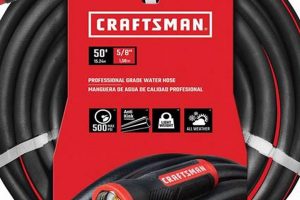
The size of the opening within a garden hose, measured from one inside wall to the opposite, directly influences water flow. A common measurement is 5/8 inch, although variations exist to suit specific applications. Different sizes will therefore deliver varying volumes of water per unit of time.
The magnitude of this dimension impacts efficiency and performance in watering tasks. A larger aperture generally allows for greater water delivery, which can reduce watering time. Conversely, a smaller aperture may be adequate for tasks requiring less volume and can reduce water waste. Its standardization allows for compatibility across various watering tools and systems, facilitating ease of use and interchangeability.
Understanding this measurement is fundamental to selecting the appropriate hose for specific needs. Subsequent sections will delve into the factors affecting the water flow, its impact on different applications, and how to determine the optimal size for individual requirements.
Practical Considerations
Proper selection and maintenance are crucial for optimal performance. The following guidelines offer practical insights for maximizing efficiency and longevity.
Tip 1: Account for Pressure Requirements: Different watering tasks necessitate specific pressure levels. Select a hose with an appropriate internal bore to maintain adequate pressure at the nozzle.
Tip 2: Consider Hose Length: Longer hoses experience greater pressure loss due to friction. An increase in the specified dimension may be required for extended hose lengths to compensate for this loss.
Tip 3: Inspect for Kinks and Obstructions: Kinks can significantly restrict flow, effectively reducing the effective diameter. Regularly inspect and remove any kinks or obstructions.
Tip 4: Store Properly: Proper storage prevents damage and prolongs lifespan. Avoid exposing the hose to extreme temperatures or direct sunlight when not in use.
Tip 5: Use Appropriate Fittings: Ensure that the fittings are compatible with the selected dimension to avoid leaks and maintain consistent flow. Mismatched fittings can restrict the orifice, negating the benefits of a larger diameter.
Tip 6: Regularly Flush the Hose: Over time, sediment and debris can accumulate inside, reducing the effective area available for water flow. Periodically flush the hose to remove these obstructions.
Adherence to these guidelines promotes efficient water delivery and extends the service life of the garden hose.
The subsequent section will provide information regarding the implications of these factors in various watering applications.
1. Water Flow Rate

Water flow rate, defined as the volume of water delivered per unit of time, is critically dependent on the size of the opening within a garden hose. This relationship dictates the effectiveness of watering and irrigation tasks. Achieving the desired water delivery hinges on understanding and managing the factors influencing this rate.
- Area and Volume
The cross-sectional area available for water to pass directly influences the volume delivered. A larger area, resulting from a wider diameter, allows a greater volume of water to pass through per unit time, given a constant pressure. An increase in radius results in a non-linear change in the area. Calculations, using the formula for the area of a circle, (r), illustrate this relationship; doubling the internal radius quadruples the cross-sectional area and potential flow rate.
- Pressure Dynamics
The water flow rate is also influenced by the pressure within the hose. Higher pressure propels water through the orifice at a faster rate, increasing the overall flow. This effect is compounded by internal wall friction, which reduces the effective pressure, especially in longer hoses or those with narrower bores. The pressure differential between the water source and the outlet governs the achievable flow.
- Friction Losses
The internal surface of the hose creates friction, which impedes water flow. A rougher internal surface increases friction, reducing flow rate. The smaller dimensions create an environment with more significant surface contact relative to volume, exacerbating the impact of friction. Longer runs of hose further amplify the effect of frictional resistance.
- Nozzle and Attachment Restrictions
Any attachments connected to the hose outlet, such as nozzles or sprinklers, inherently introduce resistance. The design of these attachments influences the water flow pattern and volume delivered. Nozzles with adjustable settings can restrict the aperture, thereby altering the flow rate. The cumulative effect of multiple attachments can significantly reduce the amount of water released.
Therefore, optimizing water flow rate necessitates consideration of aperture dimensions, water pressure, internal friction, and the properties of any connected attachments. Matching these factors to the specific demands of the watering task ensures efficient water usage and effective irrigation.
2. Pressure Loss

Pressure loss in a garden hose is inextricably linked to its internal dimensions. Specifically, a smaller internal aperture results in a greater pressure reduction along the hose’s length. This phenomenon arises from the increased friction exerted by the hose walls on the water flow. As the water molecules are forced through a constricted space, they encounter more resistance, dissipating energy in the form of heat and reducing the pressure available at the outlet. For instance, a long, narrow hose connected to a high-pressure water source may deliver only a weak stream at the nozzle due to significant pressure drop along the hose’s extent. This reduction in outlet pressure directly impacts the performance of connected devices like sprinklers or spray nozzles, potentially rendering them ineffective.
Conversely, a wider internal bore reduces friction and minimizes pressure loss. This allows for a more consistent and powerful water stream, particularly over longer distances. This attribute is crucial in professional landscaping or agricultural applications where extended hose lengths are frequently employed. Choosing a hose with an adequately sized aperture is, therefore, essential for maintaining sufficient water pressure to meet the demands of the watering task. Furthermore, understanding this relationship facilitates more efficient use of water resources, preventing the wastage of energy associated with forcing water through an unsuitable hose. Consider two identical sprinklers connected to the same water source, one using a narrow, the other a wider hose. The sprinkler connected to the wider hose will demonstrate superior range and evenness of coverage due to the maintenance of higher pressure.
In summary, press
ure loss is a critical factor to consider when selecting a garden hose. It is directly influenced by the internal cross-sectional area of the hose, with smaller areas leading to greater pressure reductions. This understanding is not merely theoretical but has significant practical implications for irrigation efficiency and the effectiveness of watering tools. Choosing an appropriately sized hose optimizes water pressure, reduces energy waste, and ensures that watering applications achieve the desired results.
3. Hose Length

The length of a garden hose directly influences the impact of its internal dimensions on water flow and pressure. As hose length increases, the frictional resistance to water flow also rises. This resistance, exacerbated by smaller internal apertures, results in a significant reduction in water pressure at the hose’s outlet. A narrow hose, adequate for short distances, may deliver insufficient water pressure over extended lengths, hindering effective watering or irrigation. Therefore, selection requires consideration of both the hose’s internal specifications and its intended length to ensure adequate water delivery.
For example, a gardener using a 1/2-inch hose may find it suitable for watering plants near the water source. However, extending that same hose to 100 feet could result in a noticeable decrease in water pressure, potentially rendering sprinklers ineffective or slowing down manual watering tasks. Conversely, employing a 5/8-inch hose over the same distance would mitigate pressure loss, maintaining a more consistent water flow rate. In agricultural settings, where hoses may extend hundreds of feet, this difference becomes even more pronounced. Understanding the relationship between hose length and dimension is crucial for designing efficient irrigation systems.
In conclusion, hose length is an integral factor when determining the appropriate internal dimensions. Longer hoses necessitate larger dimensions to compensate for increased friction and maintain adequate water pressure. Failing to consider this relationship can lead to inefficient water usage and compromised watering performance. Therefore, optimal hose selection requires a holistic approach, accounting for both the hose’s internal attributes and its intended application.
4. Material Flexibility

The flexibility of garden hose materials has a subtle but significant relationship to the selection and effectiveness of various internal diameters. The material’s ability to bend without kinking or collapsing directly affects the usable flow rate, particularly in smaller diameter hoses.
- Kinking Resistance
More flexible materials are generally less prone to kinking. When a hose kinks, the internal space is constricted, effectively reducing the water-carrying capacity, mimicking the effect of a smaller diameter. A hose with a wider internal diameter but made of inflexible material prone to kinking may deliver less water than a narrower, more flexible hose that resists kinking.
- Pressure Rating Considerations
The flexibility of the material impacts its ability to withstand internal water pressure. Highly flexible materials may expand under pressure, potentially weakening the hose walls over time. In wider diameter hoses, this expansion can be more pronounced, requiring stronger, less flexible materials to maintain structural integrity and prevent bursting. Material selection must balance flexibility with the ability to handle intended pressure levels.
- Ease of Handling and Storage
Flexibility affects the ease with which the hose can be handled, maneuvered, and stored. A highly flexible hose is easier to coil and uncoil, reducing the risk of damage and prolonging its lifespan. This is especially beneficial for larger diameter hoses, which can be cumbersome to manage if made of stiff materials. Easier handling translates to reduced strain on connectors and fittings, extending their service life as well.
- Temperature Sensitivity
The flexibility of some materials can be significantly affected by temperature. Some materials become more rigid in cold weather, increasing the likelihood of kinking and reducing flow. Others may soften in high temperatures, potentially leading to expansion or even bursting under pressure. The material should be selected with consideration to the environmental conditions in which the hose will be used, particularly when dealing with wider internal dimensions that require higher pressure resistance.
In conclusion, while the internal specifications directly influence water delivery, the material’s flexibility plays a critical supporting role. Balancing the material’s flexibility with the required pressure rating, kinking resistance, and ease of handling ensures optimal performance and longevity, regardless of the specific measurement chosen.
5. Fitting Compatibility

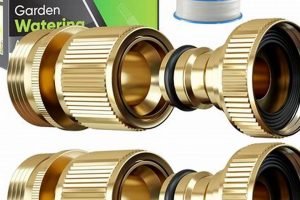
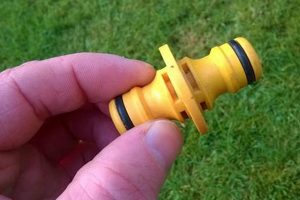
The effectiveness of a garden hose is intrinsically linked to the compatibility of its fittings with its internal bore. Mismatched fittings can severely compromise water flow, negate the benefits of a correctly specified diameter, and lead to leaks or even complete system failure. The internal measurement dictates the appropriate fitting size; a fitting designed for a smaller diameter will create a bottleneck, restricting water passage. Conversely, an oversized fitting may not seal properly, leading to water loss and reduced pressure. This principle is analogous to plumbing systems where pipe size and fitting dimensions are critical for maintaining pressure and preventing leaks. A common example is the use of a 1/2-inch fitting on a 5/8-inch hose. While the fitting may physically attach, it creates a significant reduction in the available cross-sectional area, severely impeding water delivery. Understanding this relationship is paramount for achieving optimal performance.
Several practical considerations arise from the importance of fitting compatibility. When replacing a hose, it is essential to ensure that the new hose’s dimension matches the existing fittings or that the fittings are replaced concurrently. Adaptor fittings are available, but their use should be minimized as each additional connection introduces potential points of failure and flow restriction. In commercial irrigation systems, standardized fitting sizes are crucial for ease of maintenance and interchangeability. Pre-assembled hose systems often guarantee fitting compatibility, but DIY installations necessitate careful measurement and matching of components. Ignoring this aspect can lead to frequent repairs, inefficient watering, and premature hose failure. Standardized sizing also facilitates the use of accessories like spray nozzles and timers, ensuring seamless integration within the watering system.
In conclusion, fitting compatibility is not merely a peripheral concern but a core element in the overall functionality of a garden hose system. Proper matching of fitting size to the hose’s internal dimensions is essential for maximizing water flow, preventing leaks, and ensuring the long-term reliability of the system. Addressing this aspect is key to avoiding performance issues and optimizing water usage. The benefits of s
electing the correct hose can be nullified by incompatible connections, emphasizing the holistic approach required when addressing garden irrigation needs.
6. Sprinkler Performance
Sprinkler performance is inextricably linked to the internal dimensions of the attached garden hose. The capacity of a sprinkler to effectively distribute water across a given area is directly influenced by the volume and pressure of the water supplied. A garden hose with an insufficient internal bore restricts water flow, leading to reduced pressure at the sprinkler head. This diminished pressure manifests as a shorter spray radius, uneven water distribution, and potentially, non-rotation of the sprinkler mechanism. Consider, for example, a rotary sprinkler designed to cover a 20-foot radius circle. If connected to a hose with an inadequate internal diameter, the actual coverage may be limited to a 10-foot radius, leaving portions of the lawn unwatered.
The selection of an appropriate diameter is crucial for optimizing sprinkler function. For smaller lawn areas or low-pressure water sources, a 1/2-inch hose may suffice. However, for larger areas, multiple sprinkler heads, or situations where the water source provides lower pressure, a 5/8-inch or even 3/4-inch hose is often necessary to ensure adequate water delivery. Furthermore, the length of the hose also plays a significant role. Longer hoses inherently experience greater pressure loss due to friction. Thus, even with an adequate internal diameter, excessive hose length can negate the benefits, necessitating a larger diameter or a pressure booster to maintain optimal sprinkler performance. The absence of sufficient pressure due to an inadequate dimension can lead to the sprinkler failing to operate as designed.
In conclusion, understanding the relationship between sprinkler performance and internal dimensions is essential for efficient irrigation. Selecting a hose with an appropriate bore ensures that sprinklers receive adequate water pressure and volume, enabling them to function as intended. This, in turn, promotes uniform water distribution, prevents water waste, and contributes to a healthy and well-maintained landscape. While other factors, such as water source pressure and sprinkler type, also influence performance, the internal dimension of the garden hose remains a critical, often overlooked, determinant.
7. Nozzle Effectiveness

Nozzle effectiveness, the ability of a nozzle to deliver a desired spray pattern and water volume, is fundamentally tied to the internal dimensions of the attached garden hose. Inadequate water supply, stemming from an improperly sized hose, directly compromises a nozzle’s intended functionality.
- Spray Pattern Integrity The consistency and accuracy of a nozzle’s spray pattern depend on a steady and sufficient water supply. A hose with too small an internal aperture restricts water flow, causing the spray to become weak, uneven, or distorted. This limitation is particularly noticeable in nozzles designed for wide, fan-shaped sprays, where edge definition suffers from insufficient water pressure. Improper hose selection can lead to wasted water and ineffective watering of plants.
- Pressure Regulation Nozzles often incorporate mechanisms for adjusting water pressure, allowing users to switch between gentle showers and concentrated streams. However, these adjustments are only effective if the hose provides adequate water volume to begin with. A nozzle attached to a hose with a restricted bore will struggle to achieve sufficient pressure, even at its highest setting. The user experience is therefore diminished, as the nozzle fails to deliver the advertised range of spray options.
- Distance and Reach The distance a nozzle can project water is directly proportional to the pressure at the nozzle outlet. A hose with an inadequate internal diameter reduces this pressure, limiting the nozzle’s reach. This is especially problematic for nozzles used to water hanging plants, wash second-story windows, or reach distant parts of a garden. The user is forced to compensate by using longer hoses, further exacerbating the pressure loss problem and creating a self-defeating cycle.
- Water Conservation Efficient water usage is a primary goal in many gardening and landscaping applications. Nozzles designed for specific watering tasks, such as targeted root watering or gentle misting, rely on a consistent water supply to operate efficiently. When the hose restricts water flow, users may compensate by increasing the watering duration, leading to overwatering and water waste. A properly sized hose allows the nozzle to deliver the intended amount of water, promoting water conservation and reducing the risk of plant damage.
The various facets of nozzle effectiveness demonstrate the importance of choosing an appropriate hose dimension. Optimizing nozzle performance requires a balanced approach, where the nozzle’s design, water source pressure, and hose specifications work in harmony to achieve the desired watering outcome. Failure to consider these factors can lead to compromised performance, inefficient water usage, and frustrated users.
Frequently Asked Questions
This section addresses common inquiries regarding the influence of garden hose internal dimensions on performance and application suitability.
Question 1: Why does the dimension matter when selecting a garden hose?
The dimension directly affects water flow rate and pressure at the hose outlet. A smaller diameter restricts flow, reducing pressure, while a larger diameter allows for greater flow and minimizes pressure loss, particularly over longer distances.
Question 2: What is a standard dimension for residential garden hoses?
The 5/8-inch diameter is a common standard for residential use, providing a balance between flow rate and manageability. However, applications requiring higher flow rates or extended hose lengths may benefit from a larger diameter.
Question 3: How does hose length interact with the dimension to impact water pressure?
Longer hoses inherently experience greater friction, leading to pressure loss. A larger diameter can compensate for this loss, maintaining adequate pressure at the nozzle, particularly in extended runs.
Question 4: Can the dimension affect the performance of sprinklers and spray nozzles?
Yes. Insufficient internal area restricts water flow, reducing the pressure available for sprinklers and nozzles, leading to diminished spray distance, uneven distribution, and compromised overall performance.
Question 5: Does hose material influence the importance of dimension selection?
Hose material, particularly its flexibility and resistance to kinking, can impact effective water flow. Kinking reduces the effective dimension, negating the benefits of a larger aperture. More flexible materials can minimize this effect.
Question 6: How does one determine the optimal dimension for a specific application?
The optimal dimension depends on several factors, including the desired flow rate, water source pressure, hose length, and the type of watering devices used. Assessment of these factors will guide the selection of an appropriate hose specification.
Understanding the relationship between internal specifications and performance factors is crucial for selecting the appropriate hose for individual needs. Consideration of these FAQs will contribute to informed decision-making.
The subsequent section will provide a glossary of key terms related to garden hose technology.
Conclusion
This exploration has underscored the critical role of garden hose internal diameter in dictating water flow, pressure maintenance, and the effectiveness of connected watering implements. From impacting sprinkler range to influencing nozzle spray patterns, the selection of an appropriate dimension proves pivotal for efficient water usage and optimal irrigation outcomes. The presented information demonstrates that this seemingly simple characteristic exerts a significant influence on overall gardening and landscaping performance.
Therefore, a comprehensive understanding of garden hose internal diameter and its ramifications is essential for both amateur gardeners and professional landscapers. Thoughtful consideration of factors such as hose length, water source pressure, and the specific demands of watering tasks will enable informed decision-making, promoting responsible water management and ensuring the longevity and efficacy of irrigation systems. Future advancements may yield innovative designs and materials, but the fundamental principles governing the impact of this key specification will remain central to garden hose technology.
![Best 2 Inch Garden Hose For [X] & Reviews | The Ultimate Gardening Guide: Grow a Thriving Garden Year-Round](https://MyGardenPatch.com/wp-content/uploads/2025/07/th-5631-300x200.jpg "Best 2 Inch Garden Hose For [X] & Reviews The Ultimate Gardening Guide: Grow a Thriving Garden Year-Round")