



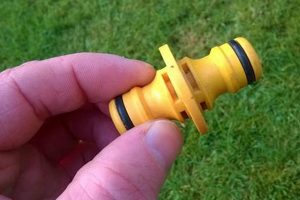
This plumbing component serves as a connector between two sections of garden hose that both terminate in a female fitting. It effectively creates a longer hose from two shorter ones, or repairs a hose where the female coupling has become damaged. For instance, if an existing hose is too short to reach a distant flower bed, this adapter allows the user to link it with another hose possessing a female end to achieve the necessary length.
The utility of this device lies in its ability to extend the reach of existing hoses, reducing the need to purchase entirely new, longer lengths. This provides both cost savings and reduces potential waste. Furthermore, it offers a practical solution for repairing damaged hose ends, preventing complete disposal of the hose and extending its lifespan. Historically, such connectors have evolved from simple, often leaky, connections to more robust and leak-resistant designs utilizing durable materials like brass or reinforced plastics.
The following discussion will delve into the various materials used in the construction of these connectors, explore the different types available on the market, and provide guidance on selecting the most appropriate option for specific watering and irrigation needs. Also addressed will be common problems encountered with their use and best practices for ensuring a secure and leak-free connection.
Essential Usage Considerations
Optimal performance necessitates careful consideration of several factors. Ensuring compatibility and proper installation are crucial for leak-free operation and longevity.
Tip 1: Material Compatibility: Verify the materials of the adapter and hose ends are compatible. Avoid connecting dissimilar metals, such as brass and aluminum, as this can lead to galvanic corrosion and eventual failure.
Tip 2: Thread Alignment: Before tightening, ensure the threads are properly aligned. Cross-threading can damage the threads and prevent a secure seal, leading to leaks and potential adapter failure.
Tip 3: Washer Inspection: Inspect the washers or O-rings inside the hose couplings before connecting. Damaged or missing washers will inevitably cause leaks. Replace them as needed with appropriately sized rubber or silicone washers.
Tip 4: Tightening Procedure: Tighten the adapter by hand until snug, then use pliers or a wrench for an additional quarter turn. Over-tightening can damage the threads or the adapter itself.
Tip 5: Leak Testing: After connecting, turn on the water supply and inspect the connection for leaks. If leaks are present, slightly tighten the connection or replace the washer if necessary.
Tip 6: Storage Practices: When not in use, store the adapter in a dry place away from direct sunlight. UV exposure can degrade the plastic or rubber components, reducing their lifespan and effectiveness.
Tip 7: Seasonal Inspection: Prior to each watering season, inspect the adapter for signs of wear or damage, such as cracks or corrosion. Replace damaged adapters promptly to prevent unexpected leaks during use.
Adhering to these considerations ensures reliable and efficient garden hose connections, maximizing the lifespan of both the hoses and the connecting hardware.
The subsequent sections will address troubleshooting common problems and exploring advanced applications of this versatile connection component.
1. Extension Capability

The utility of the garden hose female to female adapter is most evident in its extension capability. This function directly addresses the limitations of existing hose lengths, providing a practical solution for situations where a single hose is insufficient to reach the desired area. Its importance stems from the cost-effectiveness and convenience it offers compared to purchasing new, longer hoses.
- Overcoming Distance Limitations
The primary role of the adapter is to bridge the gap between the water source and the point of use when the existing hose length is inadequate. Examples include watering gardens located further from the spigot, washing vehicles parked at a distance, or filling pools situated away from the immediate vicinity of the water supply. The implications are reduced strain on the user, more efficient water delivery, and the elimination of the need for multiple trips to relocate the hose.
- Cost-Effective Alternative
Rather than investing in a new, longer hose, the adapter allows for the combination of existing hoses. This is particularly beneficial when one already possesses multiple shorter hoses. The financial savings can be significant, especially for users who only occasionally require an extended reach. The adapter provides a budget-friendly solution without compromising functionality.
- Enhanced Flexibility and Adaptability
The adapter increases the overall flexibility of a watering system. It allows for the creation of customized hose lengths, adapting to varying needs across different tasks. This adaptability is especially useful in landscapes with diverse watering requirements or in situations where the distance to the water source changes frequently. The implications are increased efficiency and reduced setup time.
- Temporary or Seasonal Extensions
The extension capability is particularly useful for temporary or seasonal needs, such as setting up a temporary irrigation system during a dry spell or extending the hose reach for a specific outdoor project. The adapter allows for easy connection and disconnection, making it ideal for situations where the extended length is not required permanently. This eliminates the need for dedicated long hoses that may only be used sporadically.
These facets collectively demonstrate the extension capability of the garden hose female to female adapter, highlighting its practicality and economic advantages. By enabling users to overcome distance limitations, reduce costs, enhance flexibility, and address temporary needs, the adapter contributes significantly to the efficiency and convenience of various watering and irrigation tasks.
2. Repair Solution
The function of a garden hose female to female adapter extends beyond simple hose extension; it serves as a viable repair solution for damaged hose ends, preventing premature disposal and maximizing the lifespan of existing equipment.
- Addressing Damaged Female Couplings
The adapter provides a direct solution for hoses where the female coupling has been compromised due to physical damage, corrosion, or thread stripping. Instead of discarding the entire hose, the adapter allows the user to bypass the damaged coupling by connecting to a section of the hose further down the line or by joining two shorter, still-functional hose segments.
The implication is a reduction in waste and a more economical use of resources. - Creating a Functional Hose from Two Damaged Sections
In instances where two hoses possess damage at their respective male ends, a garden hose female to female adapter enables the creation of a single, functional hose. This approach is particularly relevant when the majority of the hose length remains intact and only the terminal connections are faulty. This significantly reduces the financial burden associated with replacing entire hose assemblies.
- Temporary Repair for Immediate Use
The adapter can act as a temporary repair solution, providing immediate functionality while awaiting a more permanent fix or replacement part. This is especially valuable in situations where immediate watering or irrigation is critical. The adapter ensures continuity of operations with minimal downtime. This function assists in maintaining the health of plants and landscapes during unforeseen circumstances.
- Extending the Usable Life of Hoses
By facilitating repairs, the adapter inherently extends the usable life of garden hoses. This reduces the frequency of hose replacements, leading to long-term cost savings and a decrease in environmental impact through reduced manufacturing and disposal. The implications include a more sustainable approach to garden maintenance and resource management.
These aspects highlight the adapter’s significant role as a repair solution. By addressing damaged couplings, enabling the combination of damaged sections, providing temporary fixes, and extending overall hose lifespan, the garden hose female to female adapter demonstrates value that transcends mere extension, promoting resourcefulness and sustainability in garden maintenance practices.
3. Material Compatibility

Material compatibility is a critical consideration when selecting and utilizing a garden hose female to female adapter. Dissimilar metals can lead to corrosion and premature failure, while incompatible plastics may degrade or weaken over time.
- Galvanic Corrosion
The pairing of dissimilar metals, such as brass and aluminum, in the presence of an electrolyte (water) creates a galvanic cell. This electrochemical process accelerates the corrosion of the less noble metal (aluminum, in this case). The resulting corrosion products can compromise the integrity of the adapter and lead to leaks. The implications are reduced lifespan, frequent replacements, and potential water wastage. It is advisable to use adapters made of the same metal as the hose couplings or to employ dielectric fittings to prevent direct metal-to-metal contact.
- Plastic Degradation
While less susceptible to galvanic corrosion, plastic adapters can degrade if exposed to incompatible chemicals or prolonged ultraviolet (UV) radiation. Some plastics may become brittle and prone to cracking, leading to leaks and eventual failure. Consider using UV-resistant plastics for outdoor applications. Choose materials suited for the intended environmental conditions to avoid degradation and ensure longevity.
- Thermal Expansion Mismatch
Adapters made from materials with significantly different coefficients of thermal expansion can experience stress at the connection points due to temperature fluctuations. This stress can loosen the connection, damage the threads, or cause leaks. For applications where temperature variations are expected, select materials with similar thermal expansion properties to minimize stress and maintain a secure connection.
- Chemical Resistance
Certain chemicals, such as fertilizers or pesticides, can react with the materials of the adapter, causing them to weaken or dissolve. This is especially relevant in agricultural or industrial settings. Consult material compatibility charts to ensure that the adapter is resistant to the chemicals to which it will be exposed. Using chemically resistant materials will extend the life of the adapter and maintain water quality.
Understanding and addressing material compatibility issues when using a garden hose female to female adapter is essential for ensuring long-term performance, preventing leaks, and avoiding costly replacements. Careful material selection extends the lifespan of both the adapter and the connected hoses, resulting in cost savings and more efficient watering or irrigation systems.
4. Thread Integrity

Thread integrity is paramount to the functionality and lifespan of a garden hose female to female adapter. The threads, helical ridges on both the adapter and the hose couplings, are responsible for creating a secure, leak-proof connection. Damage or degradation of these threads compromises the adapter’s ability to form a tight seal, leading to water leakage and reduced system pressure. For instance, cross-threading during installation can strip or deform the threads, rendering the adapter ineffective. Similarly, corrosion or physical impact can damage the threads, preventing a proper connection. The consequences of compromised thread integrity include wasted water, inefficient irrigation, and the need for frequent adapter replacements, all underscoring the importance of maintaining thread integrity.
The materials used in manufacturing the adapter, the precision of the threading process, and the care taken during installation all contribute to thread integrity. Brass adapters, for example, are generally more resistant to corrosion than plastic adapters, thereby preserving thread integrity over a longer period. However, even brass threads can be damaged by overtightening or by using incompatible thread types. Standard garden hoses employ a specific thread standard (GHT Garden Hose Thread), and using an adapter with mismatched threads will invariably damage both the adapter and hose couplings. Proper installation involves aligning the threads carefully and tightening the adapter by hand until snug, followed by a minimal additional tightening with a wrench to avoid stripping the threads.
In summary, thread integrity is a critical component of a functional and durable garden hose female to female adapter. Maintaining thread integrity requires selecting adapters made from appropriate materials, ensuring proper thread alignment during installation, and avoiding overtightening. Failure to address thread integrity leads to leaks, inefficiencies, and premature adapter failure. Understanding the importance of thread integrity allows for informed selection and careful installation practices, maximizing the lifespan and performance of watering and irrigation systems.
5. Washer Seal
The washer seal is an indispensable component of a functional garden hose female to female adapter. It serves as the primary barrier against water leakage at the connection point between the adapter and the garden hose couplings. Without a properly functioning washer seal, the adapter becomes ineffective, rendering the connection prone to leaks and resulting in water wastage. The washer, typically made of rubber, silicone, or a similar compressible material, is positioned within the female coupling t
o create a tight, waterproof barrier when the adapter is tightened against the hose end. For example, if a washer is missing, damaged, or improperly seated, water will escape through the gaps, causing a loss of pressure and inefficient water delivery. In essence, the adapter provides the physical connection, while the washer seal ensures the integrity of that connection.
The performance of the washer seal is influenced by several factors. The material of the washer, its size, and its condition directly impact its ability to prevent leaks. Over time, washers can degrade due to exposure to sunlight, chemicals in the water, or repeated compression and decompression cycles. A hardened or cracked washer will no longer conform to the irregular surfaces within the coupling, leading to leaks. Similarly, an incorrectly sized washer may not provide adequate sealing, while an improperly installed washer can be displaced during the tightening process. The choice of washer material is therefore a critical consideration. Rubber washers offer good flexibility and sealing properties but may degrade over time. Silicone washers are more resistant to temperature extremes and chemicals but can be more expensive. Proper maintenance, including regular inspection and replacement of worn washers, is essential for maintaining a leak-free connection.
In conclusion, the washer seal is a fundamental element of a garden hose female to female adapter, playing a critical role in preventing water leakage and ensuring efficient operation. Its effectiveness depends on the material, size, condition, and proper installation of the washer. Routine maintenance, including inspection and replacement of worn washers, is vital for preserving the integrity of the seal and maximizing the lifespan of both the adapter and the connected hoses. Failure to recognize the importance of the washer seal leads to water wastage, reduced system pressure, and the need for frequent repairs or replacements, highlighting the practical significance of this seemingly small component.
6. Proper tightening
Proper tightening directly influences the efficacy of a garden hose female to female adapter. Insufficient tightening creates a pathway for water leakage, diminishing system pressure and resulting in water wastage. Conversely, excessive tightening can deform the adapter’s threads or damage the hose couplings, leading to premature failure. The optimal tightening force establishes a secure, watertight seal without inducing undue stress on the connected components. Real-world scenarios illustrate the consequences of inadequate tightening. For instance, a loosely connected adapter may cause a sprinkler system to operate at reduced pressure, resulting in uneven water distribution. Conversely, an overtightened adapter can crack under pressure, leading to a sudden burst and potential water damage. The practical significance of understanding the relationship between tightening force and adapter performance lies in maximizing water conservation, extending the lifespan of the equipment, and preventing costly repairs.
Achieving proper tightening involves several considerations. First, the materials of the adapter and hose couplings influence the required torque. Plastic components, being more susceptible to deformation, require less tightening force than brass components. Second, the presence and condition of the washer seal are critical. A worn or missing washer necessitates increased tightening, but this can easily lead to overtightening and damage. Third, the thread quality affects the ability to create a watertight seal. Damaged or corroded threads require greater tightening force, but they may never achieve a perfect seal and are prone to further damage. A best practice involves hand-tightening the adapter until snug, followed by a quarter-turn with a wrench. This approach provides sufficient force to compress the washer without overstressing the threads. Regular inspection of the adapter and hose couplings is also essential for identifying potential issues before they escalate.
In summary, proper tightening is an essential factor in ensuring the effective operation and longevity of a garden hose female to female adapter. The consequences of both undertightening and overtightening underscore the importance of applying the appropriate force. Understanding material properties, washer condition, and thread quality contributes to achieving the optimal tightening force. Challenges include variations in component materials and thread quality, which necessitate careful judgment and experience. Ultimately, mastering the art of proper tightening promotes water conservation, minimizes equipment failure, and enhances the overall performance of watering and irrigation systems.
7. Leak prevention
The role of a garden hose female to female adapter in leak prevention is paramount to efficient water usage and the overall functionality of watering systems. Leakage not only wastes water but also reduces system pressure, impacting the performance of sprinklers and other connected devices. The adapter, when properly selected and installed, plays a crucial role in mitigating these issues.
- Secure Connection Design
The design of the adapter directly influences its ability to prevent leaks. High-quality adapters often incorporate features such as precision threading, reinforced construction, and durable materials that resist deformation under pressure. These design elements ensure a tight, secure connection between the hose and the adapter, minimizing the risk of leakage. For example, an adapter with poorly machined threads may not properly mate with the hose couplings, resulting in gaps and subsequent leaks. The implication is that a well-designed adapter is a proactive measure against water wastage.
- Washer Seal Integrity
The washer, typically made of rubber or silicone, creates a watertight seal between the adapter and the hose coupling. The integrity of this seal is critical for leak prevention. A damaged, worn, or improperly installed washer can compromise the seal, allowing water to escape. For instance, a washer that has become brittle due to prolonged exposure to sunlight may no longer conform to the irregular surfaces within the coupling, resulting in leaks. Regular inspection and replacement of washers are essential maintenance practices that contribute significantly to leak prevention.
- Material Compatibility and Resistance
Material compatibility plays a significant role in leak prevention. The adapter and hose couplings should be made from materials that are resistant to corrosion, degradation, and chemical reactions. Dissimilar metals can lead to galvanic corrosion, which weakens the connection and increases the likelihood of leaks. Similarly, certain chemicals, such as fertilizers or pesticides, can degrade plastic components, compromising their ability to maintain a tight seal. Selecting adapters made from compatible and resistant materials is a proactive measure against premature failure and leaks.
- Proper Installation Techniques
Even the best adapter will leak if it is not properly installed. Proper installation involves careful alignment of the threads, hand-tightening the connection, and then using a wrench to snug the connection without overtightening. Overtightening can damage the threads or the hose couplings, leading to leaks. Cross-threading, a common installation error, also damages the threads and
prevents a secure seal. Educating users on proper installation techniques is essential for maximizing the leak prevention capabilities of the adapter.
In conclusion, leak prevention is intrinsically linked to the selection, installation, and maintenance of a garden hose female to female adapter. Secure design, washer seal integrity, material compatibility, and proper installation techniques each play a crucial role in minimizing water wastage and maximizing the efficiency of watering and irrigation systems. By addressing these factors, users can ensure a leak-free connection and optimize the performance of their gardening equipment.
Frequently Asked Questions
This section addresses common inquiries regarding the function, selection, and maintenance of garden hose female to female adapters. The information provided aims to clarify misconceptions and offer practical guidance for optimal utilization.
Question 1: What is the primary function of a garden hose female to female adapter?
The primary function is to connect two garden hoses, both terminating in female couplings, thereby extending the overall length of the hose system. It also serves as a repair solution for hoses with damaged female ends.
Question 2: Are all garden hose female to female adapters universally compatible with all garden hoses?
While most garden hoses adhere to a standard thread size (GHT – Garden Hose Thread), variations in manufacturing tolerances and thread quality may exist. It is recommended to ensure compatibility by verifying thread alignment and fit before applying excessive force during connection.
Question 3: What materials are commonly used in the construction of these adapters, and which is most durable?
Common materials include brass, plastic, and aluminum. Brass adapters generally offer superior durability and corrosion resistance compared to plastic or aluminum. However, brass is more expensive.
Question 4: How can leakage be prevented when using a garden hose female to female adapter?
Leakage can be prevented by ensuring the washer seal is in good condition and properly seated, aligning the threads correctly, and tightening the adapter sufficiently without overtightening. The use of Teflon tape on the threads can also enhance the seal.
Question 5: Can these adapters be used with high-pressure water systems?
The suitability for high-pressure systems depends on the adapter’s material and construction. Consult the manufacturer’s specifications to determine the maximum pressure rating. Using an adapter beyond its rated pressure can result in failure and potential water damage.
Question 6: What maintenance is required to prolong the lifespan of a garden hose female to female adapter?
Maintenance includes regular inspection for damage or corrosion, cleaning to remove debris, and replacement of worn or damaged washers. Storing the adapter in a dry, sheltered location when not in use can also extend its lifespan.
In conclusion, understanding the function, compatibility, material properties, and maintenance requirements of garden hose female to female adapters is crucial for ensuring reliable and efficient operation of watering systems. Addressing these frequently asked questions provides a solid foundation for informed decision-making.
The subsequent section will explore advanced applications and troubleshooting techniques associated with this versatile connection component.
Conclusion
This exploration has detailed the multifaceted role of the garden hose female to female adapter. From extending existing hoses and facilitating repairs to demanding careful material selection and installation practices, its proper utilization directly impacts the efficiency and longevity of watering systems. The component’s seemingly simple function belies its importance in resource conservation and cost management.
Therefore, a comprehensive understanding of the garden hose female to female adapter’s characteristics and limitations is essential for informed decision-making. Prioritizing quality and adhering to best practices will not only optimize performance but also contribute to sustainable water management practices in both residential and commercial applications.
![Best 2 Inch Garden Hose For [X] & Reviews | The Ultimate Gardening Guide: Grow a Thriving Garden Year-Round](https://MyGardenPatch.com/wp-content/uploads/2025/07/th-5631-300x200.jpg "Best 2 Inch Garden Hose For [X] & Reviews The Ultimate Gardening Guide: Grow a Thriving Garden Year-Round")