



The dimensions of the terminal connections on typical watering implements follow a largely uniform specification. This standardization ensures compatibility across a wide array of products, from nozzles and sprinklers to various hose attachments. The universally recognized measurement for these connectors is 3/4 inch GHT (Garden Hose Thread). This threading allows for secure and leak-resistant connections when joining different components of a watering system.
The widespread adoption of this single, consistent dimension offers significant advantages. It simplifies the process of connecting different components, eliminating the need for adapters or specialized tools in most cases. Historically, the establishment of this uniform specification facilitated the mass production and distribution of watering equipment, making efficient irrigation more accessible to both homeowners and professional landscapers.
Understanding this widely accepted measurement is crucial for selecting compatible watering tools and accessories. This article will delve deeper into the characteristics of these connections, explore variations and exceptions, and provide guidance on troubleshooting common connection issues. The focus will remain on ensuring a clear understanding of how these vital system elements interact.
Tips on Standardized Watering Connector Dimensions
These tips provide practical guidance for working with systems utilizing the commonly accepted 3/4 inch GHT (Garden Hose Thread) dimension.
Tip 1: When purchasing new watering implements, verify that the connector adheres to the standardized 3/4 inch GHT specification. This will prevent compatibility issues and the need for adapters.
Tip 2: Regularly inspect connectors for signs of wear or damage, such as stripped threads or cracks. Damaged connectors can lead to leaks and inefficient watering.
Tip 3: When connecting components, ensure the threads are clean and free of debris. Dirt and grime can interfere with a secure seal, resulting in leaks.
Tip 4: Consider using thread sealant tape (Teflon tape) to create a watertight seal, particularly when connecting metal components to plastic ones. Apply the tape in the direction of the threads.
Tip 5: Avoid overtightening connectors. Overtightening can damage the threads, especially on plastic components, and may lead to future leaks.
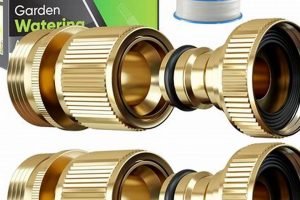
Tip 6: For systems requiring frequent connection and disconnection, quick-connect fittings that are GHT compatible can save time and effort while maintaining a secure seal.
Tip 7: Store watering implements in a sheltered location during freezing weather to prevent damage to the connectors from expanding ice.
Adhering to these tips will help ensure the efficient and reliable operation of watering systems. By understanding the importance of the standardized connector, users can minimize water waste and maximize the lifespan of their equipment.
The next section will address potential variations in threading and explore specialized fittings for unique applications.
1. 3/4 inch GHT

The designation “3/4 inch GHT” (Garden Hose Thread) serves as the defining characteristic for the dimensions of most residential water hose connectors. It is the specification that dictates the physical parameters of the threaded connection, thereby effectively defining the “size of standard garden hose fitting.” The 3/4 inch measurement refers primarily to the approximate outer diameter of the male-threaded component. Without adherence to the 3/4 inch GHT specification, the interchangeability and widespread usability of watering system components would be severely compromised.
The adoption of 3/4 inch GHT has a direct causal effect on the ease of use of watering systems. For example, a homeowner can readily attach a sprinkler from one manufacturer to a hose from another because both adhere to this common standard. A deviation from this standard would necessitate the use of adapters, potentially reducing water pressure and increasing the risk of leaks. Consider situations such as emergency water transfer or fire suppression where speed and reliability are critical. Standardized connectors are paramount.
In conclusion, the “size of standard garden hose fitting” is inextricably linked to the 3/4 inch GHT specification. Its importance lies in the ability to ensure compatibility and reliable performance across a wide range of watering and irrigation equipment. While variations and specialized fittings exist, the prevalence of 3/4 inch GHT facilitates seamless integration and efficient water management. Future challenges may involve adapting this standard to accommodate smart watering technologies or addressing the proliferation of non-compliant imported products.
2. Thread Pitch Uniformity

Thread pitch uniformity is a critical, yet often overlooked, aspect of the standardized water hose connector. While the 3/4 inch GHT specification defines the diameter, consistent thread pitch ensures reliable engagement and sealing between mating connectors. Deviations in thread pitch, even within the specified diameter, can lead to cross-threading, leaks, and ultimately, failure of the connection.
- Threads Per Inch (TPI)
TPI refers to the number of thread crests present per inch of length along the threaded portion. The GHT standard dictates a specific TPI value. A higher TPI means finer threads, potentially offering a more secure grip but requiring more turns to fully engage. A lower TPI indicates coarser threads, providing faster engagement but potentially less holding power. Non-compliance with the specified TPI compromises the integrity of the “size of standard garden hose fitting”.
- Thread Angle
The thread angle defines the angle between the flanks of a thread. The standard thread angle for GHT contributes to both the mechanical strength of the connection and its ability to create a watertight seal. Deviations from the prescribed angle can reduce the contact area between mating threads, diminishing the holding force and increasing the likelihood of leaks. This angle, therefore, is integral to proper function, affecting the ability to withstand water pressure without failure.
- Thread Form (Profile)
The thread form, or profile, dictates the shape of the thread itself, influencing its strength and sealing characteristics. Standardized GHT specifies a particular thread form designed to distribute stress evenly across the engaged threads. A non-standard thread form might concentrate stress at certain points, leading to premature wear or failure, especially under pressure. This contributes directly to the longevity and reliability of the “size of standard garden hose fitting”.
- Material Compatibility and Thread En
gagementConsistent thread pitch becomes even more vital when connecting components made from dissimilar materials, such as brass to plastic. Differences in thermal expansion rates can exacerbate any imperfections in thread engagement caused by variations in thread pitch. A uniform pitch allows for even distribution of forces, minimizing stress and preventing leaks as the materials expand and contract with temperature changes. Secure thread engagement is key to preventing failures due to material incompatibilities.
Thread pitch uniformity, therefore, is an indispensable element for reliable connections. Its impact extends beyond simple compatibility, influencing the strength, sealing ability, and longevity of watering systems. Consistent adherence to the established pitch ensures the “size of standard garden hose fitting” remains a functional and dependable standard.
3. Internal Diameter (ID)

The internal diameter (ID) of a water hose connector, while not directly defining the “size of standard garden hose fitting” (which is primarily determined by the 3/4 inch GHT specification), plays a critical role in the overall performance of the system. It dictates the available space for water flow, significantly impacting pressure and volume delivered at the output. The ID of the connector must be appropriately sized relative to the hose itself to avoid creating a bottleneck that restricts flow.
- Flow Rate and Pressure
A smaller ID in the connector will inherently restrict water flow, leading to a reduction in both the overall flow rate (gallons per minute) and water pressure at the output. This is due to increased friction and turbulence as the water is forced through a narrower opening. Consider the scenario where a high-volume nozzle is attached to a hose with a connector having a significantly reduced ID; the nozzle’s performance will be diminished due to the limited water supply. Conversely, an oversized ID, while not restricting flow, can introduce turbulence and may not provide optimal sealing surface.
- Compatibility with Hose Diameter
The connector ID should be appropriately matched to the ID of the hose itself. Mismatched IDs can create significant flow restrictions or even lead to hose damage. For instance, if a connector with a drastically smaller ID is attached to a large-diameter hose, the hose will be effectively throttled, negating the benefits of its larger bore. This mismatch can also induce undue stress on the hose near the connector, potentially leading to bursting or separation over time.
- Material and Design Considerations
The material used for the connector can also influence its ID. Some materials, such as brass, may allow for thinner walls while maintaining structural integrity, maximizing the ID for a given outer diameter. The internal design of the connector is equally important. Sharp edges or abrupt changes in diameter can create turbulence and reduce flow efficiency, even if the ID is nominally correct. A well-designed connector will have smooth internal surfaces and gradual transitions to minimize flow resistance.
- Impact on Specialized Applications
In specialized applications, such as irrigation systems or pressure washing, the ID of the connector becomes even more critical. Irrigation systems often require specific flow rates and pressures to operate effectively, and any restriction caused by a poorly sized connector can disrupt the system’s performance. Similarly, pressure washers rely on a consistent supply of high-pressure water, and a constricted connector ID can significantly reduce cleaning power. Therefore, in these scenarios, careful attention must be paid to ensuring the connector ID is adequate for the application’s demands.
In summary, while the 3/4 inch GHT specification addresses the “size of standard garden hose fitting” in terms of its threading and external dimensions, the internal diameter is a crucial factor governing its functional performance. An appropriately sized ID ensures optimal flow rates, minimizes pressure loss, and maintains the overall efficiency of the watering system. Ignoring the ID can negate the benefits of a standardized connector and lead to suboptimal performance or even damage to the connected equipment.
4. External Diameter (OD)
The external diameter (OD) of a garden hose fitting is inextricably linked to the established dimensional standard. While the internal diameter governs flow rate, the OD determines the fitting’s physical footprint and its ability to interface with mating components. The 3/4 inch GHT specification, commonly referenced when discussing the size of standard garden hose fitting, directly pertains to the approximate OD of the male-threaded component. Adherence to this OD ensures mechanical compatibility, preventing issues such as inability to connect or compromised structural integrity.
The OD’s importance extends beyond simple connectivity. It dictates the size of wrench or tool required for tightening and loosening the fitting. A non-standard OD could necessitate specialized tools, undermining the universality that the 3/4 inch GHT standard promotes. Furthermore, the OD influences the thickness of the fitting’s walls, thereby affecting its resistance to pressure and physical stress. Consider a scenario where a fitting with a significantly reduced OD is subjected to high water pressure; the thinner walls may lead to bursting or deformation, resulting in leaks and system failure. The OD, therefore, directly contributes to the fittings ability to withstand operational demands.
In conclusion, the external diameter is an essential, though often unspoken, element of the “size of standard garden hose fitting.” Its adherence to the 3/4 inch GHT specification guarantees mechanical compatibility, simplifies maintenance, and contributes to the overall durability and reliability of watering systems. Deviations from the standardized OD can lead to a cascade of problems, negating the benefits of a unified system. Future considerations should focus on maintaining consistent OD tolerances across different manufacturing processes and material types to ensure continued interoperability and performance.
5. Connector Material Strength

The structural integrity of a garden hose fitting is directly influenced by the material from which it is constructed. While the “size of standard garden hose fitting” is defined by its dimensions, the material’s strength determines its capacity to withstand pressure, resist deformation, and endure environmental stressors. The selection of material profoundly impacts the longevity and reliability of the connection.
- Pressure Resistance
Different materials exhibit varying levels of resistance to internal water pressure. Brass, for example, offers significantly higher pressure resistance compared to plastic. A brass fitting is less likely to rupture or deform under high pressure, making it suitable for applications where water pressure is elevated. Plastic fittings, while more cost-effective, are susceptible to cracking or bursting if exposed to pressur
es exceeding their design limits. This directly impacts the functional lifespan of the connector, especially when coupled with a high-pressure hose. - Environmental Degradation
Exposure to ultraviolet (UV) radiation, temperature fluctuations, and chemicals can degrade connector materials over time. Plastic fittings, particularly those made from lower-grade polymers, can become brittle and prone to cracking after prolonged exposure to sunlight. Brass fittings are generally more resistant to UV degradation but can corrode in the presence of certain chemicals. The choice of material, therefore, should consider the environmental conditions in which the fitting will be used, ensuring its long-term stability and preventing premature failure.
- Thread Integrity
The material’s strength directly affects the integrity of the threads on the fitting. When tightening a connector, excessive force can strip or damage the threads, especially on plastic fittings. Brass fittings, with their superior strength, are less prone to thread damage. Stripped threads compromise the seal, leading to leaks and inefficient water usage. The material’s ability to maintain thread integrity is crucial for ensuring a secure and leak-free connection over repeated uses.
- Impact Resistance
Accidental impacts, such as dropping a hose or striking a fitting against a hard surface, can cause damage. Materials with higher impact resistance, such as metal alloys or reinforced plastics, are better able to withstand these forces without cracking or breaking. A cracked or broken fitting will inevitably leak, requiring replacement. Therefore, in environments where physical impacts are likely, selecting a material with sufficient impact resistance is essential for maintaining the system’s functionality.
In summary, the material strength is a critical determinant of a garden hose fitting’s overall performance and lifespan. While adherence to the “size of standard garden hose fitting” ensures compatibility, the material properties dictate its ability to withstand operational stresses and environmental challenges. Selecting the appropriate material based on these factors is essential for achieving a reliable and durable watering system. Considerations of pressure resistance, environmental degradation, thread integrity, and impact resistance each play a role in ensuring a long-lasting, leak-free connection.
6. Sealing Surface Integrity

The efficacy of a garden hose connection hinges significantly on the sealing surface integrity, an element directly reliant on the “size of standard garden hose fitting” and its inherent dimensional precision. The standardized dimensions, primarily the 3/4 inch GHT specification, establish the foundational parameters for mechanical compatibility. However, the presence of a smooth, unblemished sealing surface is paramount for creating a watertight seal. Imperfections, such as scratches, dents, or debris, disrupt the interface between the fitting and the hose washer, leading to leaks. Consequently, a connection adhering to the precise “size of standard garden hose fitting” can still fail if the sealing surfaces are compromised. For instance, a brand new hose with a perfectly dimensioned fitting can leak immediately if the brass sealing surface has even a minor scratch from the manufacturing process.
The selection of materials impacts the sealing surface integrity. Brass, while durable, can develop corrosion or mineral buildup that roughens the surface. Plastic fittings are susceptible to deformation or cracking, compromising the flatness of the sealing plane. Regular inspection and cleaning of sealing surfaces are necessary preventative measures. The installation of a new hose washer is often required to compensate for minor surface imperfections. The washer, typically made of rubber or silicone, conforms to minor irregularities, enhancing the seal. The relationship between the “size of standard garden hose fitting” and sealing surface is symbiotic, where one element depends on the other for optimal performance. Consider scenarios where the supply water contains particulate matter; these particles can become embedded in the sealing surface, creating channels for leaks, regardless of how perfectly the fitting adheres to dimensional standards.
In conclusion, while the “size of standard garden hose fitting” provides the framework for mechanical compatibility, sealing surface integrity ensures the establishment of a leak-proof connection. Without a smooth, unblemished sealing surface, the dimensional precision dictated by the GHT standard is insufficient. Practical awareness of this connection allows users to implement preventative measures, such as regular inspections and cleaning, thereby maximizing the efficiency and longevity of their watering systems. Addressing the challenges of maintaining sealing surface integrity is integral to realizing the full potential of standardized hose fitting dimensions.
Frequently Asked Questions About Garden Hose Fitting Dimensions
This section addresses common inquiries regarding the established dimensions of garden hose fittings, providing clarity and practical insights for optimal system performance.
Question 1: What constitutes the “size of standard garden hose fitting”?
The term refers primarily to the 3/4 inch Garden Hose Thread (GHT) specification. This dictates the approximate outer diameter of the male-threaded component and the corresponding inner diameter of the female-threaded counterpart. Adherence to this standard ensures interchangeability and compatibility across different brands and types of watering equipment.
Question 2: Are there variations in “size of standard garden hose fitting” across different countries?
While the 3/4 inch GHT is prevalent in North America, certain regions employ alternative standards. It is essential to verify compatibility when sourcing equipment from different geographical locations. Adapters may be required to bridge the gap between dissimilar standards.
Question 3: Does the material of the fitting affect the “size of standard garden hose fitting”?
No, the material should not alter the physical dimensions as defined by the GHT specification. However, material selection impacts durability and pressure resistance. Deviations from the specified dimensions, regardless of material, indicate a non-standard fitting.
Question 4: How does thread pitch impact the functionality of the “size of standard garden hose fitting”?
Consistent thread pitch is crucial for secure engagement and leak-free connections. Variations in thread pitch, even within the 3/4 inch GHT specification, can lead to cross-threading and compromised seals. It is recommended to visually inspect thread pitch before connecting components.
Question 5: What steps can be taken to address leaks in connections adhering to the “size of standard garden hose fitting”?
Inspect the hose washer for wear or damage and replace if necessary. Ensure threads are clean and free of debris. Consider using thread sealant tape (Teflon tape) to create a watertight seal. Avoid overtightening, which can damage threads and exacerbate leaks.
Question 6: Where can one find reliable information on the precise measurements associated with the “size of standard garden hose fitting”?
Technical specifications are available from reputable manufacturers of watering equipment. Industry standards organizations, such as ANSI (Am
erican National Standards Institute), provide detailed guidelines for GHT dimensions and tolerances.
Accurate information and adherence to established standards are essential for maintaining efficient and reliable watering systems.
The subsequent section will delve into the historical context of garden hose fitting standardization.
Conclusion
The foregoing exploration underscores the critical importance of adhering to the established “size of standard garden hose fitting,” primarily defined by the 3/4 inch GHT specification. This dimensional standard dictates compatibility, influences flow rate, and contributes to the overall reliability of watering systems. Deviations from this standard can result in compromised connections, leaks, and reduced system efficiency.
The continued adherence to and understanding of the “size of standard garden hose fitting” is essential for maintaining the functionality and longevity of irrigation and watering equipment. As technology evolves and new materials emerge, vigilance in upholding dimensional standards will ensure seamless integration and optimal performance. Further research and development should focus on refining manufacturing processes to maintain consistent tolerances and promoting widespread awareness of the significance of this seemingly simple, yet profoundly impactful, dimensional standard.
![Best 2 Inch Garden Hose For [X] & Reviews | The Ultimate Gardening Guide: Grow a Thriving Garden Year-Round](https://MyGardenPatch.com/wp-content/uploads/2025/07/th-5631-300x200.jpg "Best 2 Inch Garden Hose For [X] & Reviews The Ultimate Gardening Guide: Grow a Thriving Garden Year-Round")