



A device that splits a single water source into two separate outlets is a common plumbing accessory. It attaches to a standard spigot and allows for the connection of two hoses simultaneously. This enables independent water flow control to each connected hose.
This branching adapter offers increased efficiency and convenience in outdoor water management. It eliminates the need to disconnect and reconnect hoses repeatedly, saving time and effort. Historically, such devices streamlined irrigation processes, allowing for simultaneous watering of different garden areas or concurrent use of a hose for washing and gardening.
This article will delve into the various materials used in their construction, explore different connection types and sizes, and outline key considerations for selecting the appropriate model for specific needs.
Tips for Optimal Use
Maximizing the lifespan and effectiveness requires adherence to certain best practices. These guidelines will ensure reliable performance and prevent common issues.
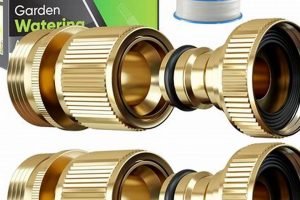
Tip 1: Select the Appropriate Material: Brass fittings offer superior durability and resistance to corrosion, particularly when exposed to frequent moisture. Plastic variants are lighter and more economical but may be less resilient under pressure or extreme temperatures.
Tip 2: Ensure Secure Connections: Before initiating water flow, meticulously tighten all connections. Leaks not only waste water but can also erode the fitting material over time.
Tip 3: Avoid Over-Tightening: While a secure connection is essential, excessive force can damage the threads. Tighten fittings until snug, and then apply a quarter turn further.
Tip 4: Protect from Freezing: During colder months, disconnect and drain any remaining water from the device. Freezing water expands and can cause cracks or breaks in the material.
Tip 5: Consider Water Pressure: Before use, assess the water pressure at the spigot. Exceeding the fitting’s pressure rating can lead to failure. Pressure regulators can be used to mitigate this risk.
Tip 6: Regularly Inspect for Wear and Tear: Periodically examine the fitting for cracks, leaks, or corrosion. Addressing minor issues promptly can prevent more significant problems down the line.
Adhering to these guidelines will contribute to the longevity and efficiency, reducing the need for frequent replacements and ensuring consistent water delivery.
The following sections will address troubleshooting common issues and exploring advanced applications.
1. Material durability

Material durability is a critical factor determining the lifespan and reliability. The device’s ability to withstand environmental stressors, water pressure, and physical handling directly impacts its performance over time. For instance, a fitting constructed from low-grade plastic may become brittle and crack under repeated exposure to sunlight or high water pressure. Conversely, a brass model, while more expensive, exhibits superior resistance to corrosion and physical damage, extending its service life.
The choice of material has significant implications for practical applications. In residential settings with moderate water pressure and infrequent use, a plastic model may suffice. However, in commercial environments or regions with high water pressure, the greater durability of brass becomes essential. Consider the scenario of a professional landscaping company utilizing multiple fittings daily. The cost savings from choosing plastic could be quickly offset by the need for frequent replacements due to damage or failure. In contrast, the initial investment in brass fittings yields a longer return through reduced maintenance and downtime.
Understanding the relationship between material durability and expected use is key to selecting a suitable fitting. While cost is a factor, prioritising durability prevents premature failure, water wastage from leaks, and the inconvenience of replacements. The longevity of a fitting ultimately influences its economic and environmental impact, making material selection a critical decision point.
2. Connection Security

Connection security, in the context of a device branching a single water source into two, dictates the efficiency and reliability of water distribution. A compromised connection leads to water wastage, pressure loss, and potential damage to surrounding areas. The integrity of the connections is therefore paramount to the overall functionality of the system.
- Thread Integrity
Thread integrity refers to the precision and condition of the threads on both the connector and the receiving spigot or hose. Damaged, cross-threaded, or mismatched threads impede a secure seal, leading to leaks. For instance, using a connector with National Pipe Thread (NPT) on a spigot designed for Garden Hose Thread (GHT) will inevitably result in a compromised connection. Correct thread standards and regular inspection for damage are essential.
- Sealing Material
Sealing material, such as rubber washers or Teflon tape, provides a barrier against water leakage by filling microscopic gaps between the threads. The selection of appropriate sealing material is crucial; a worn or improperly sized washer will fail to create a watertight seal. Similarly, the correct application of Teflon tape, ensuring it is wrapped in the direction of the thread, is vital for effective sealing.
- Tightening Torque
Tightening torque refers to the amount of rotational force applied when connecting the fitting. Insufficient torque results in a loose connection and leakage, while excessive torque can damage the threads or the connector itself. The optimal tightening torque varies depending on the materials involved; plastic connectors are particularly susceptible to damage from over-tightening. Using tools appropriately and applying a controlled, measured force is essential.
- Material Compatibility
Material compatibility addresses the interaction between the materials of the connector, spigot, and hose. Galvanic corrosion can occur when dissimilar metals are in contact in the presence of water, leading to the degradation of the connection. For example, connecting a brass fitting directly to an aluminum spigot can accelerate corrosion. Using dielectric unions or fittings made of compatible materials mitigates this risk.
These facets collectively determine connection security, underlining its importance in preventing water loss, maintaining pressure, and ensuring the long-term functionality. Neglecting any of these aspects increases the risk of system failure and necessitates costly repairs or replacements. Prioritizing secure connections, therefore, translates directly into enhanced efficiency and reduced maintenance.
3
. Water pressure

Water pressure exerts a significant influence on the function and longevity. The internal pressure of the water supply system acts as a constant force against the connector’s internal structure and connection points. Exceeding the pressure rating leads to failure, resulting in leaks or catastrophic bursts. For example, a plastic connector rated for 60 PSI (pounds per square inch) connected to a system delivering 80 PSI is prone to develop leaks at the threaded connections or even rupture under sustained pressure. Conversely, insufficient water pressure, though less damaging, impairs functionality by reducing water flow to connected hoses. This diminished flow restricts the effectiveness of sprinklers, spray nozzles, or other water-dependent devices.
The design of the connector also plays a crucial role. Narrow internal passages restrict water flow, effectively reducing pressure at the outlet points, even when the source pressure is adequate. This effect is particularly noticeable when both outlets are in use simultaneously. Selecting a model with wider internal diameters minimises pressure loss and ensures optimal flow. Material choice influences its ability to withstand pressure; brass connectors generally tolerate higher pressures than their plastic counterparts. Implementing a pressure regulator at the spigot mitigates the risk of exceeding the connector’s pressure rating, safeguarding the system from damage and extending its lifespan.
In summary, understanding the interplay between water pressure and the connector is essential for efficient and safe water management. Proper selection, installation, and pressure regulation are necessary to prevent damage, optimise water flow, and extend the life of both the connector and the connected devices. Ignoring these factors leads to reduced performance, increased water wastage, and the potential for costly repairs or replacements. The practical significance lies in balancing water pressure with the connector’s design and material characteristics to achieve optimal functionality and longevity.
4. Flow control

Flow control represents a crucial aspect of the functionality, permitting independent regulation of water output to each connected hose. The presence or absence of individual shut-off valves directly impacts the device’s utility. Models lacking these valves require both hoses to be active simultaneously, presenting limitations in scenarios where independent control is needed. For example, one hose could be used for a sprinkler system requiring constant pressure, while the other might be used intermittently for manual watering. Without independent flow control, the user would need to interrupt the sprinkler system to use the second hose.
The design and construction of the flow control mechanism significantly influence its effectiveness. Durable valves with smooth operation allow for precise adjustments, ranging from a complete shut-off to full flow. Inferior valves may exhibit stiffness, leakage, or premature failure, diminishing the overall utility. The valve material also plays a critical role; brass valves offer greater resistance to corrosion and wear compared to plastic alternatives, ensuring reliable performance over extended periods. The diameter of the valve opening affects the maximum flow rate; narrower openings restrict flow, potentially reducing the effectiveness of connected devices such as high-pressure sprayers.
Effective flow control enhances water conservation efforts by enabling targeted watering, reducing unnecessary water usage. Additionally, it simplifies tasks involving varying water requirements, such as washing a car while simultaneously irrigating a garden. The presence of reliable flow control mechanisms directly elevates the practical value, facilitating more efficient and versatile water management. The absence, or poor implementation, diminishes its utility and increases the likelihood of water wastage.
5. Spigot compatibility
Spigot compatibility defines the physical and functional connection between a water source outlet and a device designed to divide that source into multiple streams. Proper compatibility ensures a leak-proof and efficient water distribution system. Incompatibility, conversely, leads to wasted resources, potential damage to equipment, and inefficient operation. This is a fundamental requirement for proper functionality.
One primary aspect of spigot compatibility involves thread standards. North American spigots typically adhere to Garden Hose Thread (GHT) standards, while other regions may employ different standards such as British Standard Pipe (BSP). A device designed for GHT will not securely connect to a BSP spigot without an adapter, leading to leaks and pressure loss. Furthermore, the physical dimensions of the spigot and the connector must align. A connector with an internal diameter smaller than the spigot’s outlet restricts water flow, reducing the effectiveness of attached hoses. Examples include a low-flow spigot paired with a standard-size connector, which will still result in diminished water delivery.
The practical significance of understanding spigot compatibility resides in preventing system failures and optimizing water usage. Prior to installation, verifying the thread standards and physical dimensions ensures a secure and efficient connection. Neglecting compatibility results in water wastage, increased operating costs, and potential damage to connected equipment due to pressure fluctuations or leaks. Adapters can bridge incompatibility gaps, but it is crucial to select adapters rated for the intended water pressure and constructed from compatible materials to avoid corrosion or degradation. Correct pairing optimizes resources.
6. Thread Standards

Thread standards are foundational to the proper functioning. Compatibility between the connector’s threads and the spigot or hose is crucial for a secure, leak-proof connection and efficient water distribution. Divergences in thread standards necessitate the use of adapters, potentially compromising system integrity.
- National Pipe Thread (NPT)
NPT is a U.S. standard for tapered threads used on pipes and fittings. While commonly found in plumbing applications, it’s less prevalent in garden hose connections. Using an NPT fitting directly on a Garden Hose Thread (GHT) spigot will result in an insecure connection and leakage due to the incompatible thread geometry. An adapter is required to bridge the difference, but this introduces an additional potential point of failure.
- Garden Hose Thread (GHT)
GHT, also known as NH (National Hose), is the standard thread type used for garden hoses and related fittings in North America. Devices designed for GHT ensure direct compatibility with standard spigots and hoses, simplifying installation. However, it is crucial to verify that the GHT standard adheres to ANSI specifications to ensure uniformity across different manufacturers.
- British Standard Pipe (BSP)
BSP is a common thread standard used in many countries outside of North America. BSP threads are typically parallel (BSPP) or tapered (BSPT). Connecting a BSP fitting to a GHT spigot without an adapter will inevitably result in leaks and compromised water pressure. The differences in thread pitch and angle prevent a secure seal.
- Thread Pitch and Diameter
Thread pitch (threads per inch) and diameter are essential characteristics of thread standards. Mismatches in either parameter lead to connection failure. For instance, a fitting with a slightly different thread pitch may appear to engage but will not create a secure seal, resulting in leaks. Accurate measurement and identification of thread specifications are necessary for proper selection and connection.
Understanding the interplay of these thread standards is vital for ensuring effective water management. Correctly identifying the thread type on both the spigot and the ensures a secure and efficient connection, preventing water wastage and maximizing system performance. The failure to recognize and address thread standard differences can lead to significant operational inefficiencies and potential damage.
Frequently Asked Questions
The subsequent questions address common inquiries surrounding this device, providing clarification on its usage, maintenance, and selection.
Question 1: What is the typical lifespan?
Lifespan is contingent upon several factors including material composition, water pressure, and environmental conditions. Brass fittings generally exhibit a longer lifespan compared to plastic models. Regular inspection and proper winterization practices also extend the operational duration.
Question 2: Can it be used with high-pressure systems?
Pressure ratings vary significantly across different models. Before installation, verifying the connector’s maximum pressure rating is imperative. Exceeding this rating poses a risk of rupture and potential water damage. Pressure regulators mitigate this risk.
Question 3: How does thread compatibility impact performance?
Mismatched threads impede secure connections, leading to leaks and pressure loss. Ensuring thread compatibility with the spigot and hoses is crucial. Adapters can bridge differing thread standards, but they must be appropriately rated and installed.
Question 4: What maintenance procedures are recommended?
Regular inspection for leaks, cracks, and corrosion is advisable. During freezing temperatures, disconnecting and draining prevents damage from expanding ice. Periodically cleaning the threads ensures secure connections.
Question 5: What is the optimal material for long-term use?
Brass offers superior durability and corrosion resistance, making it a suitable choice for long-term use. Plastic fittings are a more economical option but may not withstand the same level of stress or environmental exposure.
Question 6: How does flow control contribute to water conservation?
Independent shut-off valves allow for selective water delivery to each connected hose, reducing water wastage. This enables targeted watering, preventing unnecessary irrigation of areas not requiring it.
Proper selection, installation, and maintenance are crucial for optimal performance. Understanding these facets maximises efficiency and extends the lifespan.
The following section will explore advanced applications and troubleshooting techniques.
In Conclusion
This exploration has provided a comprehensive overview, covering materials, connection types, compatibility considerations, and best practices for optimal utilization. From thread standards to flow control, the intricacies have been elucidated to facilitate informed decision-making and efficient water management.
Effective understanding and implementation of these principles are paramount for maximizing resource utilization and minimizing environmental impact. Continued diligence in selecting appropriate models and adhering to recommended maintenance protocols ensures the longevity of both the device and the broader water distribution system, contributing to sustainable practices in diverse applications.
![Best 2 Inch Garden Hose For [X] & Reviews | The Ultimate Gardening Guide: Grow a Thriving Garden Year-Round](https://MyGardenPatch.com/wp-content/uploads/2025/07/th-5631-300x200.jpg "Best 2 Inch Garden Hose For [X] & Reviews The Ultimate Gardening Guide: Grow a Thriving Garden Year-Round")