



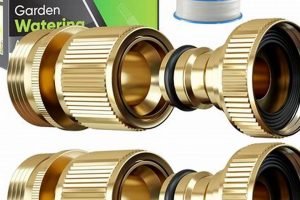
A device featuring two male-threaded ends, commonly constructed from brass or durable plastic, serves to connect two female-threaded ends of standard garden hoses or related plumbing fixtures. It effectively creates a continuous flow path between two separate hose sections or adapts a hose to a different type of connector.
This type of connector is particularly useful when hose sections are shorter than desired, extending the overall length of a watering system. It also facilitates repair by allowing damaged sections of hose with female ends to be salvaged and reused. Furthermore, it can be invaluable when adapting a hose to an irrigation system or other garden fixture lacking compatible connections, thus enhancing the versatility and functionality of watering equipment.
The following sections will delve into the specific applications, material considerations, and selection criteria for such connectors, providing a detailed understanding of their role in efficient and effective gardening and plumbing practices.
Usage Considerations for Dual-Male Hose Connectors
The following guidelines will aid in selecting and utilizing a double-ended male hose connector to achieve optimal performance and longevity.
Tip 1: Material Selection: When selecting a connector, consider the intended application and environment. Brass fittings offer superior durability and resistance to corrosion, suitable for demanding applications. Plastic fittings are a more cost-effective solution for general use but may be susceptible to damage from freezing temperatures or prolonged UV exposure.
Tip 2: Thread Compatibility: Verify that the threads of the connector precisely match the threads of the hoses or fixtures being joined. Incompatible threading can result in leaks, damage to the threads, or a failed connection.
Tip 3: Proper Sealing: Ensure a watertight seal by using Teflon tape or pipe sealant on the threads before connecting. Applying sealant correctly minimizes the risk of leaks and ensures efficient water delivery.
Tip 4: Avoid Over-Tightening: Over-tightening a fitting can damage the threads or the connector itself, particularly with plastic components. Tighten the connector sufficiently to achieve a secure seal, but avoid applying excessive force.
Tip 5: Regular Inspection: Regularly inspect connectors for signs of wear, damage, or corrosion. Replace damaged or worn fittings promptly to prevent leaks and maintain system integrity.
Tip 6: Storage Considerations: When not in use, store connectors in a dry, protected location to minimize exposure to the elements and prolong their lifespan. This is especially important for brass connectors to prevent oxidation.
Adhering to these recommendations will maximize the utility and lifespan of dual-male hose connectors, ensuring reliable and efficient watering and plumbing connections.
The subsequent section provides specific examples of practical applications for these connectors in various scenarios.
1. Connection

The primary function of a dual-male garden hose connector centers on its ability to establish a connection between two elements. This function is critical for diverse applications ranging from simple hose extension to complex plumbing adaptations. The integrity and reliability of this connection directly influence the efficiency and effectiveness of any system relying on this component.
- Hose Section Joining
This represents the most fundamental application of the connector. It enables the joining of two garden hose sections, both terminating in female fittings, to achieve a desired length. For instance, if a user possesses two 25-foot hoses, the dual-male connector can bridge them to create a single 50-foot hose. The strength and seal of this union are paramount to preventing leaks and maintaining consistent water pressure.
- Repair of Damaged Hoses
When a hose is damaged in the middle, a segment can be removed, and the remaining hose ends, usually female-threaded, can be linked using the dual-male connector. This facilitates a quick, cost-effective repair that salvages the undamaged portions of the hose. The connection ensures that the repaired hose remains functional and prevents further water loss.
- Bridging Adapters
In scenarios involving mismatched fittings, the dual-male adapter can serve as a bridge between two adapters. If a female-to-male adapter is needed at both ends of a specific configuration, the dual-male connector links these adapters, completing the connection and enabling the desired functionality. This use highlights the adapter’s versatility in complex plumbing setups.
- Temporary Plumbing Solutions
In temporary plumbing scenarios, such as setting up a temporary irrigation system or connecting a water source to a remote location, the dual-male connector provides a fast and reliable method for connecting hoses. This allows for flexible and adaptable plumbing setups without requiring permanent modifications.
The connection aspect of a dual-male garden hose connector is fundamental to its utility. These connectors ensure that hoses can be joined efficiently, reliably, and flexibly, leading to effective solutions across a multitude of gardening, plumbing, and irrigation applications. The adaptability it provides is invaluable for situations requiring temporary or modified plumbing configurations.
2. Extension

The application of a dual-male garden hose connector for extension purposes directly addresses the need for increased length in fluid conveyance systems. This functionality provides a practical and immediate solution for scenarios where existing hose lengths are insufficient.
- Reaching Distant Water Sources
One primary function is to extend a water source to a remote location. When a standard-length garden hose cannot reach a distant garden bed, vehicle washing area, or other point of use, the dual-male connector facilitates joining two or more hoses to achieve the necessary reach. This eliminates the need to purchase a single, excessively long hose, offering a more flexible and cost-effective solution.
- Adapting to Changing Landscape Needs
As garden layouts and landscaping evolve, the distances between water sources and plants or other applications can change. A dual-male connector allows users to adapt to these changes by easily adding hose sections to accommodate new distances, ensuring that water can be efficiently delivered to all necessary points. This adaptability prevents the need for major alterations to existing plumbing or irrigation systems.
- Temporary Irrigation Setups
In temporary irrigation setups, such as during new plant establishment
or temporary landscaping projects, extending hose lengths is often essential. The dual-male connector enables users to quickly create longer hoses to reach areas not typically serviced by permanent irrigation systems. This ensures adequate watering during critical periods without requiring complex or permanent plumbing modifications. - Facilitating Cleaning in Large Areas
For cleaning tasks in large areas, such as washing a large vehicle or cleaning a patio, extending the hose length is often necessary to cover the entire space without repositioning the water source. The dual-male connector enables users to easily extend the hose, providing the necessary reach and flexibility to complete the cleaning task efficiently. This minimizes the need for multiple water sources or frequent hose repositioning.
The dual-male garden hose connector’s role in extension applications underscores its importance in providing adaptable and efficient solutions for fluid conveyance. By enabling the simple and reliable joining of multiple hose sections, it addresses a range of practical needs, from adapting to changing landscape layouts to facilitating temporary irrigation setups and enhancing cleaning efficiency.
3. Repair

The utility of a dual-male garden hose connector is particularly evident in the context of repair. Hose damage, whether from physical abrasion, UV degradation, or accidental cuts, frequently occurs during typical usage. Rather than discarding an entire length of hose due to localized damage, the dual-male connector enables the salvage of undamaged sections. This approach provides a cost-effective and environmentally conscious solution by reducing waste and extending the lifespan of existing equipment. The repair process typically involves cutting out the damaged section of hose, leaving two female-threaded ends. The dual-male connector then bridges these ends, re-establishing the continuity of the hose. A critical aspect of this repair method is ensuring a secure and leak-proof connection, achieved through proper thread sealing with Teflon tape or pipe sealant and appropriate tightening of the connector.
Consider a scenario where a garden hose is accidentally sliced in the middle by a lawnmower. Without a dual-male connector, the hose would likely be rendered unusable, requiring replacement. However, by cutting out the damaged segment and utilizing the connector to join the remaining sections, the hose can be quickly restored to functionality. This is particularly beneficial in situations where immediate access to a replacement hose is limited. Furthermore, the repair function is not limited to damage occurring in the middle of the hose. It can also be applied to repair damaged hose ends by cutting off the damaged portion and using the connector to attach a new female-threaded fitting to the existing hose length, though this may also require a hose clamp. This offers a flexible solution for addressing various types of hose damage, maintaining the integrity and usability of the watering system.
In summary, the repair capability afforded by the dual-male garden hose connector is a significant factor in its overall value. It provides a practical method for addressing common hose damage, minimizing waste, reducing replacement costs, and ensuring the continued operation of essential watering and plumbing systems. While the connector offers a valuable solution, ensuring proper installation and maintenance is crucial for achieving a reliable and long-lasting repair. The selection of a connector made from durable materials like brass further enhances the longevity and effectiveness of the repair.
4. Adaptation

The function of adaptation fundamentally underscores the versatility of a dual-male garden hose connector. This adaptation capability allows for seamless integration between disparate systems or components that would otherwise be incompatible. Its significance lies in its ability to circumvent the limitations imposed by varying thread types, sizes, or connection standards, thereby broadening the scope of usable equipment and extending the functionality of existing systems.
- Bridging Incompatible Thread Types
A common application involves connecting hoses or fixtures with differing thread types. For instance, a European-standard hose may not directly connect to a North American faucet. A series of adapters, bridged by the dual-male connector, facilitates this connection by translating the thread type from one standard to another. The connector thereby acts as a central link in a chain of adaptors, enabling compatibility.
- Integrating Legacy Equipment with Modern Systems
Older gardening equipment or plumbing fixtures may utilize thread sizes or standards no longer commonly available. The dual-male connector, in conjunction with appropriate adapter fittings, allows for the continued use of this legacy equipment within modern systems. This prevents unnecessary replacement of otherwise functional components, reducing costs and promoting sustainability.
- Customizing Irrigation System Layouts
Irrigation systems frequently require customized layouts to accommodate specific plant needs or landscape features. The dual-male connector, used with a variety of specialized fittings, enables the creation of complex irrigation networks. It facilitates connections between different types of irrigation components, such as drip lines, sprinklers, and spray nozzles, providing flexibility in system design and optimization.
- Temporary Connection Solutions
In temporary plumbing or irrigation scenarios, such as setting up a temporary water supply for a construction site or connecting a rainwater harvesting system, the adaptation capabilities of the dual-male connector are invaluable. It allows for quick and easy connection of hoses to various water sources, regardless of thread compatibility, ensuring a reliable water supply for temporary needs.
The adaptation aspect of a dual-male garden hose connector significantly enhances its utility across a broad spectrum of applications. By enabling the connection of incompatible systems and components, it provides a versatile and cost-effective solution for addressing diverse plumbing and irrigation needs. The ability to bridge gaps between differing standards and connection types underscores the connector’s role in promoting flexibility and efficiency in fluid transfer systems.
5. Material

The selection of material is a critical determinant of the performance and longevity of a dual-male garden hose connector. The chosen material directly impacts its resistance to environmental factors, mechanical stress, and chemical degradation, ultimately affecting its reliability and suitability for specific applications. A connector constructed from an inappropriate material is susceptible to premature failure, leading to leaks, reduced system efficiency, and increased replacement costs.
For example, brass connectors offer superior corrosion resistance compared to plastic alternatives. This makes them particularly well-suited for outdoor applications where exposure to moisture, sunlight, and fluctuating temperatures
is inevitable. The higher tensile strength of brass also allows it to withstand higher water pressures and mechanical stresses without deforming or cracking. Conversely, plastic connectors, typically made from polypropylene or ABS, are a more economical option for less demanding applications. However, they are more vulnerable to UV degradation, which can cause them to become brittle and prone to cracking over time. Additionally, they have lower pressure ratings than brass connectors and may not be suitable for use in high-pressure systems. The choice between brass and plastic must therefore be guided by the specific operating conditions and the desired lifespan of the connector.
In conclusion, material selection is a primary consideration when choosing a dual-male garden hose connector. The trade-offs between cost, durability, and resistance to environmental factors must be carefully evaluated to ensure that the selected material aligns with the specific requirements of the intended application. Proper material selection extends the lifespan of the connector and contributes to the overall efficiency and reliability of the fluid transfer system.
6. Thread
The thread of a dual-male garden hose connector is a critical design element determining its compatibility and sealing performance. The physical dimensions of the thread, including its diameter, pitch, and form, must adhere to established standards to ensure proper engagement with mating female threads. Inconsistencies in thread specifications result in loose connections, leaks, or an inability to connect the adapter to the intended hose or fixture. Standard thread types for garden hoses, such as GHT (Garden Hose Thread), define these dimensions, enabling interchangeability between different brands and equipment. Deviation from these standards renders the connector unusable, negating its intended function.
Incorrect thread engagement leads to several practical consequences. Overtightening a mismatched thread attempting to force a connection damages both the adapter and the mating fixture. This damage compromises the integrity of the threads, potentially leading to permanent leaks. Using thread sealants like Teflon tape compensates for minor thread imperfections, however, it cannot overcome fundamental incompatibilities in thread size or pitch. For example, attempting to connect a metric-threaded hose to an adapter designed for imperial threads will fail despite the use of sealant. The structural integrity of the thread is paramount in withstanding water pressure. Defective or damaged threads cause points of weakness, causing leaks or complete failure when the system is pressurized. This illustrates the importance of selecting connectors manufactured to precise thread standards.
The thread is therefore not merely a physical attribute but a functional requirement that ensures compatibility and reliable sealing. The accuracy and consistency of the thread directly correlate with the adapters usability and contribution to overall system efficiency. Understanding thread specifications and inspecting for damage prior to installation is vital for maximizing the performance and extending the lifespan of dual-male garden hose connectors. Select adapters manufactured by reputable suppliers known for adherence to thread standards.
Frequently Asked Questions
This section addresses common inquiries regarding the application, selection, and maintenance of dual-male garden hose adapters, providing clarification on their optimal use.
Question 1: What specific purpose does a dual-male garden hose adapter serve?
A dual-male garden hose adapter facilitates the connection of two female-threaded garden hoses or plumbing fixtures. It enables the extension of hose lengths, repair of damaged hoses, and adaptation between incompatible systems.
Question 2: Are dual-male garden hose adapters available in different materials?
Yes, these adapters are commonly manufactured from brass or various plastics. Brass adapters offer greater durability and corrosion resistance, while plastic adapters provide a more economical solution for general use.
Question 3: How can the correct size of a dual-male garden hose adapter be determined?
The adapter’s thread size must match the thread size of the hoses or fixtures being connected. Standard garden hose thread (GHT) is the most prevalent. It is important to verify compatibility before purchase to prevent leaks or damage.
Question 4: What steps should be taken to ensure a leak-proof connection?
Before connecting the adapter, apply Teflon tape or pipe sealant to the threads. Ensure the adapter is tightened sufficiently to create a secure seal, but avoid over-tightening, which can damage the threads, particularly on plastic components.
Question 5: How should a dual-male garden hose adapter be maintained for longevity?
Regularly inspect the adapter for signs of wear, damage, or corrosion. Replace damaged or worn adapters promptly. Store unused adapters in a dry, protected location to minimize exposure to the elements.
Question 6: Can a dual-male garden hose adapter be used with high-pressure systems?
The suitability for high-pressure systems depends on the material and construction of the adapter. Brass adapters are generally more appropriate for high-pressure applications than plastic adapters. Consult the manufacturer’s specifications to verify pressure ratings.
In summary, selecting the correct material, ensuring thread compatibility, and implementing proper installation and maintenance practices are crucial for maximizing the utility and lifespan of dual-male garden hose adapters.
The following section provides information on troubleshooting common issues encountered when using these adapters.
Conclusion
The examination of the dual-male garden hose adapter has revealed its multifaceted utility in fluid transfer systems. From enabling hose extension and facilitating repairs to adapting disparate connections and accommodating varied material requirements, this seemingly simple component plays a pivotal role in maintaining the functionality and efficiency of numerous applications. Key considerations, including material selection, thread compatibility, and proper installation techniques, directly influence its performance and lifespan.
Therefore, a comprehensive understanding of these factors is essential for ensuring optimal utilization of the male male garden hose adapter. Continued adherence to best practices in selection, installation, and maintenance is paramount for achieving reliable and long-lasting service, contributing to the effective management of fluid transfer systems in diverse settings.
![Best 2 Inch Garden Hose For [X] & Reviews | The Ultimate Gardening Guide: Grow a Thriving Garden Year-Round](https://MyGardenPatch.com/wp-content/uploads/2025/07/th-5631-300x200.jpg "Best 2 Inch Garden Hose For [X] & Reviews The Ultimate Gardening Guide: Grow a Thriving Garden Year-Round")