



The standardized connection system found on most outdoor water faucets and the flexible tubes used for watering lawns and gardens is a critical element for fluid transfer. This connection, typically featuring parallel threads, ensures a watertight seal when properly joined. One common application includes attaching spray nozzles, sprinklers, and other irrigation devices to a water source.
The adoption of a standardized thread has significantly streamlined the process of connecting watering equipment, fostering widespread compatibility across various brands and products. This standardization simplifies the selection and installation of components. Its widespread use promotes efficient water usage and reduces the potential for leaks, contributing to water conservation efforts.
Understanding the specifications and applications of this ubiquitous connector is fundamental for anyone involved in gardening, landscaping, or general outdoor maintenance. The subsequent discussion will delve into the specific dimensions, materials, and best practices associated with its usage, enabling informed decisions regarding watering equipment selection and maintenance.
Essential Usage Guidelines
Adhering to these recommendations will maximize performance and extend the lifespan of connected equipment.
Tip 1: Proper Alignment: Before tightening, ensure the male and female components are correctly aligned to prevent cross-threading. Forceful connection attempts can damage the threads and compromise the seal.
Tip 2: Avoid Over-tightening: Excessive force during tightening can strip the threads or damage the connected fitting. A snug fit that creates a watertight seal is sufficient.
Tip 3: Utilize Thread Seal Tape: Applying thread seal tape (PTFE tape) to the male threads provides an additional layer of protection against leaks, particularly with older or worn threads.
Tip 4: Inspect Regularly: Routinely examine the threads for signs of wear, damage, or debris. Replace damaged components to maintain a reliable connection.
Tip 5: Winterize Properly: Before freezing temperatures arrive, disconnect equipment and drain all water to prevent ice damage to both the connector and the attached hose.
Tip 6: Store Properly: When not in use, store hoses and connected devices in a location protected from direct sunlight and extreme temperatures to extend their lifespan.
Tip 7: Consider Material Compatibility: Be mindful of the materials used in different components. Mixing dissimilar metals can lead to corrosion over time.
Following these precautions helps ensure a leak-free and durable connection, contributing to efficient water usage and minimizing equipment downtime.
The subsequent sections will explore advanced topics such as thread sizing variations and specialized connector types.
1. Standardized Dimensions

The functionality of a watering system hinges on the concept of standardized dimensions. Without a universally accepted thread size and pitch, compatibility between faucets, hoses, and watering accessories would be severely limited. The adoption of a consistent thread specification, predominantly Garden Hose Thread (GHT), ensures that a hose purchased from one manufacturer will readily connect to a spigot or sprinkler system from another. This interchangeability is not accidental; it is a direct result of adherence to established dimensional standards.
The cause-and-effect relationship between standardized dimensions and seamless connectivity is evident in everyday applications. Consider the scenario where a homeowner needs to replace a worn-out hose. The assurance that any new, compatible hose will fit the existing outdoor faucet eliminates the need for specialized adapters or custom fittings. This widespread compatibility reduces both the cost and complexity associated with maintaining watering systems. Furthermore, the standardized dimensions allow for mass production of components, leading to economies of scale that benefit consumers through lower prices.
In summary, the existence of standardized dimensions is an inseparable aspect of watering systems. It simplifies the selection, installation, and maintenance of watering components. While minor variations might exist across global regions, the core principle of dimensional consistency remains central. Recognizing the importance of this standardization is crucial for anyone involved in irrigation or outdoor water management, ensuring reliable and efficient operation of their watering systems.
2. Watertight Seal
The establishment of a watertight seal is paramount to the effective functioning of any system employing it as a connection. This seal prevents unintended water leakage, ensuring that water is delivered precisely where intended, thereby avoiding wastage and potential damage. The design and implementation of the threads themselves are directly linked to the capacity to form this seal. Dimensional accuracy, material selection, and the presence of complementary sealing elements such as washers all contribute to the overall effectiveness.
One real-world example demonstrating the practical significance of this lies in irrigation systems. A compromised seal at any connection point within the system can lead to a reduction in water pressure at the output nozzles, resulting in uneven or inadequate watering. This inefficiency translates to increased water consumption and potential harm to plant life. A properly formed watertight seal, conversely, ensures consistent water pressure throughout the system, optimizing water usage and promoting plant health. Another example can be found in the utilization of high-pressure cleaning equipment. Here, seal integrity is not only essential for efficient operation but also for safety, as uncontrolled leaks under high pressure can pose a risk of injury.
In summary, the ability to create and maintain a watertight seal is a defining characteristic of systems that employ it for connection. The design of the thread, coupled with appropriate sealing mechanisms, directly influences the system’s efficiency, reliability, and safety. Understanding the nuances of this connection is therefore crucial for anyone involved in the design, installation, or maintenance of any system that relies on it for fluid transfer. Achieving the necessary watertight seal can still present challenges and it demands carefull inspection and proper torque.
3. Compatibility

The concept of compatibility is intrinsic to the widespread utility. Without a reasonable degree of interchangeability, the application and convenience of such systems would be severely limited,
causing increased costs and complexity in system design and maintenance.
- Interchangeability of Components
This facet addresses the ability to connect various components from different manufacturers. The adoption of a standardized thread specification ensures that hoses, sprinklers, nozzles, and other accessories can be readily interchanged, irrespective of brand. This is particularly evident when replacing a damaged component; the user can generally select a replacement based on functional requirements rather than being constrained by manufacturer-specific compatibility issues. This level of interchangeability simplifies maintenance and reduces the overall cost of operating watering systems.
- Adaptability Across Systems
Compatibility extends beyond individual components to encompass entire systems. The standardized thread allows integration with existing irrigation setups, whether for residential or commercial applications. Adapters and converters can further expand this adaptability, enabling connections to non-standard fittings or plumbing systems. This flexibility is crucial for users who need to modify or expand their existing watering infrastructure without undertaking a complete overhaul.
- Material Compatibility Considerations
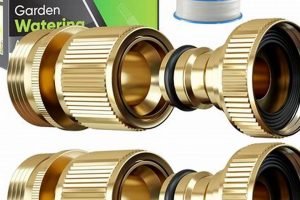
While physical connection compatibility is essential, material compatibility also plays a significant role in the long-term performance and reliability of watering systems. Connecting dissimilar metals, for example, can lead to galvanic corrosion, which can compromise the integrity of the connection over time. Understanding the compatibility of materials, such as brass, plastic, and stainless steel, is crucial for ensuring a durable and leak-free connection. Manufacturers often provide guidance on material compatibility to help users avoid potential problems.
- Compliance with Standards
Achieving a high degree of compatibility relies on adherence to established industry standards. Organizations like ANSI and ISO define the specifications for thread dimensions, materials, and performance requirements. Compliance with these standards ensures that products from different manufacturers meet a minimum level of compatibility, enabling users to confidently connect and use components from various sources. Regular updates to these standards reflect advancements in materials and technologies, further enhancing compatibility and performance.
These facets highlight the interconnectedness between compatibility and its ubiquitous application. The standardization efforts and adherence to industry benchmarks significantly contribute to a reliable, user-friendly, and cost-effective implementation. The ease of use and efficient delivery of water depend upon the compatible components which makes maintenance effortless.
4. Material Composition
The material constituents of a connection directly influence its durability, resistance to environmental degradation, and overall performance. Common materials include brass, plastic, stainless steel, and various composite materials, each exhibiting unique properties that affect its suitability for specific applications. Brass offers excellent corrosion resistance and durability, making it a frequent choice for fittings exposed to frequent use and varying water conditions. Plastic, particularly polypropylene and PVC, provides lightweight and cost-effective alternatives, suitable for low-pressure applications. Stainless steel exhibits superior strength and corrosion resistance, rendering it appropriate for demanding industrial or marine environments. Composite materials combine the advantages of multiple materials, such as enhanced strength and reduced weight. The selection of an appropriate material is paramount for ensuring a long-lasting and reliable connection.
The cause-and-effect relationship between material composition and the lifespan of a connection is readily observable in real-world scenarios. For example, a brass fitting used in a coastal environment may experience minimal corrosion over decades, while a steel fitting in the same environment could corrode rapidly, leading to leaks and eventual failure. Similarly, a plastic fitting subjected to high water pressure or extreme temperatures may become brittle and crack, whereas a brass fitting would withstand these conditions more effectively. The specific composition of the material also influences its ability to resist chemical degradation from fertilizers, pesticides, or other substances present in the water supply. Therefore, an informed decision regarding material selection is crucial for optimizing the longevity and functionality of a watering system.
In summary, the material composition of a connection is a critical determinant of its performance and lifespan. While brass, plastic, stainless steel, and composite materials each offer distinct advantages and disadvantages, the selection process should prioritize the specific application and environmental conditions. Understanding the properties of these materials and their interactions with the surrounding environment is essential for ensuring a reliable and durable watering system. Improper material selection can lead to premature failure, increased maintenance costs, and inefficient water usage. Therefore, careful consideration of material composition is a prerequisite for effective water management.
5. Thread Type

The identification of the correct thread type is foundational to the proper functioning and secure connection of watering system components. The term “Thread Type,” as it relates to it, primarily refers to Garden Hose Thread (GHT), also sometimes denoted as NH (National Hose). GHT is not a pipe thread; rather, it’s a straight thread, meaning it’s designed to create a mechanical seal rather than relying on the tapered threads found in pipe fittings to form a seal. The designation and maintenance of this thread standard ensures the physical compatibility between disparate devices like faucets, hoses, and sprinklers. Failure to recognize or adhere to the correct thread specification often results in leaks, damaged components, or the complete inability to establish a connection. The effect is a disruption of water flow and wastage of water.
For example, attempting to connect a GHT hose to a National Pipe Thread (NPT) fitting will likely result in a failed connection. While it may initially appear to thread together, the differing thread angles and tapers will prevent a tight seal. This necessitates the use of appropriate adapters, bridging the dissimilar thread types. The practical significance of this understanding extends to selecting replacement parts. Knowing the thread type avoids the purchase of incompatible components. Moreover, when troubleshooting leaks, confirming the thread type as the source of the problem is critical before replacing the entire assembly. Often, simply ensuring the correct thread type and applying thread seal tape (PTFE tape) can resolve the issue, thereby avoiding unnecessary costs.
In summary, the thread type is a defining characteristic, influencing its compatibility, function, and maintenance. The specific identification as GHT allows for consistent interchangeability and leak-free operation. Challenges arise when attempting to connect to systems using different thread types. However, the use of adapters and a thorough understanding of thread specifications mitigate these difficulties. This foundational knowledge c
ontributes to the overall efficiency and reliability of watering systems, enabling users to establish secure and effective connections for various applications.
Frequently Asked Questions about Garden Hose Thread
The following questions address common inquiries regarding the connection system employed in watering systems and related applications.
Question 1: What defines the specific dimensions of Garden Hose Thread?
The connection typically features an outer diameter of approximately 1.375 inches and 11.5 threads per inch. These dimensions, however, may vary slightly based on manufacturing tolerances. Accurate measurements can be obtained from standardized reference materials.
Question 2: Can pipe thread (NPT) be directly connected to Garden Hose Thread?
No, National Pipe Thread (NPT) and are not directly compatible. NPT is a tapered thread designed to create a seal as it’s tightened, while GHT is a straight thread that requires a gasket or washer for a watertight seal. Adapters are necessary to connect these disparate thread types.
Question 3: What is the typical material composition for connectors using Garden Hose Thread?
Connectors are commonly manufactured from brass, plastic, or a combination of both. Brass offers durability and resistance to corrosion, while plastic provides a lightweight and cost-effective alternative. The choice of material should align with the intended application and environmental conditions.
Question 4: How should leaks from Garden Hose Thread connections be addressed?
Leakage often indicates a worn or damaged washer, improperly tightened connection, or damaged threads. Replacing the washer, applying thread seal tape (PTFE tape), or carefully tightening the connection may resolve the issue. If the threads are damaged, replacement of the affected component is recommended.
Question 5: Is there a risk of galvanic corrosion when connecting dissimilar metals with Garden Hose Thread?
Yes, galvanic corrosion can occur when dissimilar metals, such as brass and aluminum, are connected in the presence of an electrolyte (water). This corrosion can degrade the connection over time. Using dielectric unions or fittings with non-conductive materials can mitigate this risk.
Question 6: How should components using Garden Hose Thread be stored during winter months?
Before freezing temperatures arrive, all components should be disconnected and drained to prevent ice damage. Storing hoses and connectors indoors or in a protected environment can prolong their lifespan and prevent cracking or deformation.
Understanding these principles assists in the effective selection, maintenance, and use of watering equipment. Applying these practices helps ensure efficient water distribution and minimizes potential complications.
The subsequent section will provide a comprehensive glossary of terms related to connections and watering systems.
Conclusion
The preceding discussion has comprehensively explored the defining attributes, practical implications, and crucial maintenance considerations surrounding the standardized connection system. This detailed examination encompasses dimensional specifications, material properties, thread types, and compatibility factors, all of which are essential for understanding the functionality and ensuring the reliable operation of watering systems. Awareness of these elements enables informed decisions regarding equipment selection, installation, and troubleshooting.
A thorough grasp of the complexities of the standardized connection fosters efficient water usage, minimizes potential leaks, and extends the lifespan of connected equipment. Continued adherence to best practices and industry standards will contribute to the long-term effectiveness and sustainability of watering systems in diverse applications. It is incumbent upon users to maintain vigilance in their application of the presented information, promoting responsible resource management and minimizing environmental impact.
![Best 2 Inch Garden Hose For [X] & Reviews | The Ultimate Gardening Guide: Grow a Thriving Garden Year-Round](https://MyGardenPatch.com/wp-content/uploads/2025/07/th-5631-300x200.jpg "Best 2 Inch Garden Hose For [X] & Reviews The Ultimate Gardening Guide: Grow a Thriving Garden Year-Round")