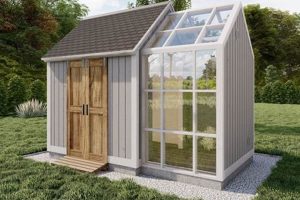
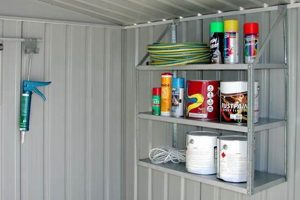
Illumination systems for outdoor structures, powered by photovoltaic energy, offer a sustainable lighting solution for areas detached from a primary power source. These systems typically comprise a small solar panel, a rechargeable battery, and an LED light. Functionality includes automatic activation at dusk and deactivation at dawn, facilitated by a light sensor. A typical application is illuminating a detached storage unit in a residential setting.
The adoption of these lighting systems presents several advantages, including reduced energy consumption and elimination of the need for electrical wiring, thereby simplifying installation and mitigating potential electrical hazards. Historically, the use of battery-powered lanterns or reliance on natural light were the primary solutions for illuminating such spaces. The advent of affordable solar technology has provided a more convenient and environmentally responsible alternative.
The subsequent sections will delve into the specific components, installation procedures, performance factors, maintenance requirements, and comparative analysis of available models within the market. This comprehensive overview aims to provide individuals with the necessary information to make informed decisions regarding the selection and implementation of these outdoor illumination solutions.
Essential Considerations for Optimal Performance
Maximizing the effectiveness of solar-powered illumination systems necessitates careful consideration of several key factors. Proper installation and maintenance are crucial for ensuring longevity and consistent performance.
Tip 1: Strategic Placement of Solar Panel: The solar panel’s placement dictates the system’s overall charging efficiency. Install the panel in an area receiving direct sunlight for a minimum of six hours daily. Avoid shaded locations or areas obstructed by trees or buildings.
Tip 2: Battery Maintenance and Replacement: Rechargeable batteries degrade over time. Monitor battery performance and replace the battery as needed to maintain optimal light output and runtime. Adhere to the manufacturer’s recommendations for battery type and replacement procedures.
Tip 3: Regular Cleaning of Solar Panel Surface: Accumulation of dirt, dust, and debris on the solar panel surface reduces its ability to absorb sunlight. Periodically clean the panel with a soft cloth and mild detergent to ensure optimal energy absorption.
Tip 4: Cold Weather Considerations: Battery performance can be affected by extreme cold. If experiencing significantly reduced runtime during cold weather, consider insulating the battery or relocating the system indoors during extended periods of sub-freezing temperatures.
Tip 5: Selecting the Appropriate Light Output: Choose a system with a light output appropriate for the size and intended use of the shed. Overly bright lighting can be unnecessary and wasteful, while insufficient lighting can compromise usability and safety.
Tip 6: Secure and Weatherproof Installation: Ensure that all components are securely mounted and protected from the elements. Proper sealing and weatherproofing will prevent water damage and prolong the lifespan of the system.
Adhering to these recommendations will significantly enhance the reliability and effectiveness of solar-powered illumination, providing a dependable and sustainable lighting solution for outdoor storage structures.
The following section will address common troubleshooting scenarios and offer practical solutions for maintaining optimal system functionality.
1. Panel Sunlight Exposure

Panel Sunlight Exposure is a critical determinant of performance for any solar-powered lighting system. In the context of “solar garden shed light,” it dictates the amount of energy available for storage in the battery, which subsequently fuels the light output and duration. Inadequate sunlight exposure directly translates to diminished brightness and reduced operational time. A system designed to operate for eight hours nightly, but positioned in a location receiving only three hours of direct sunlight, will experience significantly reduced performance, potentially failing to provide adequate illumination for the intended purpose.
The impact of Panel Sunlight Exposure is evident in real-world applications. For instance, a “solar garden shed light” installed on the north side of a building in the Northern Hemisphere will receive minimal direct sunlight, particularly during winter months. Consequently, the battery will remain undercharged, resulting in a weak or non-existent light output. Conversely, a system placed in an open area with unobstructed southern exposure will benefit from maximum sunlight capture, enabling the battery to fully charge and provide optimal illumination throughout the night. Understanding this relationship allows users to strategically position their systems for optimal performance.
Optimizing Panel Sunlight Exposure is therefore paramount to achieving the intended functionality of “solar garden shed light.” Mitigating obstructions, selecting appropriate mounting locations, and periodically cleaning the panel surface to remove accumulated debris are all essential practices. Failure to address this fundamental requirement renders other system features, such as high-lumen LEDs or large-capacity batteries, largely ineffective. In conclusion, maximizing solar panel exposure is not merely a recommendation but a prerequisite for reliable and effective solar-powered illumination.
2. Battery Charge Capacity

Battery Charge Capacity, measured in Ampere-hours (Ah) or milliampere-hours (mAh), directly determines the operational lifespan of a “solar garden shed light” between charging cycles. This metric reflects the amount of electrical charge the battery can store and subsequently deliver to power the light-emitting diode (LED). A higher Battery Charge Capacity enables the light to operate for a longer duration, particularly during periods of limited sunlight or extended nighttime hours. Conversely, an insufficient capacity results in premature depletion, rendering the light inoperable before the desired illumination period concludes. For instance, a shed requiring lighting for six hours each night necessitates a battery with sufficient capacity to meet that demand, factoring in potential energy losses due to temperature fluctuations or battery aging.
The importance of Battery Charge Capacity extends beyond mere runtime. It also impacts the light’s performance stability. A battery operating near its capacity limit experiences a more rapid voltage drop, potentially dimming the LED output over time. This phenomenon is particularly noticeable in systems employing lower-quality batteries with less efficient discharge characteristics. Selecting a system with a battery whose capacity significantly exceeds the typical daily energy consumption provides a buffer against performance degradation, ensuring consistent illumination and prolonged battery lifespan. Real-world implications include preventing premature replacements, maintaining consistent visibility within the shed, and minimizing user dissatisfaction.
Understanding the relationship between Battery Charge Capacity and the operational needs of a “solar garden shed light” is paramount for informed purchasing decisions. Factors such as regional sunlight availability, desired illumination duration, and anticipated battery lifespan must be considered. Selecting a system with an inadequate battery compromises its utility, while opting for excessive capacity may unnecessarily increase cost. Therefore, a balanced approach, informed by a clear understanding of energy consumption patterns, is essential for maximizing the value and effectiveness of this lighting solution.
3. LED Lumens Output

LED Lumens Output, quantified as a measure of total visible light emitted by a light source, plays a crucial role in determining the effectiveness of a “solar garden shed light.” Higher lumens output translates to brighter illumination within the shed, enabling enhanced visibility and facilitating task completion. The appropriate lumens output is contingent upon the shed’s dimensions and intended usage. A small storage shed may require significantly fewer lumens than a larger workshop space. Inadequate lumens output renders the lighting system functionally deficient, compromising safety and usability. A real-life example illustrates this point: a shed utilized for detailed woodworking necessitates a higher lumens output to ensure precise visual acuity, whereas a shed primarily housing garden tools requires less intense illumination.
The selection of an appropriate LED Lumens Output is further influenced by the characteristics of the shed’s interior. Dark-colored walls and stored items absorb more light, necessitating a higher lumens output to compensate for the reduced reflectivity. Conversely, light-colored surfaces reflect more light, potentially allowing for a lower lumens requirement. Practical applications include using multiple lower-lumen lights strategically positioned to provide even illumination, minimizing shadows and creating a more comfortable working environment. Additionally, considering adjustable lumens output options allows users to customize the lighting intensity based on specific needs and ambient conditions.
In summary, the LED Lumens Output is a fundamental performance characteristic of “solar garden shed lights,” directly impacting their utility and effectiveness. The appropriate lumens output is determined by a confluence of factors, including shed size, intended usage, interior characteristics, and user preferences. Understanding this relationship enables informed decision-making, ensuring the selection of a system that provides adequate and efficient illumination for the intended application. Challenges in achieving optimal lighting include balancing brightness with energy efficiency and considering the impact of ambient light on perceived illumination levels.
4. Weather Resistance Rating

The Weather Resistance Rating is a critical specification for “solar garden shed light” systems, indicating their ability to withstand environmental elements. This rating directly correlates with the longevity and reliability of the lighting system, particularly in outdoor applications where exposure to rain, snow, dust, and extreme temperatures is inevitable. Failure to select a system with an appropriate rating results in premature component failure, performance degradation, and potential safety hazards.
- Ingress Protection (IP) Code
The Ingress Protection (IP) Code is a standardized classification system that defines the level of protection provided by an enclosure against the intrusion of solid objects (dust) and liquids (water). An IP rating consists of two digits: the first indicates protection against solids, and the second indicates protection against liquids. For instance, an IP65 rating signifies that the enclosure is dust-tight (no ingress of dust) and protected against water jets from any direction. In the context of “solar garden shed light,” a minimum IP65 rating is generally recommended to ensure protection against typical outdoor conditions. Systems with lower ratings are susceptible to water damage, corrosion, and component failure, particularly in regions with high rainfall or humidity.
- UV Resistance
Prolonged exposure to ultraviolet (UV) radiation from sunlight can degrade plastic and rubber components, leading to cracking, discoloration, and reduced mechanical strength. “Solar garden shed light” systems with inadequate UV resistance exhibit premature aging and failure, particularly in regions with high solar irradiance. UV-resistant materials and coatings are essential for maintaining the structural integrity and functionality of the system over time. Examples of UV-resistant materials include specific types of plastics, such as polycarbonate with UV stabilizers, and durable coatings that block or absorb UV radiation.
- Operating Temperature Range
The Operating Temperature Range specifies the range of ambient temperatures within which the “solar garden shed light” system is designed to function optimally. Exceeding these limits can lead to reduced battery performance, component failure, and diminished light output. Extreme heat can accelerate battery degradation and damage electronic components, while extreme cold can reduce battery capacity and affect the performance of LEDs. Understanding the typical temperature range in the intended installation location is crucial for selecting a system with an appropriate operating temperature range. Systems designed for temperate climates may not be suitable for regions with extreme hot or cold conditions.
- Corrosion Resistance
Corrosion, the gradual degradation of materials due to chemical reactions with their environment, is a significant concern for outdoor lighting systems. Metal components, such as mounting brackets and enclosures, are susceptible to corrosion, particularly in coastal areas with high salt concentrations. “Solar garden shed light” systems with corrosion-resistant materials and coatings exhibit enhanced longevity and reliability. Examples of corrosion-resistant materials include stainless steel, aluminum with protective coatings, and galvanized steel. Selecting systems with appropriate corrosion resistance is essential for ensuring long-term performance and preventing structural failure.
In conclusion, the Weather Resistance Rating is a multifaceted specification that encompasses various environmental factors affecting the performance and longevity of “solar garden shed light” systems. Understanding the different aspects of weather resistance, such as IP Code, UV resistance, operating temperature range, and corrosion resistance, is essential for making informed purchasing decisions and ensuring the long-term reliability of the lighting system in its intended environment. Ignoring this crucial consideration inevitably leads to premature system failure and increased maintenance costs.
5. Installation Ease

The practicality and widespread adoption of “solar garden shed light” are significantly influenced by the simplicity and directness of its installation process. A cumbersome or technically demanding installation can deter potential users, negating the benefits of its sustainable power source. Systems designed with straightforward installation procedures contribute to greater user satisfaction and broader market acceptance.
- Component Integration and Design
The degree to which the solar panel, light fixture, and battery are pre-integrated significantly impacts installation complexity. Systems with self-contained units require minimal assembly, often involving only mounting the unit to the shed. Conversely, systems requiring separate wiring and component connections demand specialized knowledge and tools, increasing the likelihood of errors. A well-designed system minimizes loose components and utilizes standardized connectors to facilitate easy assembly. Real-world examples include systems with integrated solar panels and lights that simply require mounting screws, contrasting with systems requiring the user to wire the panel to a separate controller and battery pack.
- Mounting Hardware and Flexibility
The provision of appropriate mounting hardware and adaptable mounting options directly affects installation ease. Systems lacking suitable brackets or offering limited mounting angles necessitate improvisation, potentially compromising structural integrity and sunlight exposure. Adjustable mounting brackets that accommodate various roof pitches and wall angles enhance installation flexibility. Examples include systems with adjustable brackets that allow for optimal solar panel positioning, compared to systems with fixed brackets that restrict mounting options and sunlight capture.
- Wiring Requirements and Complexity
The absence or simplification of wiring requirements greatly facilitates installation. Wireless systems, relying on pre-charged batteries or direct solar power, eliminate the need for electrical connections, significantly reducing the risk of errors and simplifying the process. Systems requiring extensive wiring necessitate adherence to electrical codes and the use of appropriate tools, increasing the complexity and potential safety hazards. An example is a completely wireless “solar garden shed light” using a magnetic mount. Another type of lighting system may require running wires through the walls.
- Instruction Clarity and Documentation
The clarity and completeness of the installation instructions are paramount for successful implementation. Well-structured instructions with clear diagrams and step-by-step guidance minimize ambiguity and reduce the potential for errors. Systems lacking adequate documentation necessitate trial-and-error, potentially leading to component damage or incorrect installation. Examples include systems with comprehensive installation manuals, videos and online support versus systems with a single, barely-legible sheet.
In conclusion, “Installation Ease” is a multifaceted attribute of “solar garden shed light” systems, encompassing component design, mounting hardware, wiring requirements, and instruction clarity. Systems prioritizing these factors offer a user-friendly experience, promoting wider adoption and maximizing the benefits of solar-powered illumination. The integration of these considerations translates directly to reduced installation time, minimized technical expertise requirements, and enhanced user satisfaction.
6. System Lifespan

System Lifespan, representing the duration of reliable operational performance, is a critical economic and practical consideration for solar garden shed light systems. A longer lifespan translates to reduced replacement frequency, minimized maintenance costs, and a greater return on initial investment. Several factors directly influence the longevity of these systems.
- Component Quality and Durability
The quality of individual components, including the solar panel, battery, LED light source, and control circuitry, significantly impacts the overall system lifespan. High-quality components, manufactured using durable materials and adhering to stringent quality control standards, exhibit greater resistance to environmental degradation and operational stress. For example, solar panels constructed with tempered glass and corrosion-resistant frames withstand harsh weather conditions, while batteries utilizing advanced lithium-ion technology offer extended cycle life and improved thermal stability. Systems incorporating inferior components are prone to premature failure, necessitating frequent replacements and increasing long-term costs.
- Environmental Operating Conditions
The environmental conditions in which the solar garden shed light operates play a pivotal role in determining its lifespan. Exposure to extreme temperatures, humidity, ultraviolet (UV) radiation, and physical stress accelerates component degradation. Systems installed in regions with harsh climates require robust designs and protective measures to mitigate the detrimental effects of these factors. Examples include the use of UV-resistant plastics, waterproof enclosures, and thermal management systems to protect sensitive electronic components. Systems operating under less stressful conditions typically exhibit longer lifespans.
- Battery Management System (BMS)
The effectiveness of the battery management system (BMS) is crucial for maximizing battery lifespan, a key determinant of overall system longevity. The BMS monitors and regulates battery charging and discharging processes, preventing overcharging, over-discharging, and thermal runaway. These protective measures extend battery cycle life and prevent premature failure. Sophisticated BMS implementations incorporate advanced algorithms for optimizing charging profiles and balancing cell voltages, further enhancing battery performance and longevity. Systems lacking effective BMS implementations are susceptible to battery damage and reduced lifespan.
- Maintenance Practices
Regular maintenance practices, such as cleaning the solar panel surface and inspecting wiring connections, contribute to extended system lifespan. Accumulation of dust, dirt, and debris on the solar panel reduces its energy conversion efficiency, leading to reduced battery charging and diminished light output. Corrosion of wiring connections can lead to electrical faults and system failure. Periodic cleaning and inspection prevent these issues, ensuring optimal system performance and prolonging its operational life. Simple tasks, if neglected, can substantially shorten the lifespan of the entire system.
System Lifespan is therefore a function of component quality, environmental conditions, battery management, and maintenance practices. Selecting a solar garden shed light system with high-quality components, a robust design suitable for the intended operating environment, an effective BMS, and implementing regular maintenance procedures ensures a prolonged operational lifespan, maximizing the return on investment and minimizing the long-term costs associated with replacement and repair. Comparing upfront cost with potential long-term savings based on expected lifespan is a crucial consideration for any prospective buyer.
7. Motion Detection Range

Motion Detection Range, when integrated into “solar garden shed light” systems, significantly enhances their functionality beyond simple illumination. This feature allows the light to activate only when movement is detected within a defined area, offering security benefits and energy conservation. The extent of this range, typically measured in feet or meters, directly impacts the area under surveillance, influencing the effectiveness of the light as a deterrent to potential intruders or as a convenient source of light for legitimate users approaching the shed. The cause-and-effect relationship is direct: a wider range offers broader coverage, while a narrower range limits the detection zone. For example, a range of 30 feet provides ample coverage for most residential sheds, whereas a range of 10 feet would only activate when someone is in close proximity.
The practical significance of understanding Motion Detection Range extends to optimizing energy consumption. By activating only when needed, the solar garden shed light conserves battery power, extending the period between charges and maximizing the system’s operational lifespan. This is especially crucial in regions with limited sunlight where efficient energy use is paramount. Real-world application includes placing a light with a suitable motion detection range near a garden gate, illuminating the pathway only when someone approaches, thus enhancing safety and security without wasting energy. Furthermore, the angle of detection must be considered; a wide angle increases the likelihood of activation, while a narrow angle focuses detection on a specific area.
In summary, Motion Detection Range is an integral component of “solar garden shed light” systems, directly affecting both security and energy efficiency. Choosing a system with a range that aligns with the specific needs of the shed and its surroundings is crucial for maximizing its utility. Key insights include recognizing the relationship between range, coverage, and energy consumption. Challenges remain in accurately calibrating motion sensors to minimize false activations caused by animals or environmental factors, and ensuring the sensor’s durability in various weather conditions. Addressing these challenges ensures the reliable and effective operation of motion-activated solar garden shed lights.
Frequently Asked Questions about Solar Garden Shed Lights
The following section addresses common inquiries regarding the selection, installation, and maintenance of solar-powered lighting solutions for outdoor storage structures.
Question 1: What factors determine the appropriate lumens output for a solar garden shed light?
The required lumens output is primarily dependent upon the shed’s dimensions and its intended usage. Larger sheds or those used for tasks requiring detailed visual acuity necessitate higher lumens output. Ambient light levels and the reflectivity of interior surfaces also influence the optimal lumens requirement.
Question 2: How does battery capacity affect the performance of a solar garden shed light?
Battery capacity, measured in Ampere-hours (Ah), dictates the duration for which the light can operate between charging cycles. A higher capacity enables longer runtime, particularly during periods of limited sunlight. Insufficient capacity leads to premature depletion and reduced light output.
Question 3: What is the significance of the IP rating for solar garden shed lights?
The Ingress Protection (IP) rating indicates the level of protection against solid objects and liquids. A higher IP rating signifies greater resistance to dust and water intrusion, ensuring enhanced durability and reliability, especially in outdoor environments. A minimum IP65 rating is generally recommended.
Question 4: How should the solar panel be positioned to maximize energy absorption?
The solar panel should be positioned in an area receiving direct sunlight for a minimum of six hours daily. Obstructions such as trees or buildings should be avoided. Adjusting the panel angle to optimize solar irradiance is recommended.
Question 5: What maintenance is required to ensure optimal performance of a solar garden shed light?
Regular maintenance includes cleaning the solar panel surface to remove dirt and debris. Periodic inspection of wiring connections and battery condition is also recommended. Battery replacement may be necessary after several years of use.
Question 6: How does cold weather impact the performance of solar garden shed lights?
Cold temperatures can reduce battery capacity and affect light output. Insulating the battery or relocating the system indoors during extended periods of sub-freezing temperatures may be necessary. Selecting systems with batteries designed for cold weather operation is also an option.
Selecting the right solar garden shed light involves carefully considering lumens output, battery capacity, IP rating, solar panel positioning, and maintenance requirements. Attention to these factors ensures optimal performance and longevity.
The subsequent section will explore potential troubleshooting scenarios and practical solutions for maintaining solar-powered lighting systems.
Concluding Remarks on Solar Illumination for Detached Structures
This exploration of “solar garden shed light” systems has underscored the critical parameters influencing their efficacy and longevity. Lumens output, battery capacity, weather resistance, ease of installation, and system lifespan have been identified as pivotal considerations for informed decision-making. The strategic deployment of these illumination systems necessitates a comprehensive understanding of these factors to ensure optimal performance and long-term cost-effectiveness.
The adoption of photovoltaic lighting solutions represents a significant step towards sustainable energy practices in residential and commercial environments. Continued advancements in solar technology and battery storage are poised to further enhance the capabilities and affordability of these systems, solidifying their role as a viable and environmentally responsible alternative to conventional lighting methods. Prudent evaluation and implementation remain paramount to realizing the full potential of this technology.