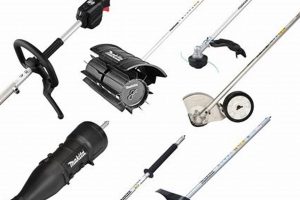
A tool designed for creating holes in soil, this device facilitates various gardening tasks. It typically consists of a helical bit attached to a shaft that can be powered manually or by a drill. An example of its use is the efficient digging of planting holes for bulbs or seedlings.
The implementation of this tool offers increased speed and reduced physical strain compared to traditional methods. Its existence streamlines planting processes, making them more accessible and efficient, especially in larger garden spaces. Historically, manual digging tools were the standard, but this powered alternative represents a significant advancement in gardening technology.
The following discussion will elaborate on selection criteria, operation techniques, maintenance practices, and safety considerations related to this category of gardening implement. Further, different types and models, along with their specific applications, will be examined.
Garden Drill Auger Tips
The following recommendations aim to optimize the use of a garden drill auger, ensuring efficient and safe operation while maximizing its benefits in various gardening activities.
Tip 1: Select the Appropriate Auger Size: The diameter of the auger should correspond to the size of the planting hole required. Using an oversized auger can lead to excessive soil disturbance and wasted effort.
Tip 2: Use a Drill with Adjustable Torque Settings: Employ a drill with variable torque settings to prevent the auger from binding in dense soil. Lower torque settings can reduce the risk of strain or injury.
Tip 3: Maintain a Consistent Drilling Angle: A consistent drilling angle ensures uniform hole depth and reduces stress on the auger and drill. Deviations from the intended angle can result in uneven planting depths.
Tip 4: Clear Debris Regularly: Periodically remove accumulated soil and debris from the auger bit during operation. This prevents clogging and maintains drilling efficiency.
Tip 5: Inspect the Auger Bit for Damage: Before each use, examine the auger bit for signs of wear, bending, or damage. A damaged bit can compromise drilling performance and increase the risk of breakage.
Tip 6: Employ Proper Safety Gear: Always wear appropriate eye protection and gloves when operating a garden drill auger. These measures protect against flying debris and potential hand injuries.
Tip 7: Consider Soil Conditions: The auger’s performance may vary depending on soil type and moisture content. In hard or compacted soil, pre-soaking the area can facilitate easier drilling.
Effective implementation of these tips can improve the efficiency and safety of using a garden drill auger, leading to enhanced gardening productivity and reduced physical exertion.
The subsequent sections will delve into specific models, advanced techniques, and troubleshooting common issues encountered during operation.
1. Drill Compatibility
Drill compatibility represents a foundational element in the effective operation of a garden drill auger. The relationship is causal: an incompatible drill will either fail to power the auger adequately or risk damage to both the drill and the auger. Proper drill selection ensures sufficient torque and speed to drive the auger bit through the soil. For instance, attempting to use a low-voltage cordless drill with a large-diameter auger in dense clay soil will likely result in the drill stalling or overheating. The compatibility is critical because the augers performance directly relies on the drills capacity to deliver consistent rotational force.
Specifically, voltage, amperage, and chuck size are key considerations. Higher voltage cordless drills generally provide greater torque. The amperage reflects the battery’s capacity to sustain power output. The chuck size must securely accommodate the auger’s shaft diameter, typically 3/8 inch or 1/2 inch. For example, a drill with insufficient voltage or a small chuck cannot reliably operate a larger auger, leading to inefficient digging or potential equipment failure. Conversely, using an overpowered drill with a smaller auger can also be problematic, potentially causing the auger to bind or the drill to be unwieldy, creating an unsafe operating condition.
Therefore, selecting a drill that matches the augers specifications and intended use is paramount. Underestimating the power requirements can lead to frustration and equipment damage, while overestimating can introduce safety concerns. A balanced approach, considering the intended soil types and the augers size, ensures optimal performance and longevity of both the drill and the garden drill auger. Careful attention to these factors contributes to more efficient and less strenuous gardening endeavors.
2. Auger Bit Size

Auger bit size directly determines the diameter of the hole created by a garden drill auger, thus influencing its suitability for various planting tasks. This relationship is fundamental: a bit that is too small may restrict root development, while a bit that is excessively large wastes soil volume and disrupts the surrounding root systems. Selecting the correct auger bit size is, therefore, a critical factor in ensuring optimal plant growth and efficient gardening practices. For instance, small auger bits are well-suited for planting bulbs or seedlings, whereas larger bits are necessary for accommodating the root balls of more mature plants or small shrubs. This selection directly impacts the plants successful establishment and subsequent growth.
Practical applications highlight the importance of precise bit selection. Using a small bit for transplanting a tomato seedling can restrict root expansion, inhibiting nutrient uptake and ultimately stunting growth. Conversely, employing a large bit for a small flower bulb creates an oversized cavity that can lead to soil settling and root instability. Professionals must align bit size with the plants specific needs. Moreover, awareness of soil conditions is crucial; a slightly larger bit might be needed in compacted clay soil to facilitate root penetration. The impact of correct auger bit selection is not only observable in the plants health but also in the efficient utilization of soil resources and the reduction of physical strain.
In conclusion, auger bit size is a key determinant of a garden drill auger’s effectiveness. Its connection to plant health and efficient gardening practices is undeniable. While the range of available bit sizes offers versatility, a careful assessment of planting requirements and soil conditions is essential for making informed selections. This understanding contributes to improved gardening outcomes and promotes sustainable soil management.
3. Soil Type

Soil type significantly influences the performance and effectiveness of a garden drill auger. The physical properties of different soil typessand, silt, clay, and loamdirectly affect the auger’s ability to penetrate and displace the soil. For instance, sandy soils, characterized by their loose structure and low cohesion, offer minimal resistance to the auger, resulting in rapid but potentially unstable hole creation. Conversely, clay soils, known for their dense structure and high cohesion, pose a greater challenge, demanding increased torque and potentially leading to auger binding or stalling. Loam, a balanced mixture of sand, silt, and clay, generally provides the most favorable conditions, offering sufficient resistance for efficient drilling while minimizing the risk of binding. The soil type is a critical determinant in selecting appropriate auger parameters, such as bit design and drill power.
Consider the practical implications of ignoring soil type. Attempting to use a small, low-torque auger in compacted clay soil will likely prove ineffective, causing the drill to overheat and the auger to wear prematurely. Conversely, employing a high-powered auger in loose sandy soil may result in excessively large and unstable holes. Real-world examples demonstrate the importance of matching the auger to the soil. Agricultural practices in regions with heavy clay soils often necessitate the use of specialized augers with reinforced bits and high-torque drills to effectively prepare planting holes. Similarly, in sandy coastal regions, wider auger bits may be preferred to prevent hole collapse. Additionally, the presence of rocks or debris within the soil matrix further complicates the process, demanding careful operation to avoid damaging the auger or injuring the operator. Proper assessment of soil conditions is, therefore, an indispensable step in optimizing auger performance.
In summary, the inherent characteristics of soil types exert a profound influence on the functionality of a garden drill auger. Ignoring these properties can lead to inefficient operation, equipment damage, and suboptimal planting outcomes. Understanding the relationship between soil type and auger performance is crucial for selecting the appropriate tool and technique, ensuring efficient and safe gardening practices. This knowledge, coupled with careful observation and adaptation, enables practitioners to maximize the benefits of auger-assisted planting while minimizing potential complications.
4. Depth Control

Depth control, as it relates to a garden drill auger, constitutes a fundamental element in achieving consistent and optimal planting depths. Inconsistent planting depths, arising from a lack of depth control, result in uneven germination rates, varying growth rates, and, ultimately, a less uniform garden aesthetic. The absence of regulated depth control can result in shallow planting, exposing seeds or roots to desiccation, or overly deep planting, hindering seedling emergence. Therefore, precise control over the drilling depth constitutes a core requirement for the efficient and effective use of the auger.
Several factors contribute to effective depth control. Adjustable depth stops, integrated into some auger designs, provide a mechanical limitation on the drilling depth, preventing over-penetration. Marking the auger shaft at predetermined intervals offers a visual reference for gauging depth during operation. Furthermore, maintaining a consistent drilling angle and applying steady pressure aid in achieving uniform depths. For example, consider planting bulbs: each bulb type necessitates a specific planting depth to ensure proper flowering. The employment of depth control mechanisms allows the gardener to accurately and repeatedly achieve this prescribed depth, ensuring consistent results. Failure to do so might cause non-flowering, rotting, or malformed flowers to come out.
In summary, depth control is an indispensable component of garden drill auger operation. Its significance extends beyond mere convenience, directly influencing plant health, growth uniformity, and overall garden success. Overcoming the challenges of inconsistent depth requires attention to auger design, drilling technique, and visual cues. This focus elevates the garden drill auger from a simple digging tool to a precision instrument for optimized planting.
5. Material Durability
Material durability represents a critical factor influencing the operational lifespan and overall value of a garden drill auger. The demanding nature of soil penetration subjects the auger bit to considerable abrasion and stress, particularly when encountering rocks, roots, or compacted soil. Consequently, the selection of robust materials is paramount to withstanding these forces and preventing premature failure. Auger bits fabricated from high-carbon steel or hardened alloys exhibit superior resistance to wear and bending compared to those constructed from softer metals. The direct consequence of insufficient material durability is a reduced operational lifespan, increased maintenance requirements, and potential safety hazards arising from bit breakage during use. For instance, an auger bit made from low-grade steel may quickly lose its cutting edge or even fracture when used in rocky soil, necessitating frequent replacements and posing a risk to the operator.
The practical significance of material durability extends to the overall cost-effectiveness of the tool. While initially less expensive, augers made from inferior materials require more frequent replacement, ultimately exceeding the cost of a more durable model over the long term. Furthermore, downtime associated with replacing damaged auger bits reduces efficiency and productivity. In professional landscaping or agricultural settings, where augers are used extensively, the impact of material durability on operational costs becomes even more pronounced. The initial investment in a high-quality auger crafted from durable materials translates to reduced maintenance expenses, extended tool lifespan, and improved operational efficiency, yielding a significant return on investment.
In conclusion, material durability is an indispensable characteristic of a garden drill auger, directly influencing its performance, lifespan, and overall cost-effectiveness. Selecting an auger constructed from high-quality, wear-resistant materials mitigates the risks associated with premature failure, reduces maintenance requirements, and enhances operational efficiency. While the initial cost may be higher, the long-term benefits of increased durability far outweigh the short-term savings of a less robust alternative. Prioritizing material durability ensures a reliable and safe gardening tool capable of withstanding the rigors of soil penetration and contributing to successful planting endeavors.
6. Maintenance Schedule

Adherence to a structured maintenance schedule is essential for preserving the functionality and extending the operational lifespan of a garden drill auger. Regular upkeep mitigates wear and tear, prevents performance degradation, and ensures safe operation. The absence of a maintenance regimen can lead to equipment failure, reduced efficiency, and pote
ntial injury to the user.
- Cleaning After Each Use
Removing soil, debris, and plant matter from the auger bit and shaft after each use prevents corrosion and buildup that can impede performance. A stiff brush and water are typically sufficient for this task. Neglecting this step allows hardened soil to accumulate, increasing friction and reducing the auger’s ability to penetrate the soil efficiently.
- Lubrication of Moving Parts
Applying lubricant, such as machine oil or grease, to the auger shaft and any associated bearings reduces friction and prevents seizing. This is especially important for augers with moving parts. Lack of lubrication leads to increased wear, overheating, and potential failure of critical components.
- Inspection for Damage
Regularly inspecting the auger bit for signs of bending, cracking, or dullness is crucial for identifying potential problems early. A damaged bit can compromise drilling performance and pose a safety hazard. Timely replacement of worn or damaged bits prevents further damage to the auger and drill.
- Sharpening the Auger Bit
Over time, the cutting edges of the auger bit can become dull, reducing its ability to penetrate the soil efficiently. Sharpening the bit using a file or grinding wheel restores its cutting ability and improves performance. A dull bit requires more force to operate, increasing strain on the drill and the user.
The implementation of a consistent maintenance schedule, encompassing cleaning, lubrication, inspection, and sharpening, maximizes the utility and longevity of the garden drill auger. These practices contribute to efficient gardening practices and reduce the likelihood of equipment failure. Furthermore, the proactive approach to maintenance promotes user safety and ensures reliable performance over time.
7. Safety Precautions

The operation of a garden drill auger, while enhancing efficiency in planting and soil preparation, introduces inherent safety risks requiring diligent adherence to established precautions. Minimizing the potential for injury necessitates a thorough understanding of these risks and the implementation of appropriate safeguards.
- Eye Protection
Operating a garden drill auger generates projectiles, including soil, stones, and plant debris. Impact with the eyes can result in serious injury. Protective eyewear, such as safety glasses or goggles, provides a barrier against these projectiles, mitigating the risk of ocular trauma. The consistent use of eye protection constitutes a primary defense against injury during auger operation.
- Hand Protection
The auger bit’s rotating action presents a risk of hand entanglement or impact with subsurface obstructions. Gloves constructed from durable materials, such as leather or reinforced fabric, provide a protective layer against abrasions, cuts, and impacts. The use of properly fitted gloves enhances grip and control, reducing the likelihood of accidents caused by slippage or loss of control.
- Appropriate Attire
Loose clothing or jewelry can become entangled in the rotating auger, posing a significant safety hazard. Wearing close-fitting clothing and securing long hair prevents entanglement. Sturdy footwear protects the feet from potential injury caused by dropped objects or accidental contact with the auger. The selection of appropriate attire minimizes the risk of entanglement and provides a degree of physical protection.
- Awareness of Surroundings
Operating a garden drill auger requires heightened awareness of the surrounding environment, including the presence of underground utilities, buried objects, and bystanders. Prior to operation, identifying the location of underground cables and pipes prevents accidental damage, which can result in electrical shock or gas leaks. Maintaining a clear work area and ensuring that bystanders remain at a safe distance minimizes the risk of injury to others.
The cumulative effect of adhering to these safety precautions significantly reduces the potential for injury during garden drill auger operation. Consistent application of these measures fosters a safer working environment and ensures the responsible use of this potentially hazardous tool. The aforementioned examples should guide, but do not limit the user. All scenarios may require additional preventative measures.
Frequently Asked Questions
This section addresses common inquiries regarding the utilization, maintenance, and safety aspects of a garden drill auger, providing objective and informative responses.
Question 1: What drill voltage is recommended for optimal garden drill auger performance?
The recommended drill voltage depends on the auger bit size and soil type. For general gardening tasks, a cordless drill with a minimum of 18 volts is advised. Heavier soils or larger auger bits may necessitate a 20-volt or higher drill for sufficient torque.
Question 2: How often should a garden drill auger bit be sharpened?
Sharpening frequency depends on usage and soil conditions. Inspect the bit regularly for dullness or damage. If the bit struggles to penetrate the soil, sharpening is necessary. As a general guideline, sharpen after every 20-30 hours of use or more frequently in abrasive soils.
Question 3: Is it safe to use a garden drill auger near underground utilities?
Operating a garden drill auger near underground utilities presents a significant risk. Contact local utility companies to locate and mark underground lines before commencing any digging. Maintain a safe distance from marked utilities to prevent damage and potential injury.
Question 4: What types of soil are unsuitable for use with a garden drill auger?
Soils containing large rocks, dense roots, or construction debris pose challenges for a garden drill auger. These obstructions can damage the auger bit or cause the drill to bind. Remove any large obstacles before attempting to use the auger.
Question 5: How can the risk of kickback during garden drill auger operation be minimized?
Kickback, the sudden and forceful rotation of the drill, can occur when the auger bit binds in the soil. Use a drill with a clutch or torque control feature. Employ a firm grip on the drill and maintain a balanced stance. Avoid excessive downward pressure on the auger.
Question 6: What are the recommended storage practices for a garden drill auger?
Store the garden drill auger in a dry, protected location. Clean and lubricate the bit before storage to prevent corrosion. Consider storing the auger in a case or sheath to protect the bit from damage.
The information provided addresses critical aspects of garden drill auger utilization. Diligent adherence to these guidelines promotes safe and effective gardening practices.
The subsequent section will examine the cost considerations associated with garden drill auger ownership.
Conclusion
This examination has detailed the multifaceted nature of the garden drill auger, encompassing its operational principles, selection criteria, maintenance requirements, and safety protocols. The preceding discussions have emphasized the importance of drill compatibility, auger bit size selection, soil type considerations, depth control techniques, and material durability assessments. Furthermore, the criticality of adhering to a
consistent maintenance schedule and implementing stringent safety precautions has been underscored.
The effective and responsible utilization of the garden drill auger requires a comprehensive understanding of its capabilities and limitations. Continued adherence to best practices, coupled with ongoing evaluation of performance in specific gardening contexts, will optimize its contribution to efficient and safe soil preparation. Further investigation into advanced auger technologies and innovative gardening techniques may unlock even greater potential for this tool in the future, promoting sustainable and productive landscaping endeavors.
![Discover Avant Garde Condo Designs Now + [City Name] | The Ultimate Gardening Guide: Grow a Thriving Garden Year-Round](https://MyGardenPatch.com/wp-content/uploads/2025/07/th-9043-300x200.jpg "Discover Avant Garde Condo Designs Now + [City Name] The Ultimate Gardening Guide: Grow a Thriving Garden Year-Round")


![Discover Your Secluded Garden Estate Retreat [Guide] | The Ultimate Gardening Guide: Grow a Thriving Garden Year-Round](https://MyGardenPatch.com/wp-content/uploads/2025/07/th-9038-300x200.jpg "Discover Your Secluded Garden Estate Retreat [Guide] The Ultimate Gardening Guide: Grow a Thriving Garden Year-Round")