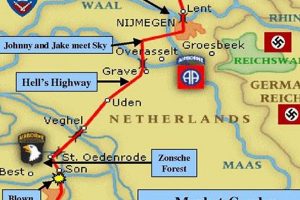
The Allied airborne operation, codenamed Market Garden, aimed to seize key bridges across the Netherlands in September 1944, thereby opening a route into Germany and potentially shortening the war. The plan involved a coordinated air assault (Market) to secure these bridges, followed by a rapid ground advance (Garden) to reinforce the airborne troops. Failure resulted from a combination of factors, including intelligence shortcomings, unexpected German resistance, and logistical challenges.
The operation’s significance lies in its ambition and potential impact on the war’s trajectory. Success could have bypassed the heavily fortified Siegfried Line and allowed the Allies to strike directly at the German industrial heartland. Understanding its failure provides valuable lessons in military strategy, highlighting the critical importance of accurate intelligence, realistic planning, and adaptability in the face of unforeseen circumstances. The historical context demonstrates the complex realities of large-scale combined operations and the inherent risks involved.
The reasons behind the operation’s ultimate failure are multifaceted and can be attributed to flawed assumptions, inadequate preparation, and the resilience of the German forces. These elements contributed significantly to the operation falling short of its objectives. A closer examination reveals the key issues that led to the defeat.
Analyzing the Shortcomings of Operation Market Garden
To understand the operational failure, a rigorous examination of contributing factors is essential. These considerations serve as crucial learning points for military strategists and historians.
Tip 1: Re-evaluate Intelligence Assessments: Inaccurate or incomplete intelligence can significantly impede operational success. In the case of Market Garden, underestimation of German armored strength in the Arnhem area proved critical.
Tip 2: Consider Terrain Constraints: The Dutch landscape, characterized by canals and polders, presented formidable obstacles. The plan’s reliance on a single highway for ground advance made the operation vulnerable to delays and ambushes.
Tip 3: Acknowledge Logistical Limitations: Maintaining a consistent supply line over extended distances is crucial. The slow pace of the ground advance hampered the timely delivery of reinforcements and vital resources to airborne units.
Tip 4: Analyze Enemy Capabilities: A comprehensive understanding of the enemy’s capabilities and potential responses is vital. The German forces, though initially surprised, exhibited remarkable resilience and tactical adaptability.
Tip 5: Scrutinize Communication Effectiveness: Reliable communication is essential for coordinating complex operations. Disruptions in communication between airborne units and ground forces hindered effective coordination and decision-making.
Tip 6: Understand Weather Impact: Adverse weather conditions can significantly impact airborne operations. Fog and poor visibility hampered resupply efforts and limited air support for the beleaguered airborne troops.
Tip 7: Critique Command Decisions: Objective analysis of strategic and tactical decisions made during the operation is important. Choices regarding troop deployment, resource allocation, and adaptation to changing circumstances require careful scrutiny.
These considerations highlight the interconnectedness of various elements contributing to operational failure. A holistic approach to planning and execution is paramount in mitigating risks and maximizing the likelihood of success in large-scale military endeavors.
By acknowledging the shortcomings of this historical campaign, military strategists and analysts can derive insights to better inform future operations and avoid repeating critical errors.
1. Intelligence Inaccuracies and Operation Market Garden's Failure

Intelligence inaccuracies served as a critical contributing factor to the operational failure of Market Garden. The underestimation of German armored strength, particularly the presence of the 9th and 10th SS Panzer Divisions near Arnhem, directly contradicted Allied intelligence assessments. This deficiency led to the deployment of British airborne troops into a far more heavily defended area than anticipated, severely compromising their ability to secure key objectives. The failure to accurately assess the enemy’s capabilities demonstrates a significant intelligence failure with dire operational consequences.
The practical significance of this intelligence shortcoming can be understood through examining its impact on the ground. The British 1st Airborne Division’s initial landings faced immediate and intense opposition, hindering their progress towards the Arnhem bridge. The unanticipated armored presence directly contributed to the prolonged and ultimately unsuccessful battle for the bridge, preventing the linkup with ground forces and disrupting the overall timetable. Accurate intelligence could have prompted a re-evaluation of the operational plan or the allocation of additional resources, potentially altering the course of the battle.
In summary, flawed intelligence regarding German strength played a pivotal role in the operation’s defeat. The underestimation of armored units near Arnhem translated directly into increased Allied casualties, compromised objectives, and ultimately, operational failure. The case of Market Garden underscores the critical importance of reliable and accurate intelligence in military planning and the potentially catastrophic consequences of intelligence failures. It highlights a pivotal lesson in the need for rigorous verification and skepticism when assessing enemy capabilities and intentions.
2. German armored strength

The unexpected presence and strength of German armored units were a primary factor in the failure of Operation Market Garden. Allied intelligence significantly underestimated the number and combat readiness of German armor, particularly the 9th and 10th SS Panzer Divisions, stationed near Arnhem. This underestimation led to the British 1st Airborne Division encountering far stronger resistance than anticipated upon landing, preventing them from securing the crucial Arnhem bridge. The subsequent inability to establish a secure bridgehead across the Rhine directly impeded the advance of the ground forces, effectively stalling the entire operation. The unexpectedly robust German armored presence thus served as a key catalyst for the overall failure, disrupting the planned timetable and inflicting heavy casualties on Allied forces.
The practical significance of German armored strength manifested in several ways. The delayed advance of the ground forces, hampered by German armor engaging the single hig
hway, prevented the timely reinforcement of the airborne troops in Arnhem. This logistical bottleneck left the paratroopers isolated and vulnerable, ultimately leading to their defeat and withdrawal. Furthermore, the presence of German tanks forced the Allies to divert resources from other objectives to contain the armored threat, weakening the overall offensive. The unexpected intensity of the German armored resistance exposed critical flaws in the Allied planning and highlighted the need for more accurate and comprehensive intelligence gathering.
In conclusion, the unanticipated German armored strength significantly contributed to the operational failure of Market Garden. It undermined the initial airborne assault, disrupted the ground advance, and ultimately prevented the Allies from achieving their objectives. This outcome underscores the critical importance of accurate intelligence assessments and robust contingency planning in large-scale military operations. The lessons learned from the German armored strength’s impact on Market Garden remain relevant for understanding the complexities and potential pitfalls of modern warfare.
3. Terrain Constraints and Operation Market Garden's Failure
Terrain constraints significantly contributed to the overall failure of Operation Market Garden. The geographical characteristics of the Netherlands, specifically the presence of numerous canals, rivers, and polders, hampered both airborne and ground operations. These factors imposed limitations on maneuverability, speed of advance, and logistical support, ultimately undermining the ambitious Allied plan.
- Canal Obstacles
The prevalence of canals presented significant obstacles to ground forces. These waterways restricted movement to established bridges and causeways, creating chokepoints vulnerable to enemy fire and delaying the advance of armored units. The narrow corridors of advance increased vulnerability to flanking attacks and limited the ability to deploy forces effectively. The reliance on securing these limited crossings proved critical and, when delayed or prevented, significantly disrupted the operational timetable.
- Polder Landscape
The polder landscape, characterized by flat, open fields and low-lying areas, offered little natural cover for advancing troops. This lack of concealment exposed soldiers to enemy observation and fire, resulting in increased casualties and a slower rate of progress. The open terrain also made it difficult to bypass enemy strongpoints, forcing direct assaults across exposed ground. Consequently, the defenders gained a tactical advantage, impeding the advance.
- Single-Axis Advance Limitations
The operation’s reliance on a single main supply route, specifically Highway 69, exacerbated the impact of the terrain. This single-axis advance made the entire operation vulnerable to disruption by even small-scale enemy action. Any delay or obstacle along the highway had a cascading effect, hindering the delivery of supplies, reinforcements, and vital equipment to forward units. The resulting logistical bottlenecks further contributed to the overall operational slowdown and ultimately, failure.
- River Obstacles and Crossing Difficulties
The presence of major rivers, notably the Rhine, presented significant obstacles to the operation’s success. The need to secure intact bridges across these rivers before the arrival of ground forces placed immense pressure on the airborne units. The failure to secure the Arnhem bridge across the Rhine, in particular, proved decisive. Without a secure crossing, the ground forces could not effectively reinforce the airborne troops or advance further into Germany, effectively halting the operation’s progress.
In conclusion, terrain constraints in the Netherlands played a critical role in the failure of Operation Market Garden. The complex network of waterways, the open polder landscape, the reliance on a single supply route, and the challenges of securing river crossings all contributed to the difficulties faced by Allied forces. These geographical limitations, combined with other factors such as intelligence failures and German resistance, ultimately undermined the operation’s objectives and led to its disappointing outcome. The experience highlights the importance of thorough terrain analysis and adaptive planning in military operations.
4. Single-axis advance

The single-axis advance, characterized by reliance on Highway 69 as the primary route for ground forces, significantly contributed to the operational failure. This dependence created a critical vulnerability, transforming the entire operation into a high-stakes gamble contingent upon maintaining unimpeded progress along this singular corridor. Disruptions or delays along Highway 69 cascaded rapidly, impacting the timetable, hindering logistical support, and preventing timely reinforcement of the airborne troops. The lack of alternative routes meant that even relatively small pockets of resistance or localized damage to the highway could have disproportionately severe consequences, crippling the advance and jeopardizing the entire mission.
A key example illustrating the dangers of the single-axis advance is the prolonged engagement near Son and Veghel. German forces successfully destroyed the bridge at Son and heavily contested the area around Veghel. These actions effectively severed Highway 69, creating a significant bottleneck that stalled the advance of the British XXX Corps. This delay prevented the rapid reinforcement of the British 1st Airborne Division at Arnhem, which was then facing increasingly fierce resistance. The inability to bypass the damaged bridge or outflank the German positions underscored the severe limitations imposed by the single-axis approach. This situation underscored the importance of securing and maintaining the integrity of the sole line of advance, a task rendered exceedingly difficult by determined enemy resistance and challenging terrain.
The single-axis advance strategy magnified the impact of other operational shortcomings, such as intelligence failures and logistical delays. Because the entire operation hinged on a single route, any impediment along that route had a far greater impact than it would have in an operation with multiple lines of advance. This ultimately led to the isolation and defeat of the airborne forces at Arnhem. Understanding the single-axis advance as a critical element of the failure is therefore essential for military planning; it highlights the need for diversified routes, robust contingency plans, and the ability to adapt quickly to unforeseen disruptions. These insights demonstrate the inherent risks associated with over-reliance on a single point of failure in large-scale military operations, and have informed subsequent strategies.
5. Logistical delays

Logistical delays were a critical factor contributing to the failure of Operation Market Garden. The ambitious plan depended on the rapid movement of ground forces along a single axis to reinforce airborne units holding key bridges. S
ignificant delays in the ground advance, however, undermined this critical component of the operation, resulting in the isolation and eventual defeat of the British 1st Airborne Division at Arnhem. These delays stemmed from a combination of factors, including German resistance, terrain constraints, and the vulnerabilities inherent in relying on a single supply route.
The inability to maintain a consistent and timely flow of supplies had cascading effects. Airborne troops, lacking adequate ammunition, medical supplies, and reinforcements, were increasingly vulnerable to German counterattacks. For example, the prolonged engagement at Nijmegen bridge significantly delayed the ground advance, preventing the timely reinforcement of Arnhem. This failure to resupply the airborne divisions directly compromised their fighting capability and contributed to their inability to hold their positions. The reliance on airborne resupply, hampered by adverse weather and effective German anti-aircraft fire, further exacerbated the situation. The inability to quickly replace lost equipment and personnel severely diminished the combat effectiveness of the isolated airborne troops.
In summary, logistical delays played a pivotal role in undermining the success of Operation Market Garden. The delays in the ground advance prevented the timely reinforcement of the airborne troops, contributing significantly to their eventual defeat. The failure to maintain a consistent flow of supplies further weakened the airborne units, diminishing their fighting capabilities. This experience underscores the critical importance of robust logistical planning and execution in large-scale military operations. The operational outcome highlights the potentially catastrophic consequences of logistical failures and the inherent risks of relying on a single line of supply, especially when faced with determined enemy resistance and challenging environmental conditions.
6. Communication breakdowns

Communication breakdowns represent a significant contributing factor to the operational failure. Effective communication is paramount in complex military operations such as this one, where coordination across multiple units and geographically dispersed forces is critical. Deficiencies in communication networks and protocols directly undermined situational awareness, decision-making processes, and the ability to react effectively to unforeseen circumstances, thereby contributing significantly to the overall operational failure.
- Radio Equipment Limitations
The limitations of radio technology available at the time presented inherent challenges. Airborne units often experienced difficulties maintaining reliable communication with ground forces due to the range limitations of their radios and the effects of terrain and atmospheric conditions on signal propagation. This hampered the ability to coordinate air support, request reinforcements, and relay critical intelligence in a timely manner. Consequently, isolated units faced increasing pressure without adequate support or clear direction.
- Inter-Unit Communication Protocols
Variations in communication protocols between different Allied units further complicated the coordination effort. Differences in radio frequencies, encryption methods, and reporting procedures impeded seamless communication between British, American, and Polish forces. These inconsistencies led to delays in information exchange, misunderstandings, and difficulties in establishing a common operational picture. The lack of interoperability undermined combined arms operations and reduced overall effectiveness.
- Disruptions Caused by Enemy Action
German forces actively targeted Allied communication networks to disrupt coordination and sow confusion. Strategic attacks on communication hubs, radio jamming, and the infiltration of enemy agents into Allied lines significantly hampered the flow of information. These disruptions severed critical communication links between airborne units and ground forces, isolating pockets of resistance and preventing timely reinforcement. The enemy’s ability to effectively disrupt communication channels created a significant tactical advantage, contributing to the operation’s failure.
- Impact on Situational Awareness
The cumulative effect of communication breakdowns had a detrimental impact on situational awareness at all levels of command. Delays and inaccuracies in information flow hindered the ability of commanders to assess the evolving battlefield situation, make informed decisions, and adapt to changing circumstances. This lack of situational awareness led to misallocation of resources, delayed responses to enemy movements, and a general loss of control over the operational tempo. The inability to effectively monitor and respond to developments on the ground significantly contributed to the overall failure.
The aforementioned communication breakdowns directly impacted key operational aspects, ranging from coordinating air support to adjusting to shifts in the battlefield. The limitations in radio tech, compounded by protocol differences between Allied units and direct disruptions from enemy action, led to a systemic loss of situational awareness. Ultimately, this cascade of failures contributed significantly to the Allies’ inability to achieve their objectives in the operation. The deficiencies highlight the paramount importance of robust, reliable, and interoperable communication systems in modern military operations, and underscore the critical need for effective countermeasures against enemy attempts to disrupt these networks.
7. Weather interference
Weather interference played a tangible role in the failure of Operation Market Garden, primarily through its disruption of air operations and logistical support. Adverse weather conditions, particularly persistent fog and low cloud cover over England and the Netherlands, directly impeded the ability of Allied aircraft to deliver paratroopers and glider-borne troops accurately and on schedule. These conditions also severely hampered aerial resupply efforts, leaving already isolated airborne units critically short of ammunition, medical supplies, and other essential resources. The combination of delayed troop deployments and inadequate resupply significantly weakened the Allied forces, directly contributing to their inability to achieve their objectives.
The practical significance of weather’s impact can be illustrated by examining the experience of the British 1st Airborne Division at Arnhem. Persistent fog delayed the arrival of reinforcements and essential supplies, leaving them vulnerable to increasingly intense German counterattacks. The limited visibility also hindered the ability of Allied air support to effectively target enemy positions, providing a crucial advantage to the defending forces. The inability to quickly reinforce and resupply the besieged paratroopers, directly attributable to adverse weather, significantly eroded their combat effectiveness and ultimately contributed to their defeat. Contingency planning for such weather-related disruptions proved inadequate, highlighting the importance of factoring unpredictable atmospheric conditions into operational planning.
In conclusion, weather interference was a consequential factor in the chain of events that led to the operation’s failure. The unpredictable nature of weather, combi
ned with its direct impact on airborne operations and logistical support, created conditions that severely hampered the Allied forces and facilitated the German defense. Understanding the specific ways in which weather conditions undermined the operation provides valuable insights into the challenges of conducting large-scale airborne assaults and underscores the critical importance of incorporating robust weather forecasting and contingency planning into military strategy. The lessons learned from Operation Market Garden highlight the need for adaptive planning and the recognition of weather conditions as a crucial variable in operational success or failure.
Frequently Asked Questions
The following questions address common inquiries regarding the factors that contributed to the failure of Operation Market Garden, a significant Allied military operation during World War II.
Question 1: To what extent did intelligence failures contribute to the outcome?
Intelligence failures were significant. Allied intelligence underestimated the strength and positioning of German armored units, particularly near Arnhem. This miscalculation led to the deployment of airborne troops into unexpectedly heavy resistance, undermining the operation from the outset.
Question 2: How did the terrain of the Netherlands impede the Allied advance?
The Dutch landscape, characterized by canals, rivers, and polders, posed significant challenges. These geographical features restricted maneuverability, slowed the ground advance, and created logistical bottlenecks, hindering the reinforcement of airborne troops.
Question 3: Why was the reliance on a single axis of advance a critical flaw?
The dependence on Highway 69 as the primary supply route created a single point of failure. Any disruption along this route, whether due to enemy action or logistical issues, had a cascading effect, impeding the timely delivery of reinforcements and supplies to the forward units.
Question 4: What role did logistical delays play in the operation’s failure?
Logistical delays significantly hampered the operation. The slow pace of the ground advance prevented the timely reinforcement of the airborne troops, leaving them isolated and vulnerable. Inadequate resupply further weakened the airborne divisions, diminishing their combat effectiveness.
Question 5: How did communication breakdowns impact the Allied effort?
Communication breakdowns between airborne units and ground forces impeded effective coordination and situational awareness. Disruptions in radio communication and variations in communication protocols hindered the timely exchange of critical information, undermining the ability to react effectively to changing circumstances.
Question 6: Did adverse weather conditions contribute to the operational difficulties?
Adverse weather, particularly fog and low cloud cover, disrupted air operations and logistical support. These conditions delayed the deployment of airborne troops and hampered aerial resupply efforts, further compounding the challenges faced by Allied forces.
In conclusion, the failure of Operation Market Garden resulted from a complex interplay of factors, including intelligence failures, terrain constraints, logistical challenges, and adverse weather conditions. The operation serves as a valuable case study in military planning, highlighting the importance of accurate intelligence, realistic assessments, and adaptability in the face of unforeseen circumstances.
Consider the provided points when analyzing the strategic implications of large-scale military operations.
Why Did Market Garden Fail
The preceding analysis has illuminated several critical factors contributing to the operational failure. Intelligence shortcomings, specifically the underestimation of German armored strength, set the stage for unexpected and intense resistance. Terrain constraints, marked by canals and a restrictive single-axis advance, compounded logistical challenges and impeded reinforcement efforts. Communication breakdowns further exacerbated difficulties in coordination and situational awareness. Finally, adverse weather conditions hampered aerial resupply and troop deployments, further diminishing the Allied forces’ capacity to achieve their objectives. These elements, interwoven and mutually reinforcing, ultimately thwarted the ambitious plan.
The failure of Operation Market Garden serves as a sobering reminder of the inherent complexities and risks associated with large-scale military endeavors. A rigorous understanding of the operation’s shortcomings offers enduring lessons in strategic planning, the vital importance of accurate intelligence, and the necessity of adaptability in the face of unforeseen challenges. Further investigation into the historical records and analyses is warranted to ensure that the sacrifices made during this pivotal battle inform future military doctrine and strategic decision-making.