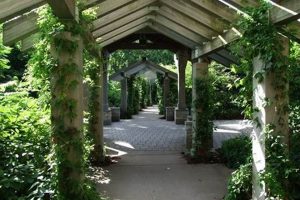
A specifically designed space that incorporates Japanese characters into its landscape is a feature of some gardens. These spaces frequently integrate stone arrangements, water features, and carefully selected flora to visually represent and enhance the understanding of the characters they feature. For example, a garden might utilize groupings of rocks to suggest the strokes of a character meaning “mountain” or “water”.
Such installations offer a unique approach to cultural appreciation and education. They foster a deeper engagement with the written language by presenting it in a three-dimensional, immersive environment. Historically, gardens in Japan have served as places for contemplation and artistic expression, and the integration of written language extends this tradition, blending aesthetics with intellectual stimulation.
The following discussion will delve into specific examples of this art form, exploring the principles of design involved, the selection process for appropriate characters, and the interpretive challenges and rewards associated with experiencing language in this novel setting.
Guidelines for Conceptualizing a Character-Based Landscape
The following outlines key considerations for those interested in planning a landscape that integrates written script elements.
Tip 1: Character Selection: Prioritize characters with strong visual potential. Simpler characters with bold strokes are generally more effective when translated into physical forms such as rock arrangements or plant groupings. For example, (kawa, river) lends itself well to a meandering water feature.
Tip 2: Material Harmony: Choose materials that complement both the character’s meaning and the surrounding environment. Using dark, textured stones to represent (yama, mountain) creates a visual link to the natural world.
Tip 3: Spatial Awareness: The scale of the representation should be proportionate to the available space. Overly large installations can overwhelm smaller gardens, while diminutive displays may be lost in expansive settings. Consider the sight lines and vantage points from which the installation will be viewed.
Tip 4: Symbolic Flora: Plants can enhance the character’s meaning. For instance, planting bamboo around (take, bamboo) reinforces its symbolism of resilience and growth. Consider the seasonal changes and how the plants will evolve over time.
Tip 5: Integration with Existing Elements: Seamlessly incorporate the character-based features into the pre-existing landscape. Avoid jarring contrasts in style or material. Use pathways and water features to guide the eye and create a cohesive flow.
Tip 6: Consider the Viewpoint: The design should be considerate of the point of view, because one perspective may change a meaning. Understand the view, and adjust the design to make sense.
Tip 7: Maintenance and Longevity: Plan for the long-term upkeep of the display. Select durable materials and plants that are well-suited to the local climate. Regular maintenance will ensure that the features remain legible and visually appealing for years to come.
Strategic planning, material selection, and an understanding of spatial relationships are crucial to creating a successful and enduring landscape. These considerations will enhance the aesthetic appeal and deepen the symbolic resonance of the installation.
The next section will explore the challenges inherent in interpreting these unconventional displays and the methods by which viewers can maximize their engagement and understanding.
1. Visual Representation
Visual representation serves as the foundational element of any character landscape. It is the translation of abstract calligraphic forms into tangible, three-dimensional features within a garden setting. This process demands a meticulous understanding of both the character’s structure and the physical properties of the selected materials. A successful visual rendering accurately conveys the intended character, regardless of the viewer’s familiarity with the written language. The arrangement of stones to mimic the strokes of (ki, tree) or the shaping of a water feature to evoke (mizu, water) are prime examples. Without effective visual representation, the garden lacks its core communicative function, becoming merely an aesthetically pleasing space devoid of linguistic meaning.
The effectiveness of the visual translation dictates the interpretative success of the design. Ambiguity in form can lead to misinterpretation, undermining the garden’s purpose. Careful consideration must be given to perspective, scale, and the negative space surrounding the representation. The renowned Adachi Museum of Art in Yasugi, Japan, features several meticulously maintained gardens, some of which incorporate subtle allusions to literary and philosophical concepts. These examples demonstrate how skillful visual representation elevates a garden beyond mere decoration, transforming it into a space for intellectual and spiritual engagement.
In conclusion, visual representation is not merely a design element but the crucial link between the abstract symbol and the tangible landscape. The clarity and accuracy of this representation determine the effectiveness of the character landscape in conveying its intended meaning. Challenges arise in balancing artistic interpretation with linguistic fidelity, but the practical significance of achieving this balance lies in creating spaces that foster a deeper understanding and appreciation of language and culture.
2. Character Semantics

The meaning inherent within Japanese characters forms a crucial layer of understanding when interpreting landscape designs. This intrinsic semantic value provides a foundation for the artistic and philosophical intent of the garden, transforming it from a purely aesthetic space into one laden with cultural and linguistic significance.
- Core Meaning and Connotations
Each character carries a fundamental definition, but its use in literature, poetry, and philosophy imbues it with layers of connotation. For example, the character (tsuki, moon) signifies a celestial body, but also evokes notions of tranquility, reflection, and the passage of time. When integrated into a garden, these connotations shape the experience and invite contemplation beyond the surface level.
- Compound Words and Idiomatic Expressions
Individual characters often combine to form compound words, significantly altering or expanding their original meaning. Understanding these compounds is essential for a comprehensive interpretation. A garden that incorporates both (hana, flower) and (mizuki, dogwood) might allude to the beauty of nature or the fleeting nature of existence, depending on the design’s intent.
- Historical and Literary
AllusionsThe characters may reference specific historical events, literary works, or philosophical concepts. A garden featuring (matsu, pine) could allude to the resilience of the pine tree, a symbol often used in Japanese art and literature to represent strength and longevity. This requires viewers to have some familiarity with Japanese cultural history and literary traditions.
- Subjective Interpretation and Artistic License
While characters possess defined meanings, artists may employ them metaphorically or symbolically to convey more nuanced or personal interpretations. This allows for a degree of artistic freedom but also demands that viewers engage actively with the design, drawing upon their own knowledge and experience to discern the intended message. For example, repeated use of the character (ken, sword) might represent not literal weaponry, but power or control within a given scenario.
Comprehending semantics is indispensable for navigating these garden designs. The interplay between literal definitions, nuanced connotations, historical allusions, and artistic interpretation enriches the experience, elevating it to a profound and culturally immersive engagement.
3. Material Symbolism

Material symbolism within a character landscape is integral to conveying meaning and enhancing interpretive depth. The selection of materials is not arbitrary; it is a deliberate act that imbues the representation with layers of cultural, philosophical, and aesthetic significance. The inherent properties of materials, combined with their traditional associations, amplify the message conveyed by the characters themselves. For instance, the use of granite to represent (iwa, rock) reinforces the character’s literal meaning and alludes to qualities of permanence and steadfastness. Conversely, employing bamboo to depict (take, bamboo) creates a visual and symbolic link between the written form and its living counterpart, evoking notions of resilience and adaptability.
The deliberate integration of materials acts as a non-verbal language, communicating subtle nuances that enrich the overall interpretive experience. The use of water to depict (mizu, water) extends beyond mere visual representation, engaging auditory and tactile senses and imbuing the character with dynamism and fluidity. Furthermore, the material’s historical context and traditional use contribute to its symbolic weight. For example, the use of moss-covered stones, common in Japanese gardens, suggests age, history, and a connection to the natural world, influencing the perception of the surrounding characters. In the Ryoan-ji Zen garden in Kyoto, the carefully selected stones and gravel, though not explicitly forming characters, embody Zen principles of simplicity and meditation, demonstrating the power of material symbolism to evoke profound spiritual meaning.
In conclusion, material symbolism is not merely a decorative element within a character-based landscape; it is a fundamental component that shapes the viewer’s understanding and emotional response. The careful selection and arrangement of materials create a multi-sensory experience that amplifies the character’s intrinsic meaning, grounding it in a tangible, culturally resonant context. Ignoring this aspect diminishes the potential for meaningful engagement and reduces the installation to a purely superficial display.
4. Spatial Arrangement

Spatial arrangement functions as a pivotal element within landscape architecture integrating Japanese characters. The strategic placement of components directly influences the legibility and interpretive potential of the characters. A poorly conceived layout can obscure the intended forms, rendering the characters unrecognizable and disrupting the overall harmony of the space. Conversely, thoughtful arrangement enhances the visual impact, guiding the viewer’s eye and facilitating a deeper understanding of the intended message. Consider the Katsura Imperial Villa in Kyoto, where carefully positioned stones and plants create distinct visual planes, emphasizing the relationship between structure and nature.
The relative positioning of characters, their size in relation to the surrounding environment, and the pathways guiding visitor movement all contribute to the overall experience. Intentionally crafted sightlines frame specific views, directing attention to key elements and creating a sense of discovery. Negative space plays a crucial role, defining the characters and preventing visual clutter. The distance between elements allows for individual appreciation and prevents the composition from appearing congested. These considerations are not merely aesthetic; they are fundamental to communicating the intended meaning and evoking the desired emotional response. The spatial arrangement must also accommodate the garden’s functionality, balancing visual appeal with accessibility and ease of maintenance.
In summary, spatial arrangement serves as a critical determinant in the success of landscape designs incorporating characters. It governs not only the aesthetic appeal but also the clarity of communication and the overall experience. Challenges arise in harmonizing artistic expression with functional considerations, but a thorough understanding of spatial principles is essential for creating environments that are both visually compelling and intellectually stimulating. The careful management of space, perspective, and movement transforms a collection of individual elements into a cohesive and meaningful whole.
5. Cultural Context
The integration of Japanese characters within landscape architecture inextricably links to cultural context. The characters selected, the materials employed in their representation, and the overall design aesthetic are all deeply rooted in Japanese history, philosophy, and artistic traditions. A comprehensive understanding of this cultural milieu is essential for both the designer and the viewer to fully appreciate the significance of a space. Without such understanding, the landscape risks being perceived as merely decorative, devoid of its intended symbolic and intellectual depth. The selection of specific characters often alludes to classical literature, philosophical concepts, or historical events. For example, using the character “pine” might reference its symbolic association with longevity and steadfastness, a concept prevalent in Japanese art and poetry. Similarly, the arrangement of stones may reflect principles of Zen Buddhism, emphasizing balance, harmony, and the beauty of impermanence. This necessitates an awareness of the symbolic weight attached to elements.
Ignoring context risks misinterpretation. A character symbolizing strength might, without background knowledge, be viewed simply as an aesthetic element, its deeper meaning lost. The selection of materials likewise carries cultural significance. The use of natural, unrefined materials such as moss, bamboo, and weathered stone reflects a reverence for nature and an appreciation for the beauty of imperfection, central tenets of the Wabi-sabi aesthetic. Contemporary examples are most clearly visible in traditional gardens. Correctly interpreting these elements adds additional layers o
f meaning. The practice of including specific symbolic plants alongside the stone formation can add additional historical context.
In summary, cultural context is not merely an ancillary consideration but an indispensable component of landscape designs utilizing Japanese characters. It informs the selection of elements, influences the overall aesthetic, and ultimately shapes the viewer’s experience. The depth of appreciation is directly proportional to one’s familiarity with the cultural backdrop. Challenges arise in bridging the cultural divide, but the rewards are substantial: a deeper understanding of Japanese philosophy, art, and the intricate relationship between humanity and the natural world. A disregard for cultural context diminishes its impact, rendering it superficial.
6. Interpretive Depth

Interpretive depth, in the context of Japanese character landscapes, refers to the capacity for a viewer to derive layers of meaning from the installation beyond a superficial understanding. This depth arises from the interplay of visual representation, character semantics, material symbolism, spatial arrangement, and cultural context. A landscape with high interpretive depth invites ongoing contemplation and yields new insights upon repeated viewing. The degree of a works interpretive depth directly impacts the aesthetic value and intellectual significance attributed. It transforms a decorative space into a site for profound engagement with language, culture, and philosophy.
The practical significance of understanding interpretive depth lies in its ability to inform both the design and appreciation of these landscapes. Designers can intentionally craft features that encourage multifaceted readings, incorporating elements that allude to historical events, literary allusions, or philosophical concepts. Viewers, equipped with an awareness of the various interpretive layers, can actively engage with the landscape, drawing upon their own knowledge and experience to unlock its hidden meanings. For example, the dry landscape gardens (karesansui) of Zen temples, such as Ryoan-ji, are not merely arrangements of rocks and gravel. Their spatial arrangement and symbolic use of materials evoke Zen principles of simplicity, emptiness, and the interconnectedness of all things, prompting viewers to engage in meditative contemplation. Understanding this intentionally constructed interpretive depth changes the understanding.
Successfully establishing and engaging with the interpretive depth of character landscape architecture poses significant challenges. It requires an intimate knowledge of Japanese language, culture, and aesthetics, often exceeding the grasp of casual observers. Ambiguity in visual representation or a lack of cultural context can hinder understanding and diminish the overall impact. However, the rewards are substantial. By intentionally crafting depth of meaning, viewers can experience a more complete understanding and feeling.
Frequently Asked Questions About Kanji Gardens
The following section addresses common inquiries and misconceptions surrounding the design, interpretation, and cultural significance of landscape architecture integrating Japanese characters.
Question 1: What is the primary purpose of a character garden?
The purpose is to create a space that fosters a deeper engagement with the Japanese language and culture by presenting written characters in a three-dimensional, immersive environment. It combines artistic aesthetics with intellectual stimulation.
Question 2: What challenges are most frequently encountered in the design process?
Design challenges include translating abstract calligraphic forms into tangible features, selecting materials that complement both the character’s meaning and the surrounding environment, and ensuring long-term maintenance and legibility of the installation.
Question 3: How is the selection of characters determined for the space?
The selection prioritizes characters with strong visual potential and relevance to the garden’s intended theme or philosophical message. Simpler characters with bold strokes are generally more effective when translated into physical forms.
Question 4: To what extent is knowledge of Japanese language and culture essential for appreciating landscape architecture with characters?
A degree of familiarity with Japanese language, history, and cultural traditions enhances the experience and allows for a deeper understanding of the characters’ symbolic meanings. However, even without prior knowledge, the visual representation and spatial arrangement can convey certain levels of meaning.
Question 5: What distinguishes a landscape with characters from a conventional Japanese garden?
While a conventional Japanese garden focuses on creating harmonious natural scenes, one with characters explicitly incorporates written language as a central design element, using landscape features to represent and enhance the understanding of specific characters and their associated meanings.
Question 6: Are these only found in Japan, or are there examples elsewhere?
While most prevalent in Japan, such gardens can be found in other parts of the world, often within Japanese cultural centers, botanical gardens, or private collections. However, the cultural context and design principles remain rooted in Japanese traditions.
In summary, landscape architecture is a multifaceted art form that requires careful consideration of linguistic, aesthetic, and cultural factors. A thoughtful design fosters a deeper appreciation of language and the intricate relationship between humanity and the natural world.
The following section explores the future directions and potential innovations within this art form.
Conclusion
This exploration has demonstrated that the integration of Japanese characters into landscape architecture transcends mere aesthetic embellishment. It represents a sophisticated synthesis of language, art, and cultural expression, demanding a comprehensive understanding of visual representation, character semantics, material symbolism, spatial arrangement, and cultural context. The interpretive depth of these installations relies on a reciprocal relationship between designer intent and viewer engagement, fostering a profound connection with Japanese intellectual and artistic traditions.
As a unique art form, the kanji garden holds the potential to evolve and adapt, incorporating new materials, technologies, and interpretive approaches. Continued scholarship and thoughtful design are essential to ensuring the enduring relevance and intellectual integrity of this cultural practice, inviting future generations to contemplate the intricate relationship between language, nature, and human creativity.


![[Stunning] Garden Pointe Seattle Clip Art Designs [Free] | The Ultimate Gardening Guide: Grow a Thriving Garden Year-Round](https://MyGardenPatch.com/wp-content/uploads/2025/07/th-9292-300x200.jpg "[Stunning] Garden Pointe Seattle Clip Art Designs [Free] The Ultimate Gardening Guide: Grow a Thriving Garden Year-Round")