



The standardized connection for most garden hoses in North America utilizes a thread specification known as Garden Hose Thread (GHT). This standard dictates the dimensions and thread pitch necessary for compatibility between hoses, nozzles, sprinklers, and spigots. GHT is defined by a 1 1/16 inch outside diameter for the male thread and has 11.5 threads per inch. This standardization ensures that diverse watering tools can be easily interconnected, regardless of manufacturer.
The widespread adoption of a uniform thread dimension for garden hoses provides several advantages. It facilitates interchangeability, simplifies the process of selecting and connecting watering equipment, and reduces the likelihood of leaks due to mismatched fittings. This standardization has been in place for many years, becoming a de facto industry standard that contributes to the efficient and reliable operation of residential and commercial watering systems. The consistency allows consumers to readily replace or upgrade components without needing specialized knowledge or tools.
Understanding this dimensional specification is crucial when repairing existing systems or building new ones. Ensuring adherence to the GHT standard during replacement or expansion projects guarantees compatibility and avoids the frustration of incompatible fittings. Therefore, when selecting new hoses, nozzles, or any related accessories, confirming that they conform to this standard is highly recommended.
Thread Size Considerations for Garden Hose Connections
Adhering to recognized dimensional standards during garden hose-related tasks is essential for achieving reliable connections and preventing leaks. The following tips emphasize the importance of understanding and applying the appropriate thread size when working with garden hoses.
Tip 1: Verify Compatibility Before Purchase: Prior to acquiring any new garden hose, nozzle, sprinkler, or fitting, examine the product specifications to ensure it adheres to the Garden Hose Thread (GHT) standard. Mismatched thread sizes can lead to leaks and unreliable connections.
Tip 2: Inspect Existing Threads Regularly: Periodically examine the threads on both the hose and the spigot for damage, such as stripped or cross-threaded areas. Damaged threads compromise the seal and can result in water wastage and reduced water pressure.
Tip 3: Use Thread Seal Tape for a Watertight Seal: Applying thread seal tape (also known as Teflon tape) to the male threads before connecting the hose to the spigot or nozzle creates a tighter, more watertight seal. This is particularly important when dealing with older fittings or those that have been frequently connected and disconnected.
Tip 4: Avoid Overtightening Connections: Overtightening can damage the threads, leading to leaks and premature wear. Tighten the connection until it is snug and secure, but avoid applying excessive force.
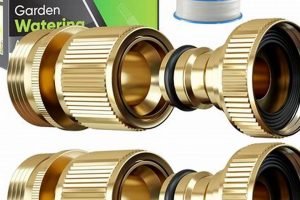
Tip 5: Consider Brass or Metal Fittings for Durability: While plastic fittings are more economical, brass or metal fittings offer superior durability and resistance to wear and tear. This is especially important for connections that are frequently used or exposed to harsh weather conditions.
Tip 6: Protect Hose Threads During Storage: When storing garden hoses, protect the threads from damage by using protective caps or storing the hose in a manner that prevents the threads from rubbing against abrasive surfaces.
By paying close attention to the dimensional specifications and implementing these preventative measures, individuals can ensure the longevity and optimal performance of their garden hose systems, minimizing water wastage and reducing the need for frequent repairs or replacements.
The next section addresses common issues encountered with garden hose connections and offers practical solutions.
1. Standardization (GHT)

Standardization, specifically the Garden Hose Thread (GHT) standard, is the foundational element defining thread size for garden hoses. Its primary function is to ensure interchangeability among diverse watering system components. Without GHT standardization, connecting hoses, nozzles, sprinklers, and spigots would be a complex, unreliable endeavor.
- Dimensional Consistency
The GHT standard mandates precise dimensions for both male and female hose fittings. The male thread must have an outer diameter of 1 1/16 inches, with 11.5 threads per inch. These defined dimensions guarantee that any compliant fitting will connect securely and without leaks, irrespective of manufacturer. This consistency is a direct result of adhering to the GHT standard and eliminates compatibility issues common in non-standardized systems.
- Material and Manufacturing Alignment
While GHT primarily addresses thread dimensions, it also influences material selection and manufacturing processes. Manufacturers producing GHT-compliant components must maintain stringent quality control to ensure their products meet the specified dimensions and tolerances. This adherence affects the longevity and reliability of connections, contributing to the overall performance of watering systems. The standard indirectly promotes the use of durable materials capable of withstanding repeated connections and disconnections.
- Facilitation of Consumer Choice and Replacement
The GHT standard simplifies consumer decision-making when selecting or replacing garden hose components. Consumers can confidently purchase any GHT-compliant product, knowing it will seamlessly integrate with their existing system. This ease of use reduces the likelihood of purchasing incompatible items and streamlines the maintenance or expansion of watering setups. The existence of a universal standard fosters a competitive market where manufacturers are incentivized to offer high-quality, compatible products.
- Influence on International Standards
Although GHT is predominantly used in North America, its success has influenced the development of similar standards in other regions. While not directly applicable worldwide, the principles of dimensional standardization and interchangeability that underpin GHT have served as a model for other countries seeking to improve the efficiency and reliability of their own watering systems. The legacy of GHT extends beyond its immediate geographic area, shaping the broader landscape of irrigation technology.
In summary, the GHT standard provides the critical framework for thread size specification in garden hoses. It ensures dimensional consistency, influences material and manufacturing practices, simplifies consumer choice, and has even shaped the development of international standards. Without this standardization, the functionality and usability of garden hose systems would be significantly compromised.
2. 1 1/16 inch diameter

The 1 1/16 inch diameter is a critical dimension defining the male Garden Hose Thread (GHT), the standard thread size for garden hose connections in North America. This measurement dictates the outer diameter of the threaded portion of the male fitting, playing a fundamental role in ensuring compatibility between hoses, spigots, and various watering accessories.
- Essential for Compatibility
The 1 1/16 inch diameter, when coupled with the specification of 11.5 threads per inch, ensures that male and female GHT fittings can properly engage. This specific dimension enables a secure mechanical connection that, when properly sealed, prevents leaks and maintains water pressure. Deviations from this specified diameter can result in loose connections or the inability to connect components, rendering the system unusable. Real-world examples include the seamless connection of hoses to outdoor faucets and the easy attachment of spray nozzles to hose ends, all reliant on this precise diameter.
- Impact on Sealing Performance
The diameter of the thread directly affects the ability to create a watertight seal. The threads on the male fitting must align correctly with the threads on the female fitting, allowing for proper compression and the formation of a seal. If the diameter is incorrect, the threads may not engage fully, resulting in gaps that water can escape through. This underscores the importance of precise manufacturing and adherence to the standard. Failure to meet this specification can lead to significant water wastage and decreased system efficiency.
- Role in Material Selection and Manufacturing
The requirement for a 1 1/16 inch diameter influences the selection of materials and manufacturing processes used in producing hose fittings. Materials must be sufficiently strong and dimensionally stable to maintain the integrity of the thread under pressure and repeated use. Manufacturing processes must be precise to ensure that the threads are accurately formed to the specified diameter. This requirement places demands on both the material and manufacturing aspects of garden hose component production, contributing to the overall quality and reliability of the final product. For instance, brass fittings, known for their durability and corrosion resistance, are often chosen to ensure long-term adherence to the dimensional standard.
- Contribution to System Standardization
The existence of the 1 1/16 inch diameter as a core element of the GHT standard allows for the creation of standardized watering systems. This standardization simplifies the process of selecting and replacing components, as users can be confident that any GHT-compliant fitting will work with their existing system. This promotes efficiency and reduces the likelihood of compatibility issues, facilitating easier maintenance and upgrades of watering setups. The widespread adoption of this diameter as a standard simplifies the design, manufacture, and use of garden hose systems, benefiting both manufacturers and consumers.
The 1 1/16 inch diameter is therefore integral to understanding the thread size of a garden hose. It is more than just a measurement; it is a fundamental component of a standardized system that ensures compatibility, performance, and ease of use in garden hose connections. The specification promotes efficiency and minimizes potential for leaks and connection failures, offering substantial benefits for residential and commercial watering applications.
3. 11.5 threads/inch

The specification of 11.5 threads per inch is an indispensable element defining the thread size of a garden hose, specifically within the Garden Hose Thread (GHT) standard. This measurement denotes the thread pitch, which is the number of threads contained within a one-inch length of the threaded portion. It works in conjunction with the 1 1/16 inch outer diameter to guarantee proper mechanical engagement between male and female fittings. The 11.5 threads per inch ensures that the threads align and interlock correctly, creating a secure, leak-resistant connection. Without this standardized thread pitch, achieving a reliable seal in garden hose systems would be exceedingly difficult. For instance, when connecting a garden hose to an outdoor spigot, the 11.5 threads per inch on both fittings allow them to mesh seamlessly, forming a watertight bond. Any deviation from this thread pitch would compromise the connection, leading to leaks and inefficient water usage.
The practical significance of understanding the 11.5 threads per inch specification extends to various scenarios involving garden hose maintenance and modification. When replacing a damaged hose end or installing a new fitting, ensuring that the replacement component adheres to the 11.5 threads per inch standard is crucial. If a fitting with a different thread pitch is used, it may not properly engage with the existing hose, resulting in a loose connection and potential water loss. Moreover, knowing this specification allows users to select appropriate adapters and connectors when transitioning between different types of watering systems or when connecting a garden hose to non-standard fittings. In commercial settings, where irrigation systems are frequently modified and expanded, adherence to the 11.5 threads per inch standard is vital for maintaining system integrity and preventing costly leaks.
In conclusion, the 11.5 threads per inch specification is a fundamental aspect of garden hose thread size. It contributes directly to the proper functioning and reliability of garden hose systems. Its precise definition, within the GHT standard, makes it possible to achieve secure, leak-resistant connections. Recognizing the importance of this specification facilitates effective maintenance, repair, and modification of garden hose systems, promoting water conservation and minimizing potential system failures. The standardized thread pitch serves as a cornerstone of efficient and dependable watering practices.
4. Male thread definition
The male thread definition is a critical component in understanding the thread size of a garden hose, as it specifies the outer, protruding threads that engage with a corresponding female fitting. Without a precise definition of these male threads, achieving a secure, leak-proof connection within a garden hose system would be impossible. The Garden Hose Thread (GHT) standard establishes the dimensions and thread pitch for the male fitting, dictating its 1 1/16 inch outer diameter and 11.5 threads per inch. This definition is not merely descriptive; it is prescriptive, mandating adherence to specific measurements for proper functionality. A real-life example of its importance is evident when connecting a garden hose to an outdoor faucet; the male threads on the hose end must conform precisely to the faucet’s female threads to create a seal capable of withstanding water pressure. Inconsistency or deviation from this definition leads directly to leaks and system inefficiency.
The male thread definition also influences the manufacturing process of garden hose fittings. Manufacturers must adhere rigorously to the specified dimensions to ensure interchangeability and compatibility across different brands and components. This standardization simplifies consumer decision-making, allowing individuals
to confidently select replacement parts or new accessories without the risk of incompatibility. Furthermore, the male thread definition informs the design of related tools and accessories, such as thread repair kits and adapters, which are designed to address specific issues related to male thread damage or modification. The definition also dictates the tolerances acceptable in the manufacturing process, directly affecting the long-term durability and reliability of garden hose connections.
In summary, the male thread definition is not merely a technical detail but an essential element of the garden hose thread size standard. It ensures compatibility, promotes efficient water usage, and informs the design and manufacturing of related components. The practical significance of this understanding is evident in the ability to maintain and modify garden hose systems effectively, minimizing water wastage and maximizing system lifespan. Challenges such as thread damage or corrosion highlight the importance of proper maintenance and the selection of durable materials that can withstand environmental factors and repeated use. The accurate definition of the male thread forms the cornerstone of efficient garden hose system functionality.
5. Female thread acceptance

Female thread acceptance, in the context of garden hose thread size, refers to the precise dimensional requirements of the female fitting necessary to properly engage with the male Garden Hose Thread (GHT). It’s intrinsically linked to the overall definition of “what is the thread size of a garden hose” because it specifies the internal characteristics a female connector must possess to ensure compatibility and a watertight seal. Cause and effect are readily apparent: a female fitting that deviates from the specified internal diameter and thread pitch will not accept a standard male GHT fitting, resulting in leaks or a complete inability to connect the components. The importance of proper female thread acceptance lies in its role as the counterpart to the male thread definition, together ensuring the functional integrity of the connection. For instance, a female hose repair coupling must accurately accept the male threads of a standard garden hose; otherwise, the repair is ineffective, and water loss occurs.
Practical application of this understanding is critical for both manufacturers and consumers. Manufacturers must adhere to strict quality control to ensure their female fittings meet the dimensional standards for GHT. Consumers, when selecting replacement hoses, nozzles, or connectors, implicitly rely on the adherence to these standards. A failure to properly accept the male threadfor example, due to manufacturing defects or damage to the female fittingnecessitates replacement and highlights the importance of visual inspection before use. Furthermore, adaptations and connectors designed to bridge dissimilar thread sizes depend on accurate female thread acceptance at one or both ends, providing versatility in connecting various watering system components.
In conclusion, female thread acceptance is not merely a passive characteristic but an active requirement of the garden hose thread size definition. It ensures compatibility, prevents water loss, and allows for effective maintenance and modification of watering systems. Challenges related to thread damage, corrosion, or manufacturing defects emphasize the necessity of regular inspection and the selection of durable materials. The accuracy and consistency of female thread acceptance ultimately contributes to the efficiency and reliability of garden hose systems as a whole.
6. Material Compatibility

Material compatibility is an often-overlooked, yet critical factor influencing the long-term reliability and performance of garden hose connections. The chosen material for both male and female fittings directly impacts their ability to maintain dimensional stability, resist corrosion, and withstand mechanical stress, all essential considerations when determining the thread size’s functional lifespan and effectiveness.
- Corrosion Resistance
Different materials exhibit varying degrees of resistance to corrosion, which can significantly affect thread integrity. Brass, for example, is commonly used in garden hose fittings due to its inherent resistance to corrosion from water and environmental exposure. Conversely, some plastics may degrade over time, leading to thread deformation and eventual failure. Corrosion compromises the thread’s ability to properly engage and seal, rendering the specified thread size irrelevant as the connection becomes unreliable and prone to leaks. In coastal regions, where salt air accelerates corrosion, selecting corrosion-resistant materials is especially vital for preserving thread integrity and maintaining a watertight seal.
- Thermal Expansion and Contraction
Materials expand and contract at different rates in response to temperature changes. When dissimilar materials are joined, such as a brass fitting connected to a plastic hose, differential thermal expansion can create stress on the threads. This stress can lead to thread deformation, loosening of the connection, and ultimately, leaks. Understanding the thermal expansion coefficients of different materials is crucial for designing durable connections that can withstand fluctuating temperatures without compromising the integrity of the thread size. This consideration is particularly important in regions with extreme temperature variations, where connections are subjected to repeated expansion and contraction cycles.
- Mechanical Strength and Durability
The mechanical strength of the materials used in garden hose fittings directly impacts their ability to withstand the forces exerted during connection and disconnection, as well as the pressure from water flowing through the hose. Brittle materials may crack or break under stress, while softer materials may deform over time, altering the thread dimensions. Brass and certain reinforced plastics offer a good balance of strength and durability, ensuring that the thread size remains consistent over numerous uses. Regular connections to faucets or nozzles subject threads to wear, making robust materials a necessity for long-term reliability. Fittings made of inferior materials may quickly strip or deform, negating the benefit of adhering to the specified thread size.
- Chemical Compatibility
Depending on the intended use, garden hoses and fittings may come into contact with various chemicals, such as fertilizers, pesticides, or cleaning agents. Some materials are susceptible to degradation or chemical reactions when exposed to these substances, which can compromise the thread dimensions and sealing ability. Selecting materials that are chemically compatible with the intended application is crucial for maintaining the integrity of the thread size and preventing leaks or failures. For example, using a hose and fittings made of chemical-resistant materials when dispensing fertilizers can prevent premature degradation and ensure a reliable connection.
In summary, material compatibility is not an isolated consideration but an integral aspect of understanding the functional implications of the garden hose thread size. The choice of materials directly impacts the longevity, reliability, and overall performance of garden hose connections. By carefully considering factors such as corro
sion resistance, thermal expansion, mechanical strength, and chemical compatibility, users can ensure that the specified thread size effectively facilitates a secure, leak-proof connection throughout the system’s lifespan.
Frequently Asked Questions
The following questions address common inquiries concerning garden hose thread dimensions, intended to clarify ambiguities and provide comprehensive information.
Question 1: Is there a universal thread standard for all garden hoses?
In North America, the Garden Hose Thread (GHT) serves as the prevailing standard. However, variations may exist in other regions, necessitating verification of thread compatibility when utilizing hoses or fittings sourced internationally.
Question 2: What are the precise dimensions of a standard garden hose thread?
A standard garden hose thread, conforming to GHT specifications, exhibits an outer diameter of 1 1/16 inches on the male fitting and incorporates 11.5 threads per inch.
Question 3: Can mismatched thread sizes be forced together?
Attempting to force mismatched threads can result in damage to both fittings, compromising their ability to form a watertight seal. It is imperative to use compatible components adhering to the same thread standard.
Question 4: Does the material of the hose fitting affect thread compatibility?
While material composition does not directly alter thread dimensions, it can influence durability and resistance to damage. Selecting robust materials, such as brass, contributes to maintaining thread integrity over time.
Question 5: How can damaged garden hose threads be repaired?
Minor thread damage may be addressed using thread repair tools or Teflon tape to create a tighter seal. Significant damage, however, often necessitates replacement of the affected fitting or hose.
Question 6: Are there adapters available for connecting hoses with different thread types?
Yes, adapters exist to facilitate connections between different thread types or sizes. It is crucial to select adapters that are specifically designed for the intended application to ensure compatibility and prevent leaks.
Understanding these aspects of garden hose thread specifications ensures efficient and reliable watering system management.
The subsequent section explores practical tips for maintaining garden hose connections and preventing common problems.
Conclusion
The preceding discussion has elucidated the critical dimensions defining “what is the thread size of a garden hose,” emphasizing the Garden Hose Thread (GHT) standard’s role in ensuring compatibility and reliable connections. Key points include the 1 1/16 inch outer diameter on the male fitting, the specification of 11.5 threads per inch, and the importance of material compatibility in maintaining long-term system integrity. Adherence to these specifications is paramount for preventing leaks, optimizing water usage, and ensuring the seamless integration of various watering system components.
A thorough understanding of these technical details is essential for both consumers and professionals involved in irrigation and water management. As technology advances and more sophisticated watering systems emerge, the foundational knowledge of thread size standards will continue to be a crucial element in achieving efficient and sustainable water practices. The informed application of this knowledge contributes directly to responsible resource management and the prevention of costly system failures.
![Best 2 Inch Garden Hose For [X] & Reviews | The Ultimate Gardening Guide: Grow a Thriving Garden Year-Round](https://MyGardenPatch.com/wp-content/uploads/2025/07/th-5631-300x200.jpg "Best 2 Inch Garden Hose For [X] & Reviews The Ultimate Gardening Guide: Grow a Thriving Garden Year-Round")