



The prevalent dimension for interconnecting watering implements to water sources is typically 3/4 inch Garden Hose Thread (GHT). This dimensional specification allows for interchangeability amongst various brands and types of hoses, nozzles, sprinklers, and other related equipment. For example, a user can typically attach a new spray nozzle purchased from one manufacturer to an existing hose from another manufacturer without issue, provided both adhere to this sizing convention.
Adherence to this common dimension provides significant advantages, promoting ease of use and cost-effectiveness. Its widespread adoption simplifies the process of assembling and disassembling watering systems, as users can confidently expect compatibility between components. Historically, the establishment of this standard has reduced waste and frustration, preventing the need for proprietary adapters or the disposal of otherwise functional equipment.
Understanding this dimensional characteristic is the first step toward selecting appropriate components for any home watering system. Subsequent articles will explore different material compositions, specialized fittings for unique applications, and best practices for maintaining leak-free connections.
Tips for Optimal Use
Proper utilization of equipment with a common dimensional specification, such as the established size for watering implements, is crucial for efficient and reliable operation. Consider the following tips to ensure long-lasting performance.
Tip 1: Inspect Threads Regularly: Prior to each use, examine the threads for damage such as cross-threading, wear, or debris. Damaged threads can compromise the seal and lead to leaks or even component failure.
Tip 2: Use Washers Properly: Ensure a rubber or silicone washer is correctly positioned inside the female end of the connection. A missing or damaged washer is a common cause of leaks.
Tip 3: Avoid Over-Tightening: Overtightening can damage the threads on either the male or female component, leading to premature wear and eventual failure. Tighten only until a snug connection is achieved.
Tip 4: Store Hoses Properly: When not in use, store hoses neatly coiled or on a reel to prevent kinks and strain on the connection points. Kinks can weaken the hose near the fittings over time.
Tip 5: Protect from Freezing: In regions with freezing temperatures, disconnect hoses from faucets and drain all water to prevent ice expansion from damaging the hose and its connections.
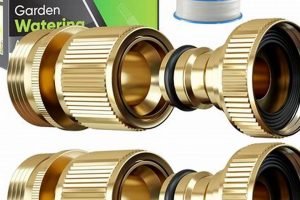
Tip 6: Consider Brass Fittings: For increased durability and resistance to corrosion, particularly when using hard water, opt for fittings made of brass. Brass offers superior longevity compared to plastic alternatives.
By adhering to these guidelines, users can extend the lifespan of their watering equipment and ensure a reliable and leak-free watering system.
The next section will delve into troubleshooting common issues encountered with these connections, such as leaks and difficult connections, providing practical solutions for resolution.
1. 3/4 inch GHT

The designation “3/4 inch GHT” serves as the defining characteristic of what is commonly recognized as the typical garden hose fitting dimension. The acronym “GHT” stands for Garden Hose Thread, specifying not just the diameter but also the thread form, pitch, and other dimensional characteristics crucial for interoperability. This specification ensures that hoses, sprinklers, nozzles, and related accessories can be readily connected across various manufacturers and product lines. Without this dimensional agreement, a multitude of incompatible connection types would proliferate, significantly increasing complexity and cost for consumers. For instance, a homeowner replacing a spray nozzle would need to ensure both the new nozzle and the existing hose utilize the identical connection type, a task greatly simplified by the ubiquitous adoption of the 3/4 inch GHT standard.
The widespread use of the 3/4 inch GHT specification has practical ramifications beyond simple compatibility. Manufacturers can leverage economies of scale by producing fittings and accessories to a single, widely accepted standard. This translates to lower production costs, which can then be passed on to consumers in the form of lower prices. Furthermore, the prevalence of this dimensional characteristic fosters a competitive market, encouraging innovation and product development within a standardized framework. Emergency situations, such as the need to quickly connect multiple hoses to combat a fire in a garden or small area, benefit directly from this standardization, as any hose employing the dimensional characteristic can be reliably connected to any spigot or accessory also adhering to this dimensional specification.
In conclusion, the “3/4 inch GHT” is fundamentally synonymous with what is understood as the common garden hose fitting dimension. Its adoption facilitates interchangeability, reduces costs, and enables rapid deployment in critical situations. While alternative connection methods exist, the “3/4 inch GHT” remains the de facto standard, providing a foundation for the garden hose industry. Challenges remain in preventing the introduction of non-standard fittings, particularly from overseas manufacturers, and educating consumers about the importance of adhering to this established dimensional characteristic.
2. Male and Female

The terms “male” and “female” describe the reciprocal connection types necessary for creating a functional joint within a standard watering system. These designations are not merely descriptive labels; they represent essential, dimensionally-defined features integral to the integrity of the connection and the overall performance of the system.
- Interlocking Functionality
The male component, characterized by its external threads, inserts into the female component, which features internal threads. This interlocking design allows for the creation of a secure mechanical bond, preventing separation under pressure. A common example is the connection between a hose and a spigot, where the spigot typically presents a male thread and the hose end contains a female thread to receive it. Misalignment or damage to either thread can compromise the seal, leading to leaks and reduced water pressure.
- Standard Thread Dimensions
While the terms “male” and “female” describe the physical arrangement, the success of the connection hinges on adherence to the 3/4 inch Garden Hose Thread (GHT) standard. This standardization ensures that a male fitting from one manufacturer will reliably engage with a female fitting from another manufacturer. Deviation from these specified thread dimensions can lead to incompatibility, requiring specialized adapters or rendering the connection unusable. The GHT standard dictates not only
the diameter but also the thread pitch (threads per inch) and thread angle, all of which must be consistent for a proper fit. - Washer and Seal Integrity
The female component typically incorporates a washer seat, a recessed area designed to accommodate a rubber or silicone washer. When the male and female fittings are tightened, the washer is compressed, creating a watertight seal. The absence of a washer, or the use of an incorrect size or type of washer, is a frequent cause of leaks. The washer must conform to the dimensions of the washer seat to provide adequate sealing pressure, which directly relates to maintaining pressure within the watering system.
- Material Compatibility and Longevity
The material composition of the male and female components, whether brass, plastic, or a composite, influences the durability and longevity of the connection. Brass fittings offer superior resistance to corrosion, particularly in hard water environments, while plastic fittings are often more cost-effective but may be more susceptible to damage from UV exposure or physical stress. The material choice impacts the lifespan of both the male and female components and, consequently, the reliability of the overall connection.
In essence, the male and female configuration within a standard garden hose fitting represents a carefully engineered interface, governed by dimensional standards and material properties, to ensure a secure and leak-free connection. Understanding the interplay between these elements is crucial for proper assembly, maintenance, and troubleshooting of watering systems.
3. Thread Pitch

Thread pitch, as it relates to the dimensional specification for watering implements, refers to the distance between threads, typically measured in threads per inch (TPI). For the common 3/4 inch Garden Hose Thread (GHT), adherence to a specific thread pitch is crucial for compatibility and secure connection. An incorrect thread pitch, even within the same diameter, will prevent the male and female components from properly engaging, resulting in a loose or non-existent seal. Consider, for instance, attempting to connect a standard hose to a faucet with a pipe thread. Although the diameter may appear similar, the differing thread pitch will preclude a successful connection, highlighting the critical role of this parameter in ensuring proper functionality. Therefore, the importance of correct thread pitch is that ensures reliable connections and avoids water leaks.
The selection of materials for these components is directly influenced by the standardized thread pitch. Manufacturers can optimize designs and manufacturing processes knowing that a specific thread form and TPI must be consistently produced. For example, molds for plastic fittings are engineered to precisely replicate the GHT thread pitch, ensuring that the resulting parts will seamlessly integrate with other compliant components. Quality control procedures also focus heavily on verifying thread pitch accuracy, employing gauges and other measurement tools to identify and reject parts that deviate from the specification. Proper thread pitch also distributes the stress evenly across all the threads of the fitting when tightened. This reduces the risk of stripping or damaging the threads, which can lead to leaks and reduce the lifespan of the hose.
In summary, thread pitch is an indispensable element of the dimensional specification for watering equipment. Its accurate replication and adherence to the GHT standard is a prerequisite for achieving secure, leak-free connections. Challenges remain in combating the influx of non-compliant fittings, underscoring the need for continued education and rigorous quality control measures to maintain the integrity of the 3/4 inch GHT standard. This understanding is further essential in maintaining optimal watering systems.
4. Washer Seat
The washer seat is an integral component of the female portion of a standard garden hose connection, contributing directly to the system’s ability to maintain a leak-free seal. Its design and dimensions are specifically engineered to accommodate a sealing washer, typically made of rubber or silicone, within the 3/4 inch Garden Hose Thread (GHT) dimensional standard.
- Dimensional Conformance
The washer seat’s diameter and depth are precisely calibrated to the GHT standard. This ensures that washers of the appropriate size will fit snugly within the recess, allowing for adequate compression when the male fitting is tightened. Deviations from these dimensional parameters can lead to an ineffective seal, resulting in leaks and reduced water pressure. For instance, an undersized seat may not properly retain the washer, while an oversized seat may prevent sufficient compression. Dimensional compliance is therefore paramount.
- Material Compatibility
The material composition of the washer seat itself, often plastic or metal, must be compatible with both the sealing washer and the fluid being conveyed. Incompatibility can lead to degradation of the washer seat material, compromising its ability to properly support the sealing washer. For example, certain chemical additives in fertilizers or pesticides can corrode plastic washer seats over time, necessitating replacement. Brass washer seats, while more durable, may be subject to galvanic corrosion when in contact with dissimilar metals in certain water conditions.
- Surface Finish and Integrity
The surface finish of the washer seat must be smooth and free from imperfections to ensure a uniform sealing surface. Rough surfaces, scratches, or molding flaws can create pathways for water to escape, even with a properly sized and installed washer. Visual inspection of the washer seat for any surface irregularities is a critical step in preventing leaks. Furthermore, the washer seat must be structurally sound to withstand the compressive forces exerted during tightening, preventing deformation or cracking that could compromise the seal.
- Washer Retention Features
Some washer seat designs incorporate features to aid in retaining the washer during installation and removal of the hose. These features may include small ridges or lips around the perimeter of the seat, which prevent the washer from easily falling out. Such retention mechanisms can simplify the connection process and reduce the likelihood of washer damage or loss. The presence and effectiveness of these retention features contribute directly to the ease of use and reliability of the watering system.
In conclusion, the washer seat is not merely a passive recess but an actively engineered component within the standard garden hose connection. Its dimensional accuracy, material compatibility, surface finish, and retention features all contribute to the effectiveness of the seal and the overall performance of the watering system, reinforcing the importance of adhering to the specified dimensions and material guidelines for optimal functionality.
5. Material Type

The selection of material for a component conforming to the standard garden hose fitting dimensions directly impacts its durability, longevity, and ov
erall suitability for various environmental conditions. While the 3/4 inch Garden Hose Thread (GHT) defines the physical dimensions, the chosen material dictates the fitting’s resistance to factors such as corrosion, UV exposure, and mechanical stress. For instance, a fitting manufactured from low-grade plastic may be cost-effective initially, but is more susceptible to cracking or degradation upon prolonged exposure to sunlight, ultimately leading to leaks and premature failure. Conversely, a fitting crafted from brass, while typically more expensive, offers superior resistance to corrosion and mechanical damage, resulting in a longer lifespan and greater reliability. Therefore, the type of material directly influences its reliability.
Furthermore, the material composition influences the fitting’s performance under varying water pressures and temperatures. Plastic fittings, depending on the specific type of plastic used, may become brittle at low temperatures or deform under high pressure, compromising the seal and potentially causing the fitting to burst. Brass fittings, due to their greater strength and thermal stability, are generally better suited for applications involving higher pressures or temperatures. The presence of specific chemicals or minerals in the water supply can also affect the material’s performance. For example, hard water with high mineral content can accelerate corrosion in certain metal alloys, while acidic water can degrade some types of plastic. Therefore, you have to consider the environment to use the products.
In conclusion, the material type represents a critical, yet often overlooked, aspect of the standard garden hose fitting. While the 3/4 inch GHT ensures dimensional compatibility, the material dictates the fitting’s ability to withstand environmental stressors and maintain a reliable seal over time. Understanding the properties of different materials, and selecting the appropriate material based on the specific application and environmental conditions, is essential for maximizing the lifespan and performance of any watering system. It also prevent from water leaks, damages etc.
6. Inner Diameter

The inner diameter (ID) of a standard garden hose fitting is critically linked to its overall performance and compatibility within a watering system. Although the 3/4 inch Garden Hose Thread (GHT) primarily defines the outer dimensions and thread specifications for connection, the ID directly impacts water flow rate and pressure. A reduced ID, even with correct thread dimensions, will restrict flow, potentially rendering the system ineffective for applications requiring substantial water delivery, such as large sprinklers or rapid filling of containers. The relationship is causal: a smaller ID directly results in reduced flow, and vice-versa. The significance lies in optimized system performance; neglecting the ID creates a bottleneck irrespective of external fitting dimensions.
In practical terms, consider two hoses utilizing standard 3/4 inch GHT fittings but differing in ID. The hose with a larger ID will deliver a higher volume of water at a given pressure compared to the hose with a smaller ID. This difference is noticeable in irrigation scenarios where consistent water pressure is vital for uniform plant hydration. Furthermore, the ID affects the efficiency of the water supply; a significantly constricted ID necessitates higher pump pressures to achieve the same flow rate, increasing energy consumption. Selecting hoses and fittings with appropriately sized IDs, consistent with the desired water flow requirements, is crucial for minimizing energy waste and maximizing system efficiency.
In conclusion, the inner diameter, while not explicitly part of the dimensional characteristic, is inextricably linked to the functional performance of said characteristics. Its size directly influences water flow rate and pressure, impacting overall system efficiency and effectiveness. Recognizing this connection, and selecting components with appropriate IDs for the intended application, is crucial for achieving optimal results in watering systems. Future materials should explore the variance between nominal ID and actual measured ID within commercially available fittings, and its implications on flow rates.
7. Outer Diameter
Outer diameter (OD) plays a pivotal role in defining the physical size and compatibility of connections, despite the 3/4 inch Garden Hose Thread (GHT) primarily focusing on thread characteristics. The OD influences the mechanical strength of the fitting, its ability to withstand external forces, and the overall footprint of the connection. A properly dimensioned OD ensures that the fitting integrates seamlessly with related components, such as hose clamps or threaded adaptors. An undersized OD may result in a weak connection, prone to slippage or leakage, while an oversized OD may interfere with adjacent parts or prevent proper tightening. The OD, therefore, is a critical, though often implicit, parameter of the GHT standard. It affects the strength and durability of the connection.
For example, consider the attachment of a hose to a spigot using a threaded fitting and a hose clamp. If the OD of the fitting is significantly smaller than the inner diameter of the hose, the clamp will be unable to exert sufficient pressure to create a watertight seal. Conversely, if the OD is excessively large, the clamp may be difficult to install or may damage the hose. Manufacturers must carefully control the OD during the manufacturing process to ensure consistent performance and compatibility. Variations in OD can arise from factors such as material shrinkage during molding or machining tolerances. Rigorous quality control measures are essential to minimize these variations and maintain adherence to the GHT standard. Failure can results in broken products.
In summary, while the thread characteristics receive primary emphasis in the Garden Hose Thread specification, the outer diameter constitutes an equally essential, albeit less explicitly defined, parameter. It directly influences the mechanical strength, compatibility with ancillary components, and overall reliability of the connection. Careful consideration of the OD is crucial for both manufacturers and end-users to ensure proper functioning and long-term durability of watering systems. Therefore, attention to the outer diameter is essential for creating successful connections.
Frequently Asked Questions
This section addresses common inquiries regarding the dimensional specification for interconnecting watering system components. The following questions and answers aim to clarify key aspects and resolve potential ambiguities.
Question 1: What does “3/4 inch Garden Hose Thread” (GHT) signify?
The designation “3/4 inch GHT” refers to a standardized set of dimensions for threads used on garden hoses and related accessories. It specifies the thread diameter, pitch, and form, ensuring interchangeability among various brands and product types. This standard is essential for creating secure, leak-free connections.
Question 2: Are there alternative fitting sizes commonly used for garden hoses?
While the 3/4 inch GHT is the prevailing standard, other sizes exist, particularly in industrial or specialized applications. However, these alternative sizes are not typically found in residential settings, and attempting to connect them to standard garden hoses will likely require adaptors.
Employing non-standard fittings can lead to leaks, reduced water pressure, and potential damage to equipment. Incompatibility between threads may prevent a secure connection, resulting in water wastage and inefficient operation of the watering system.
Question 4: What materials are commonly used in the manufacture of Garden Hose Thread fittings?
Garden Hose Thread fittings are typically constructed from brass, plastic, or composite materials. Brass offers superior durability and corrosion resistance, while plastic is more cost-effective. The choice of material depends on the intended application and environmental conditions.
Question 5: How can one ensure a proper seal when connecting components with standard Garden Hose Thread?
A proper seal is achieved by ensuring that the threads are clean and undamaged, a washer is correctly positioned within the female fitting, and the connection is tightened sufficiently to compress the washer without overtightening, which can damage the threads.
Question 6: Where can fittings adhering to the standard be purchased?
Fittings conforming to the standard are widely available at hardware stores, home improvement centers, and online retailers. It is advisable to verify that the product description explicitly states compliance with the 3/4 inch GHT standard to ensure compatibility.
The correct adherence to dimensional characteristics promotes ease of use and longevity for all watering systems.
The subsequent article will delve into troubleshooting issues of said characteristics, which include leaks and damages and how to resolve it.
Conclusion
The preceding analysis has underscored the critical role of dimensional characteristics in ensuring the reliable operation of watering systems. From thread pitch to outer diameter, each parameter contributes to the integrity of the connection and overall system performance. Consistent adherence to the 3/4 inch Garden Hose Thread specification remains essential for achieving interchangeability and leak-free operation.
Moving forward, continued vigilance in maintaining standards is crucial. The proliferation of non-compliant components threatens the foundational interoperability that benefits both consumers and manufacturers. Therefore, diligent product selection and rigorous quality control measures are paramount in preserving the efficacy of watering systems.
![Best 2 Inch Garden Hose For [X] & Reviews | The Ultimate Gardening Guide: Grow a Thriving Garden Year-Round](https://MyGardenPatch.com/wp-content/uploads/2025/07/th-5631-300x200.jpg "Best 2 Inch Garden Hose For [X] & Reviews The Ultimate Gardening Guide: Grow a Thriving Garden Year-Round")