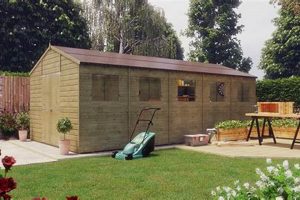
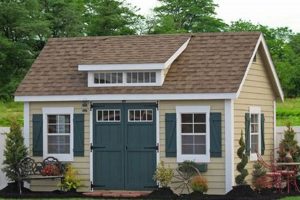
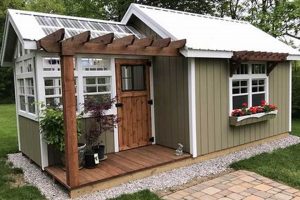
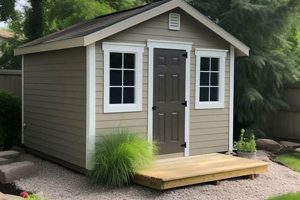
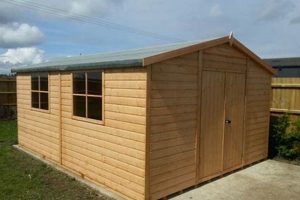
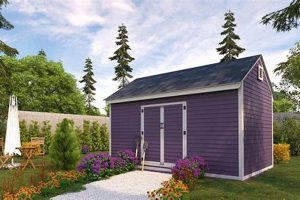
Illumination systems for outdoor storage structures, energized by photovoltaic technology, represent a category of lighting solutions designed for sheds and similar constructions. These systems utilize solar panels to capture sunlight, convert it into electricity, and store it in batteries for subsequent use in powering light fixtures within the structure. An example would be a small shed used for storing gardening tools, equipped with an overhead LED fixture powered by a solar panel mounted on the roof.
The adoption of these systems presents several advantages, including energy independence, reduced electricity bills, and minimal environmental impact. Historically, sheds and outbuildings were often relegated to the periphery of properties, lacking convenient access to the main electrical grid. This necessitated the use of extension cords or reliance on potentially dangerous open-flame sources for illumination. These lighting systems, however, offer a safer and more sustainable alternative, promoting accessibility and usability of these structures after dark.
The subsequent sections will delve into the technical specifications, installation considerations, maintenance requirements, and various applications of this technology, providing a comprehensive overview for potential users and those seeking to understand its functionality and benefits.
Optimizing Solar-Powered Illumination for Garden Sheds
The following recommendations are intended to maximize the efficiency and longevity of photovoltaic lighting systems installed within garden sheds and similar outbuildings.
Tip 1: Solar Panel Placement: Prioritize a location for the solar panel that receives unobstructed sunlight for the majority of the day. Southern exposure is generally optimal in the Northern Hemisphere. Trim any overhanging tree branches that may cast shadows on the panel surface.
Tip 2: Battery Selection: Choose batteries specifically designed for solar applications. Lithium-ion or deep-cycle lead-acid batteries offer superior performance and lifespan compared to standard batteries in these systems.
Tip 3: Light Fixture Efficiency: Employ LED light fixtures with low power consumption. LEDs provide ample illumination while minimizing the drain on the battery, extending the operational time between charges.
Tip 4: Wiring and Connections: Ensure all wiring and connections are weatherproof and properly insulated. This prevents short circuits, corrosion, and potential safety hazards, especially in damp or humid environments.
Tip 5: Regular Cleaning: Periodically clean the solar panel surface with a soft cloth and water. Accumulated dust, dirt, and debris can significantly reduce the panel’s ability to absorb sunlight.
Tip 6: Battery Maintenance: Check battery terminals for corrosion and clean them as needed. If using lead-acid batteries, periodically check and replenish the electrolyte levels according to the manufacturer’s instructions.
Tip 7: System Monitoring: Monitor the system’s performance regularly. Observe the charge level of the battery and the brightness of the lights. Diminished performance may indicate a problem with the solar panel, battery, or wiring.
Consistent adherence to these recommendations will contribute to a reliable and efficient lighting system, reducing the need for grid-based electricity and promoting a sustainable approach to outdoor illumination.
The next section will address common troubleshooting issues and provide solutions for maintaining optimal system functionality.
1. Photovoltaic Panel Efficiency

Photovoltaic panel efficiency is a critical determinant of the overall performance and practicality of solar-powered lighting systems for garden sheds. It dictates the rate at which solar energy is converted into usable electricity, directly impacting the system’s ability to charge batteries and provide illumination.
- Conversion Rate and System Sizing
A higher conversion rate allows for the use of smaller photovoltaic panels to generate the same amount of power compared to less efficient panels. This is particularly relevant in space-constrained garden shed applications where roof area may be limited. The size of the panel required directly impacts the initial cost and ease of installation.
- Impact on Battery Charging Time
More efficient panels charge batteries faster under identical sunlight conditions. This is crucial for ensuring adequate power storage, especially during periods of reduced sunlight, such as winter months or on cloudy days. Faster charging minimizes the risk of battery depletion and ensures reliable nighttime illumination.
- Performance Under Low-Light Conditions
Some photovoltaic panels exhibit superior performance under low-light conditions. This is a significant factor for garden sheds located in areas with frequent overcast skies or partial shading. Selecting panels optimized for low-light performance ensures consistent energy generation even when direct sunlight is limited.
- Long-Term Energy Yield
Panel efficiency degrades over time. High-quality, efficient panels typically exhibit slower degradation rates, maintaining a higher percentage of their initial output capacity over their lifespan. This results in a greater overall energy yield and reduces the need for premature panel replacement, contributing to the long-term cost-effectiveness of the lighting system.
The selection of photovoltaic panels with appropriate efficiency characteristics is paramount for ensuring the reliable and sustainable operation of lighting solutions for garden sheds. Considering factors such as available space, local climate, and long-term performance is essential for optimizing system design and maximizing the return on investment.
2. Battery Storage Capacity

Battery storage capacity represents a critical parameter within solar-powered lighting systems for garden sheds. It directly dictates the amount of electrical energy that can be stored for subsequent use, influencing the duration and reliability of illumination, particularly during periods of limited sunlight. Insufficient storage capacity results in diminished lighting runtime, while excessive capacity increases system cost and physical footprint without necessarily yielding proportional benefits.
The selection of an appropriate battery storage capacity necessitates consideration of several factors. These include the energy consumption of the lighting fixtures, the average daily sunlight availability at the installation location, and the desired autonomythe number of consecutive days the system should operate without solar input. For example, a garden shed located in a region with frequent cloud cover, utilizing high-intensity LED lighting, requires a larger battery bank than a shed in a sunny area with low-wattage lamps. Overestimating capacity increases initial cost, while underestimating results in premature battery depletion and reduced light output. Real-world applications demonstrate that accurately assessing energy demands and solar irradiance patterns is paramount for achieving optimal system performance.
Ultimately, battery storage capacity serves as the bridge between energy generation and energy consumption within solar-powered shed lighting. Proper sizing is vital for ensuring a balance between system cost, operational performance, and long-term reliability. Ignoring this critical component can lead to dissatisfaction and inefficiency, highlighting the importance of informed decision-making during system design and implementation.
3. LED Luminaire Output

Light Emitting Diode (LED) luminaire output is a crucial parameter in determining the effectiveness of photovoltaic-powered lighting systems intended for garden sheds. The measured light output, typically in lumens, directly affects the usability of the shed space after dark. Low output necessitates supplemental light sources or restricts activities within the shed to daylight hours only. High-output luminaires, while providing ample illumination, demand greater energy consumption, impacting the overall system efficiency and requiring larger photovoltaic panels or batteries. Therefore, matching the luminaire output to the specific needs of the shed’s intended use is paramount. For example, a shed used primarily for storage might require only minimal illumination for locating items, whereas a shed used as a workshop would demand significantly higher output for detailed tasks.
The selection of LED luminaires within a solar-powered system also necessitates considering their energy efficiency, typically expressed as lumens per watt. Higher efficiency luminaires deliver more light for a given power consumption, maximizing the runtime available from the battery. This is especially critical in off-grid applications where power is a limited resource. In comparing two luminaires providing the same light output, the more efficient model will reduce the photovoltaic panel and battery capacity requirements, leading to lower system costs and a smaller environmental footprint. The efficacy of LED lighting has significantly improved compared to incandescent or fluorescent options, making them the logical choice for sustainable, off-grid lighting solutions.
In summary, LED luminaire output plays a vital role in balancing illumination needs with energy efficiency in solar-powered garden shed lighting. Careful consideration of both the required light levels and the energy efficiency of the chosen luminaires is essential for optimizing system performance, minimizing costs, and ensuring a reliable and sustainable lighting solution. Ignoring these factors results in either inadequate lighting or an unnecessarily expensive and inefficient system.
4. Weatherproof Component Rating

The weatherproof component rating is a critical specification for all elements incorporated into photovoltaic-powered lighting systems destined for garden shed applications. It directly relates to the system’s durability, reliability, and longevity when exposed to the variable environmental conditions typically encountered in outdoor settings.
- Ingress Protection (IP) Codes
IP codes define the level of protection provided by enclosures against the intrusion of solid objects (e.g., dust) and liquids (e.g., water). An IP65 rating, commonly seen on lighting components, signifies protection against dust ingress and water jets from any direction. Using components with inadequate IP ratings risks premature failure due to moisture or dust contamination, rendering the system inoperable. For example, a control box with an insufficient IP rating installed on the exterior of a shed is likely to suffer corrosion and electrical failure within a short period.
- UV Resistance
Prolonged exposure to ultraviolet (UV) radiation from sunlight can degrade the materials used in photovoltaic panels, wiring insulation, and plastic enclosures. Components lacking UV resistance may become brittle, discolored, or cracked, compromising their structural integrity and electrical safety. Selecting materials specifically formulated for UV resistance extends the lifespan of the entire system. The outer casing of a solar panel, if not UV resistant, can delaminate over time, reducing its power output and increasing the risk of water ingress.
- Temperature Tolerance
Garden sheds often experience significant temperature fluctuations, ranging from freezing conditions in winter to extreme heat in summer. Components must be capable of operating reliably within this temperature range without performance degradation or physical damage. Battery performance, in particular, is highly temperature-sensitive. Utilizing batteries not rated for extreme temperatures can lead to reduced capacity and shortened lifespan. For instance, a lithium-ion battery subjected to freezing temperatures may experience irreversible damage, significantly diminishing its energy storage capabilities.
- Corrosion Resistance
Outdoor environments expose metal components to moisture, humidity, and potential corrosive agents such as salt spray or acidic rainwater. Using corrosion-resistant materials, such as stainless steel or anodized aluminum, is essential for preventing rust and maintaining electrical conductivity. Terminals and connectors lacking corrosion protection are prone to oxidation, leading to increased resistance and potential failure. Over time, unprotected terminals in a damp environment can corrode to the point of complete electrical discontinuity.
These facets of weatherproof component rating are inextricably linked to the long-term viability of photovoltaic-powered lighting for garden sheds. Careful attention to these specifications during system design and component selection minimizes the risk of failure and ensures a reliable, sustainable lighting solution. Ignoring these factors results in reduced lifespan, increased maintenance costs, and potential safety hazards.
5. Installation Site Selection

Installation site selection significantly impacts the efficiency and effectiveness of solar-powered lighting systems for garden sheds. Proper site selection maximizes solar energy capture, optimizing battery charging and ensuring reliable illumination. Suboptimal placement diminishes system performance, potentially rendering it ineffective.
- Solar Irradiance Exposure
The primary criterion for site selection is maximizing exposure to direct solar irradiance. Locations with unobstructed sunlight for the majority of the day are ideal. South-facing orientations (in the Northern Hemisphere) typically receive the greatest solar exposure. Conversely, sites shaded by trees, buildings, or other obstructions reduce irradiance levels, diminishing photovoltaic panel output. A panel receiving only partial sunlight throughout the day will exhibit significantly reduced energy generation, potentially insufficient for powering the lighting system. The inverse square law dictates that even small reductions in distance from obstructions cause significantly greater losses in irradiance.
- Panel Angle and Tilt
The angle and tilt of the photovoltaic panel relative to the sun’s path significantly impact energy capture. The optimal angle varies based on latitude and season. Generally, steeper angles are preferable during winter months when the sun is lower in the sky, while shallower angles are more effective during summer. Adjustable mounting brackets allow for optimizing panel tilt throughout the year to maximize energy generation. A fixed panel angle that is not properly optimized for the locations latitude will exhibit reduced energy generation throughout the year.
- Environmental Obstructions
Assess the site for potential environmental obstructions that may impact solar irradiance. Deciduous trees, while providing shade during summer, shed their leaves in winter, potentially increasing solar exposure during periods of lower sunlight. However, evergreen trees provide year-round shading. The presence of reflective surfaces, such as light-colored walls or roofs, can augment solar irradiance, increasing panel output. Consider the impact of snow accumulation on panel performance during winter. Snow cover can significantly reduce or completely block sunlight from reaching the panel surface. Regular snow removal may be necessary in areas with heavy snowfall.
- Proximity to Load and System Components
While maximizing solar exposure is paramount, proximity to the garden shed and system components also requires consideration. Minimize the distance between the photovoltaic panel and the battery/charge controller to reduce voltage drop and transmission losses. Shorter cable runs enhance system efficiency and minimize the risk of electrical hazards. Mounting the panel directly on the shed roof may simplify wiring but potentially compromise solar exposure if the roof is shaded. Remote panel mounting requires careful consideration of cable routing and weatherproofing. The location of the battery and charge controller should be protected from extreme temperatures and moisture.
These facets underscore the importance of a comprehensive site assessment prior to installation. Optimizing solar irradiance, panel angle, and proximity to system components ensures reliable and efficient operation of solar-powered lighting systems for garden sheds. Neglecting these considerations can significantly reduce system performance and lifespan.
Frequently Asked Questions
This section addresses common inquiries regarding the installation and operation of photovoltaic lighting systems designed for use in garden sheds, providing factual answers to facilitate informed decision-making.
Question 1: What factors determine the optimal photovoltaic panel size for a garden shed lighting system?
The required photovoltaic panel size is contingent upon the electrical load of the lighting fixtures, the average daily sunlight hours at the location, and the desired autonomy (days of operation without sunlight). A detailed energy audit and solar irradiance assessment are necessary to accurately determine the appropriate panel size.
Question 2: How frequently do the batteries in a solar-powered garden shed lighting system require replacement?
Battery lifespan depends on battery type, depth of discharge, operating temperature, and maintenance practices. High-quality deep-cycle batteries, properly maintained, can last five to seven years. However, improper use or extreme temperature exposure can significantly reduce battery lifespan.
Question 3: Can photovoltaic-powered lighting systems for garden sheds operate effectively during winter months?
System performance may be reduced during winter months due to shorter days and lower solar irradiance. Over-sizing the photovoltaic panel and battery storage capacity can compensate for reduced winter sunlight. Regular snow removal from the panel surface is also essential.
Question 4: What safety precautions are necessary during the installation of a solar-powered garden shed lighting system?
Safety precautions include disconnecting the power source before working on electrical components, using properly insulated tools, adhering to local electrical codes, and ensuring proper grounding of the system. Professional installation is recommended if unfamiliar with electrical wiring.
Question 5: Are photovoltaic panels susceptible to damage from hail or other weather-related events?
Photovoltaic panels are typically designed to withstand moderate hail and weather conditions. However, extreme events, such as large hailstorms, can cause damage. Selecting panels with high impact resistance and considering protective measures, such as panel covers, can mitigate the risk of damage.
Question 6: Does the orientation of a garden shed impact the effectiveness of a photovoltaic lighting system?
Shed orientation significantly impacts solar energy capture. South-facing orientations (in the Northern Hemisphere) generally provide the greatest solar exposure. However, shading from trees or nearby structures can negate the benefits of optimal orientation. A site assessment should evaluate the potential for shading before determining panel placement.
In summary, the effective implementation of this technology requires careful planning, component selection, and adherence to safety guidelines. Understanding these factors is essential for achieving a reliable and sustainable lighting solution.
The following section will delve into specific case studies illustrating successful applications.
Conclusion
This exposition has addressed critical aspects of lighting systems for garden sheds energized by photovoltaic conversion. It explored panel efficiency, battery storage, luminaire output, environmental protection ratings, and optimal installation practices. Effective deployment hinges on a comprehensive understanding of each element and their interdependencies.
The presented information serves as a foundation for informed decisions regarding sustainable illumination solutions for outdoor structures. Continued innovation in photovoltaic technology and energy storage holds the potential to further enhance efficiency and reduce the environmental impact of these lighting systems, representing a vital step toward broader adoption of off-grid power solutions.