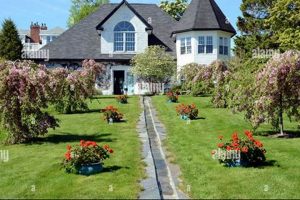
A compact outdoor space featuring woody perennial plants is the subject of this discussion. These areas, often found in residential settings, integrate botanical specimens of significant size into a limited footprint. Such a configuration requires careful planning and execution to ensure the health and aesthetic appeal of the flora and the usability of the area.
Integrating these arboreal elements into a smaller land area offers several advantages. It can enhance property value, provide shade and temperature regulation, improve air quality, and create a habitat for wildlife. Historically, similar designs have been seen in various cultures, reflecting humanity’s enduring connection to nature and a desire to incorporate natural elements into living spaces, regardless of size limitations.
This exploration will delve into the practical considerations for designing and maintaining such a space. Topics covered will include appropriate species selection, spatial arrangement, soil management techniques, pruning strategies, and integrated pest management. The aim is to provide guidance for creating a functional and visually pleasing environment that balances horticultural needs with spatial constraints.
Cultivating Harmony
Creating a flourishing environment within spatial constraints requires strategic planning and diligent execution. These guidelines outline essential practices for maximizing the potential of restricted botanical areas featuring woody perennials.
Tip 1: Prioritize Species Selection: Thoroughly research the mature size, growth rate, and environmental needs of any potential tree or shrub species. Select cultivars known for compact growth habits and suitability to the local climate and soil conditions. Dwarf varieties are often optimal.
Tip 2: Implement Vertical Stratification: Utilize the concept of vertical gardening to maximize usable space. Employ climbing plants, espalier techniques, or wall-mounted structures to integrate additional greenery without expanding the ground footprint.
Tip 3: Optimize Soil Health: Conduct a comprehensive soil analysis to determine nutrient deficiencies and pH imbalances. Amend the soil with organic matter, such as compost or aged manure, to improve drainage, aeration, and nutrient retention. Consider raised beds or container gardening to control soil composition.
Tip 4: Employ Strategic Pruning Techniques: Regular pruning is essential to maintain the desired shape, size, and health of trees and shrubs. Practice proper pruning techniques to remove dead, damaged, or crossing branches, and to encourage air circulation and light penetration throughout the canopy.
Tip 5: Control Invasive Root Systems: Some tree species possess aggressive root systems that can damage nearby structures or outcompete other plants for resources. Install root barriers or select non-invasive varieties to mitigate these risks.
Tip 6: Manage Light Exposure: Assess the amount of sunlight received by different areas within the space. Select plant species that are appropriate for the prevailing light conditions, whether full sun, partial shade, or full shade. Consider the shade cast by existing structures and adjust planting locations accordingly.
Tip 7: Integrated Pest Management: Implement an integrated pest management (IPM) strategy to minimize the use of chemical pesticides. Monitor plants regularly for signs of pests or diseases, and employ preventative measures such as beneficial insects, organic sprays, or hand-picking.
Adhering to these principles can transform a limited area into a thriving botanical haven. Careful planning, diligent maintenance, and a commitment to sustainable practices are key to achieving long-term success.
The next section will address common challenges and potential solutions encountered when cultivating such spaces.
1. Dwarf tree selection

Dwarf tree selection is a cornerstone of successful botanical design when space is limited. The deliberate choice of tree species and cultivars specifically bred for their reduced size directly influences the overall aesthetic, functionality, and ecological balance of these confined environments.
- Scale and Proportion Management
Dwarf varieties maintain proportionate dimensions within a restricted footprint, preventing the dwarfing of other plants and avoiding overwhelming the space. Examples include dwarf Japanese Maples (Acer palmatum ‘Atropurpureum Nana’) and weeping cherries (Prunus x ‘Kiku-shidare-zakura’), whose smaller stature complements the scale of a compact setting, enhancing visual harmony and balance. This approach ensures the arboreal element enhances rather than dominates the landscape.
- Resource Optimization
Smaller tree size translates to reduced resource demands. Dwarf trees typically require less water, nutrients, and pruning compared to their standard-sized counterparts. This facilitates easier maintenance, reduces the risk of nutrient competition with other plantings, and minimizes the environmental impact of horticultural practices. Examples include dwarf fruit trees that produce harvests suitable for smaller households without requiring extensive care or large amounts of space.
- Microclimate Modification
Even in reduced size, arboreal specimens influence microclimates. Dwarf trees still provide shade, reduce wind velocity, and contribute to humidity levels. Strategic placement can create sheltered areas for more delicate plants, reduce energy consumption by shading structures, and enhance the overall biodiversity within the small botanical area. For example, a dwarf evergreen can buffer against winter winds, protecting other plants from cold damage.
- Disease and Pest Resistance
Certain dwarf cultivars are specifically bred for enhanced resistance to common diseases and pests. This reduces the need for chemical interventions, promotes plant health, and contributes to a more sustainable botanical design. Examples include disease-resistant crabapples or pear trees, providing aesthetic benefits without the high maintenance associated with less resistant varieties.
The selection of dwarf trees, therefore, is not merely an aesthetic choice but a functional imperative. By carefully considering the scale, resource needs, microclimate influence, and disease resistance of dwarf varieties, botanical designers can create sustainable, visually appealing, and ecologically balanced spaces. Furthermore, these choices address the challenges inherent in limited-area arboreal gardens, fostering a harmonious relationship between flora and environment.
2. Root system management

Effective root system management is critical in compact botanical environments featuring arboreal elements. The restricted space necessitat
es careful consideration of root growth patterns to prevent structural damage, ensure equitable resource distribution, and maintain overall landscape health. Uncontrolled root expansion can cause damage to foundations, sidewalks, and underground utilities, leading to costly repairs and potential safety hazards. Furthermore, aggressive root systems can outcompete neighboring plants for water and nutrients, ultimately stunting their growth or causing their demise. Understanding the growth habits of different tree species and implementing appropriate control measures are therefore essential for the long-term success of such a garden. For example, planting a willow tree without a root barrier in a small garden can lead to blocked drainage pipes, cracked paving stones, and dehydrated flower beds.
Several strategies exist to mitigate the potential problems associated with root growth in these confined spaces. Root barriers, constructed from durable materials such as plastic or metal, can physically redirect root growth away from vulnerable structures and sensitive plantings. Planting trees in large containers above ground or partially buried restricts root expansion to a defined volume. Regular root pruning, while requiring specialized knowledge and careful execution, can further control root growth and maintain a healthy balance between the above-ground and below-ground portions of the tree. Choosing tree species with less aggressive root systems, such as Amelanchier or Cornus florida, is another proactive approach to minimizing potential problems. The implementation of a well-drained soil profile, coupled with proper irrigation techniques, reduces the propensity for roots to seek out moisture aggressively, thereby lessening the risk of structural damage.
In conclusion, the integration of woody perennial specimens into limited botanical spaces requires a proactive and informed approach to root system management. Failure to adequately address this aspect can result in significant structural damage, ecological imbalances, and aesthetic degradation. By employing a combination of preventative measures, such as root barriers and strategic species selection, and implementing ongoing maintenance practices, such as root pruning, gardeners can create thriving arboreal environments without compromising the integrity of the surrounding infrastructure or the health of the overall landscape. A robust understanding of plant physiology and soil science is vital to achieving lasting success in this endeavor.
3. Vertical space utilization

Within the context of limited-area arboreal gardens, vertical space utilization emerges as a critical design principle. The inherent constraint of horizontal space necessitates an upward orientation in order to maximize planting area, diversify botanical elements, and enhance the overall aesthetic appeal. The correlation between vertical space implementation and the success of a small garden featuring woody plants is direct: the greater the effective use of vertical surfaces, the higher the potential for a rich and visually engaging environment. Conversely, neglect of vertical dimensions leads to a restrictive, potentially monotonous landscape. Examples of effective vertical implementation include the espaliering of fruit trees or shrubs against walls or fences, the construction of tiered planters to accommodate cascading vegetation, and the installation of trellises or pergolas for climbing vines and roses. These methods not only expand the physical planting area but also introduce varied textures, colors, and forms, enriching the overall sensory experience.
The practical significance of understanding vertical utilization extends beyond mere aesthetics. Strategically positioned vertical elements can provide functional benefits such as privacy screening, noise reduction, and microclimate modification. A densely planted green wall, for example, can act as a thermal buffer, reducing heat gain in summer and heat loss in winter. Vertical structures can also serve as support systems for vining crops, enabling the cultivation of edibles even in the absence of ground space. Moreover, the elevation of plants off the ground can improve air circulation, reduce the incidence of fungal diseases, and enhance the accessibility of tending and harvesting. Consider the example of a small urban courtyard transformed into a lush oasis through the incorporation of a living wall, dramatically increasing the planting density and creating a visually stunning focal point.
Challenges associated with vertical gardening in limited spaces include structural support considerations, irrigation management, and access for maintenance. The weight of plants and growing media, particularly when saturated with water, requires robust support systems. Efficient irrigation strategies are necessary to ensure uniform moisture distribution throughout the vertical planting, especially in elevated areas that are prone to drying out. Regular pruning and pest control become more complex when plants are located at different heights. Nevertheless, overcoming these challenges through careful planning and appropriate technology unlocks the full potential of vertical space utilization, transforming even the smallest garden into a vibrant and productive ecosystem. This approach, therefore, is not merely an aesthetic enhancement but a fundamental strategy for optimizing the resources and enjoyment derived from restricted botanical areas.
4. Sunlight exposure control

Sunlight exposure control represents a foundational element in the establishment and maintenance of a compact botanical area incorporating woody perennial species. In these spatially restricted environments, optimal plant health and aesthetic appeal depend significantly on meticulous management of solar radiation. The orientation of the site, adjacent structures, and the selection of plant species all contribute to the complex interplay between light availability and plant growth. Failure to adequately control sunlight exposure can lead to etiolation, reduced flowering, susceptibility to pests and diseases, and ultimately, plant death. For example, a small garden situated on the north side of a building, receiving minimal direct sunlight, will necessitate the selection of shade-tolerant tree and shrub species to ensure their survival and vigor. Conversely, an area with full southern exposure may experience excessive heat and desiccation, requiring the use of shade structures or drought-tolerant varieties. The practical significance of understanding these dynamics is paramount to the successful integration of arboreal elements into these compact gardens.
Strategies for effective sunlight exposure control encompass several key areas. Strategic placement of taller trees can provide shade to more delicate understory plants, creating a layered effect that maximizes biodiversity and ecological function. The use of deciduous trees allows for seasonal variation in sunlight penetration, providing shade during the hot summer months while permitting sunlight to reach the ground during the cooler winter months. Furthermore, reflective surfaces, such as light-colored walls or paving materials, can be employed to increase light levels in shaded areas. Pruning techniques can also be used to manipulate the density of the tree canopy, allowing for more or less sunlight to filter through. Consider a small urban garden where a carefully pruned Japanese maple casts dappled shade over a collection of ferns and hostas, creating a
serene and visually appealing microclimate. These examples illustrate the practical application of sunlight exposure control in optimizing the growth and health of plants in a constrained environment.
In conclusion, sunlight exposure control is not merely an optional consideration but a fundamental imperative in the design and management of compact gardens featuring trees. Challenges such as fluctuating light levels, limited space, and microclimatic variations necessitate a proactive and informed approach to optimizing solar radiation for the benefit of the plants. By carefully considering site conditions, selecting appropriate species, and implementing effective management strategies, it is possible to create a thriving and aesthetically pleasing botanical haven, even in the most spatially restricted environments. The principles of sunlight exposure control are thus inextricably linked to the broader goals of sustainable and harmonious integration of nature into urban and suburban landscapes.
5. Pruning and shaping
Pruning and shaping are indispensable horticultural practices when integrating woody perennial specimens into confined garden spaces. The restricted dimensions inherent in such settings necessitate deliberate intervention to control the size, form, and health of trees. Uncontrolled growth can rapidly lead to overcrowding, diminished sunlight penetration, and increased susceptibility to pests and diseases. Therefore, pruning and shaping are not merely aesthetic considerations but fundamental components of maintaining a balanced and thriving ecosystem within the small garden. The effects of neglecting these practices can manifest as distorted growth habits, reduced flowering or fruiting, and potential damage to surrounding structures. For example, a neglected dwarf fruit tree may outgrow its intended space, shading out smaller plants and compromising the garden’s overall aesthetic.
Strategic pruning techniques, such as crown thinning, heading cuts, and renewal pruning, play a critical role in managing the size and density of trees in limited areas. Crown thinning involves selectively removing branches to increase light penetration and air circulation, reducing the risk of fungal diseases. Heading cuts shorten branches to promote denser growth and maintain a desired shape. Renewal pruning removes older, less productive branches to encourage the growth of younger, more vigorous shoots. Espalier, a specialized shaping technique, trains trees to grow flat against a wall or fence, maximizing space utilization and creating a visually striking focal point. Consider a small urban courtyard where a carefully espaliered apple tree provides both ornamental value and a source of fresh fruit.
In conclusion, the integration of trees into confined garden spaces demands a proactive approach to pruning and shaping. These practices are essential for maintaining plant health, controlling size, enhancing aesthetic appeal, and optimizing space utilization. Challenges associated with pruning and shaping in small gardens include the need for specialized knowledge, the risk of improper cuts leading to disease or structural weakness, and the time commitment required for regular maintenance. However, these challenges can be overcome through education, careful planning, and the adoption of appropriate techniques. Ultimately, effective pruning and shaping transform the integration of woody perennials into a harmonious and sustainable element of the small garden environment.
6. Soil composition amendment

The establishment and sustained health of arboreal specimens within restricted botanical areas are intrinsically linked to soil composition. Compact environments frequently exhibit soil deficiencies, compaction, and inadequate drainage, which impede root development and nutrient uptake. Soil composition amendment, therefore, becomes a crucial intervention to mitigate these limitations and create a favorable substrate for tree growth. Neglecting soil modification in such spaces can result in stunted growth, increased vulnerability to diseases, and ultimately, plant failure. For instance, planting an acid-loving azalea into alkaline soil will result in chlorosis and eventual decline, demonstrating the critical need for tailored soil adjustments. The effectiveness of a small garden with trees hinges, to a significant extent, on the success of soil amendment strategies.
Practical application of soil composition amendment involves several key strategies. Incorporation of organic matter, such as compost or well-rotted manure, improves soil structure, water retention, and nutrient availability. Amendment with specific minerals, such as sulfur for acidifying alkaline soils or lime for raising the pH of acidic soils, addresses particular nutrient deficiencies. The implementation of proper drainage techniques, such as the installation of drainage tiles or the incorporation of coarse sand, prevents waterlogging and promotes healthy root development. Consideration must be given to the specific needs of the selected tree species, as nutrient requirements and pH tolerances vary widely. A carefully amended soil profile not only supports healthy tree growth but also enhances the overall biodiversity of the garden by creating a favorable environment for beneficial microorganisms and soil fauna.
In summary, soil composition amendment is not merely an optional practice, but a fundamental requirement for successful integration of woody perennial species into confined garden spaces. The challenges inherent in limited-area environments, such as poor drainage, nutrient deficiencies, and soil compaction, necessitate a proactive and informed approach to soil modification. By carefully analyzing soil conditions, selecting appropriate amendment materials, and implementing effective drainage techniques, gardeners can create a thriving arboreal ecosystem, even in the most spatially restricted settings. The understanding and application of soil science principles are thus essential to achieving lasting success in small garden design.
Frequently Asked Questions
The following addresses common inquiries concerning the integration of woody perennials into spatially constrained botanical settings. Accuracy and practicality guide these responses.
Question 1: What is the minimum recommended area for a botanical design incorporating a small tree?
The minimum area varies depending on the species. Dwarf varieties may thrive in spaces as small as 100 square feet, while larger cultivars necessitate considerably more space to accommodate root systems and canopy spread.
Question 2: How frequently should trees within limited-area gardens be pruned?
Pruning frequency depends on growth rate and species. Generally, annual pruning is recommended to maintain desired shape, remove dead or damaged branches, and promote air circulation.
Question 3: What type of soil is best suited for woody perennial plantings in these compact environments?
Well-draining soil rich in organic matter is optimal. Soil tests are advisable to determine specific nutrient deficiencies and pH imbalances requiring amendment.
Question 4: Are root barriers always necessary when planting trees in close proximity to structures?
While not always mandatory, root barriers are strongly recommended for species known for aggressive root sy
stems. This measure mitigates potential damage to foundations and underground utilities.
Question 5: What is the best method for providing adequate sunlight to trees when surrounded by buildings or other tall structures?
Careful species selection based on light tolerance is crucial. Strategic placement and pruning of surrounding vegetation can also maximize sunlight penetration.
Question 6: What are the most common pest and disease issues encountered in limited-area arboreal gardens, and how should they be addressed?
Aphids, spider mites, and fungal diseases are common. Integrated pest management strategies, including biological controls and judicious use of pesticides, are recommended.
Consistent adherence to these principles ensures both the health and aesthetic integrity of botanicals in a limited area.
This knowledge provides the foundation for a sustainable and visually pleasing small arboreal area.
Small Garden with Trees
This exploration has detailed the multifaceted considerations inherent in cultivating small garden with trees. From species selection and root system management to vertical space utilization and sunlight exposure control, the successful integration of woody perennials within confined spaces demands meticulous planning and diligent execution. Pruning and shaping, along with appropriate soil composition amendment, further contribute to the long-term viability and aesthetic appeal of these environments.
The principles outlined herein offer a framework for creating sustainable and visually harmonious outdoor spaces, even within the limitations of restricted areas. Continued research and innovation in horticultural practices will further refine the art and science of the small garden with trees, enhancing the possibilities for integrating nature into urban and suburban landscapes. Prudent application of these insights ensures the enduring beauty and ecological benefits of such undertakings.