



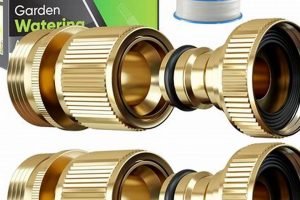
These components serve as replacements for damaged or non-functional terminations on water conduits used in horticulture and landscaping. They are designed to restore the integrity of a compromised hose, enabling continued use without requiring complete replacement. Examples include male and female threaded fittings and barbed inserts that securely attach to the hose material.
Utilizing these replacement parts offers significant cost savings compared to purchasing new hoses. They also contribute to sustainability by extending the lifespan of existing equipment and reducing waste. Historically, rudimentary methods were employed to mend damaged hoses; modern repair ends provide a more reliable and durable solution.
The following sections will delve into the various types available, installation procedures, factors to consider when selecting the appropriate style, and preventative measures to prolong the service life of these essential fixings.
Essential Usage Guidance
The following points highlight best practices to ensure optimal performance and longevity when utilizing these components.
Tip 1: Select the Correct Size. Ensure the selected component matches the inner diameter of the hose. An improperly sized part may result in leaks or failure of the connection.
Tip 2: Prepare the Hose Properly. Before installation, cut the hose cleanly and remove any debris or damaged sections. A clean, even surface ensures a secure fit.
Tip 3: Use Appropriate Clamps. When barbed fittings are used, employ stainless steel clamps designed for hose applications. Tighten the clamps adequately to prevent slippage, but avoid over-tightening, which can damage the hose.
Tip 4: Consider Material Compatibility. Choose components constructed from materials compatible with the hose material. Dissimilar materials can lead to corrosion or degradation over time.
Tip 5: Apply Thread Sealant. When threaded connections are involved, utilize Teflon tape or pipe dope to create a watertight seal. Follow the manufacturer’s instructions for application.
Tip 6: Test the Connection. After installation, test the connection under pressure to identify any leaks or weaknesses. Make necessary adjustments to ensure a secure and leak-free seal.
Tip 7: Protect from Extreme Weather. When possible, protect the repair from direct sunlight and freezing temperatures. These conditions can degrade the materials and weaken the connection.
By adhering to these guidelines, the efficacy and lifespan of the installed parts are maximized, minimizing future repairs and extending the utility of the hose.
The subsequent discussion will address common troubleshooting scenarios and advanced repair techniques.
1. Compatibility

The functionality of garden hose repair ends relies significantly on material and dimensional compatibility. Mismatched components lead to compromised seals and subsequent water loss. For instance, inserting a brass fitting into a hose designed for plastic fittings can induce galvanic corrosion, weakening the connection over time. Similarly, using a repair end with an incorrect inner diameter results in either a loose, leaking fit or a connection impossible to establish. Proper compatibility is not simply a matter of physical fit; it includes chemical and electrochemical considerations. Different polymers can react negatively, causing premature degradation of the hose or the repair end.
Consider a scenario where a homeowner attempts to repair a polyurethane hose with an aluminum fitting. While the initial connection might appear secure, the differential expansion rates of these materials under temperature fluctuations cause stress fractures and eventual failure. Another example is the use of a repair end designed for high-pressure applications on a low-pressure hose. The resulting pressure imbalance weakens the hose wall around the fitting, leading to bursting. The effectiveness of these repair components is directly proportional to the proper material and dimensional accord with the original hose material and specifications.
In summary, component harmony is vital for effective repair. Selection must go beyond superficial fit, considering the potential for material interactions, pressure ratings, and thermal expansion coefficients. Failure to account for compatibility will invariably lead to repeat repairs and ultimately negate the cost-saving benefits of employing replacement ends. This understanding is not merely theoretical; it is a practical necessity for ensuring lasting functionality and minimizing water waste.
2. Durability

The longevity of a garden hose repair depends significantly on the inherent durability of the replacement ends employed. Material selection directly influences the resistance to environmental stressors, mechanical strain, and chemical degradation. Inferior materials, such as low-grade plastics or improperly treated metals, are prone to cracking, corrosion, and weakening under normal operational conditions. These failures necessitate frequent replacements, negating the economic benefits of repair. Consider, for example, a brass fitting exposed to highly acidic soil; corrosion will compromise the integrity of the connection, resulting in leaks and potential system failure. Conversely, stainless steel or reinforced polymers offer superior resistance, extending the lifespan of the repair.
Furthermore, the method of attachment contributes to overall durability. Crimped connections, when properly executed with appropriate tools, provide a more robust and leak-resistant seal than simple hose clamps, which can loosen over time due to pressure fluctuations and temperature variations. The design of the repair end also plays a crucial role; reinforced stress points and thicker walls enhance resistance to physical damage, such as accidental impacts or crushing forces. In agricultural settings, where hoses are subjected to rough handling and exposure to fertilizers and pesticides, durable repair ends are essential for minimizing downtime and maintaining consistent water delivery.
In conclusion, durability is a paramount consideration when selecting garden hose repair ends. The initial cost savings of cheaper, less durable options are often offset by the increased frequency of replacement and the associated labor. Investing in high-quality, corrosion-resistant materials and robust connection methods ensures long-term reliability, reduced maintenance, and sustained functionality of the repaired hose, thereby maximizing resource utilization and minimizing environmental impact. The focus on enduring performance is essential for effective and sustainable garden hose maintenance.
3. Installation

Installation is a critical determinant of the efficacy of garden hose repair ends. Improper fitting negates the inherent benefits of even the highest-quality components. A poorly executed installation results in leaks, diminished water pressure, and ultimately, a failure of the repair. The connection process, whether involving threaded fittings, barbed inserts, or crimped sleeves, demands precision and adherence to established procedures. For instance, failing to adequately tighten a threaded connection allows water to escape, leading to wasted resources and potential damage to surrounding areas. Similarly, insufficient insertion of a barbed fitting results in a weak connection prone to detachment under pressure. The correct selection of tools and the application of appropriate techniques are paramount to achieving a secure and watertight seal.
Consider the scenario of a homeowner attempting to repair a burst hose without properly preparing the hose end. If the cut is uneven or frayed, the repair end cannot establish a uniform grip, resulting in a persistent leak. Another common mistake is neglecting to use thread sealant on threaded connections. This omission creates micro-channels for water to seep through, compromising the integrity of the repair. Furthermore, over-tightening connections, particularly plastic components, risks stripping the threads or cracking the fitting, rendering the repair ineffective. Adherence to manufacturer instructions and the use of appropriate tools, such as hose cutters, crimpers, and wrenches, are crucial for successful implementation. The installation phase directly dictates the long-term performance of the repair.
In summary, effective installation is indispensable for realizing the full potential of garden hose repair ends. Careless or inaccurate installation practices undermine the investment in quality components and lead to avoidable failures. A thorough understanding of proper techniques, the correct application of tools, and meticulous attention to detail are essential for achieving durable and reliable repairs. The quality of the installation process directly influences the longevity of the hose and the efficiency of water usage, underscoring its significance in sustainable gardening practices.
4. Sealing

Effective sealing constitutes a fundamental requirement for successful garden hose repair. The primary function of repair ends is to restore the hydraulic integrity of a damaged hose, and this is achieved through the creation of a watertight seal. Imperfect sealing results in leakage, diminished water pressure, and ultimately, the failure of the intended repair. The process hinges on the precise mating of the repair end with the hose material, ensuring a continuous barrier against water passage. Real-world examples include situations where improperly sized or poorly installed repair ends permit a steady drip, leading to significant water wastage over time. Understanding sealing mechanisms is therefore essential for effective hose maintenance and resource conservation.
Achieving optimal sealing often necessitates the use of supplementary materials such as Teflon tape or pipe dope on threaded connections. These compounds fill microscopic imperfections in the threads, creating a more robust barrier against leakage. Similarly, the correct application of hose clamps on barbed fittings ensures a uniform compressive force, preventing water from escaping between the hose and the repair end. The selection of appropriate materials for the repair end, compatible with the hose composition, further contributes to the effectiveness of the seal. For example, using a metal fitting on a plastic hose without proper insulation can lead to galvanic corrosion, compromising the sealing surface over time. The practicality of this understanding manifests in reduced water bills, healthier plant growth due to consistent watering, and minimized environmental impact.
In conclusion, the connection between sealing and the utilization of garden hose repair ends is direct and undeniable. Effective sealing guarantees the intended functionality of the repair, preventing water loss and ensuring efficient water delivery. Challenges arise from mismatched materials, improper installation techniques, and the failure to employ appropriate sealing compounds. The broader theme of resource conservation is directly linked to the success of these repairs, highlighting the importance of understanding and implementing proper sealing practices. This understanding is essential for anyone seeking to maintain a functional and environmentally responsible garden.
5. Material

The material composition of garden hose repair ends directly dictates their performance and longevity. Material selection determines resistance to corrosion, pressure, temperature fluctuations, and ultraviolet (UV) radiation. Employing incompatible or substandard materials invariably leads to premature failure. For example, using a ferrous metal repair end in acidic soil promotes rapid corrosion, resulting in leaks and eventual disintegration of the connection. Conversely, a repair end constructed from brass, stainless steel, or UV-stabilized polymer offers superior resistance, extending the lifespan of the repair and minimizing the need for repeated replacements.
Specific material properties impact functionality in distinct ways. Brass provides excellent corrosion resistance in many environments but can be susceptible to dezincification in specific water chemistries. Stainless steel offers superior strength and resistance to a wider range of corrosive agents, making it suitable for demanding applications. Polymers, such as polypropylene or nylon, provide lightweight and cost-effective alternatives but may degrade under prolonged UV exposure or high-pressure conditions. The choice depends on the intended application, environmental conditions, and budget considerations. Ignoring these material characteristics will lead to suboptimal performance and increased maintenance costs. The selection of the right material is not merely an aesthetic preference; it is a critical engineering decision.
In summary, the material of construction is a primary determinant of the efficacy and durability of garden hose repair ends. Matching material properties to the specific environmental and operational conditions is essential for achieving long-term reliability and minimizing maintenance requirements. Careful consideration of material compatibility, corrosion resistance, pressure rating, and UV stability will ensure that the repair end performs its intended function effectively and efficiently, contributing to sustainable water management practices and cost savings. The practical significance of this understanding lies in the ability to select repair ends that provide long-lasting, reliable performance under real-world conditions.
6. Size

The dimension of garden hose repair ends stands as a critical determinant of successful hose restoration. A mismatch in size between the repair end and the host hose leads to compromised performance, manifested as leaks, reduced water pressure, or complete failure of the connection. The effect of improper sizing is immediate and predictable; a repair end too small restricts flow, while one too large fails to create a secure, watertight seal. Therefore, accurate sizing is not merely a conveni
ence but a fundamental requirement for effective hose repair. For instance, attempting to force a 5/8-inch repair end onto a 3/4-inch hose invariably results in a distorted, weakened connection, rendering the repair ineffective. Practical significance lies in the immediate savings associated with avoiding repeat repairs and the long-term conservation of water resources.
Understanding the size conventions is crucial. Hoses are typically identified by their inner diameter (ID), and repair ends must match this dimension. Common sizes include 1/2 inch, 5/8 inch, and 3/4 inch. Measurement errors, even slight ones, can lead to incompatibility. For example, confusing a 1/2-inch hose with a 5/8-inch hose will result in an inability to securely connect the repair end. Furthermore, the type of connection influences size considerations; barbed fittings require a snug fit, while threaded fittings must match the thread size and pitch. Ignoring these nuances leads to frustration and wasted resources. Practical applications range from residential gardening to large-scale agricultural irrigation, where even minor leaks accumulate into significant water loss over time.
In summary, size is a non-negotiable factor in garden hose repair. Proper sizing ensures a secure, leak-free connection, maximizing water pressure and minimizing waste. The consequences of improper sizing are immediate and detrimental, highlighting the importance of accurate measurement and adherence to size conventions. Challenges arise from inaccurate hose labeling and the proliferation of non-standard sizes, underscoring the need for careful verification before purchase. The broader theme of water conservation is inextricably linked to the diligent application of correct sizing principles in hose repair, contributing to more efficient and sustainable gardening practices.
7. Thread

The term “thread,” when considered in the context of garden hose repair ends, refers to the helical ridge or groove cut into the surface of a fitting designed to engage with a corresponding thread on another component, typically a faucet, sprinkler, or another hose section. The dimensional accuracy and material integrity of these threads are paramount to creating a secure, leak-proof seal. An incorrectly sized or damaged thread prevents proper engagement, leading to water loss and rendering the repair ineffective. For instance, National Pipe Thread (NPT) is a common standard, and a mismatched NPT fitting results in an inability to tighten the connection sufficiently, leading to immediate leakage. The practical significance of understanding thread specifications lies in ensuring compatibility between the repair end and the existing plumbing system, preventing wasted effort and resources.
Further considerations extend to thread materials and thread type. Brass threads, for example, offer corrosion resistance but are susceptible to damage from overtightening. Plastic threads, while less prone to corrosion, are weaker and require more careful handling. The thread type, whether straight or tapered, also influences sealing effectiveness. Tapered threads, like NPT, are designed to create a tighter seal as they are tightened, while straight threads require an additional sealing element, such as a rubber washer or O-ring. A common scenario involves attempting to connect a straight-threaded fitting to a tapered thread, resulting in incomplete engagement and leakage. The selection of appropriate thread types and materials is crucial for achieving a durable and reliable repair, especially in high-pressure applications or environments with fluctuating temperatures.
In summary, the successful utilization of garden hose repair ends hinges on a comprehensive understanding of thread specifications, materials, and types. Mismatched or damaged threads compromise the integrity of the connection, leading to water wastage and system inefficiency. Challenges arise from the proliferation of non-standard thread types and the difficulty in visually identifying thread characteristics. The broader theme of water conservation is inextricably linked to the proper application of thread-related knowledge in hose repair, contributing to more sustainable and environmentally responsible practices. Therefore, attention to thread details is not merely a technical consideration but a vital component of effective water management.
Frequently Asked Questions
The following section addresses common inquiries regarding the selection, installation, and maintenance of replacement components for damaged water conduits.
Question 1: What factors determine the appropriate material for hose repair ends?
Material selection depends primarily on environmental conditions and the hose composition. Exposure to corrosive elements necessitates corrosion-resistant materials such as brass or stainless steel. Material compatibility prevents galvanic corrosion or degradation over time.
Question 2: What tools are essential for proper installation?
Essential tools include a sharp hose cutter for clean cuts, appropriate wrenches for tightening threaded connections, and crimping tools for barbed fittings where applicable. Thread sealant is also necessary for threaded connections to ensure a watertight seal.
Question 3: How does hose diameter influence the choice of repair ends?
The inner diameter (ID) of the hose dictates the size of the repair end. A mismatched size results in leaks or restricted water flow. Accurate measurement of the hose ID is essential before selecting a repair end.
Question 4: What is the significance of thread type in threaded connections?
Thread type, such as National Pipe Thread (NPT), must match the corresponding fitting. Mismatched thread types prevent proper engagement and sealing. Teflon tape or pipe dope are typically required to ensure a watertight seal in threaded connections.
Question 5: How does one prevent leaks after installing a repair end?
Leak prevention involves proper installation techniques, including clean cuts, secure connections, and the use of appropriate sealing materials. Testing the connection under pressure after installation identifies any leaks that require adjustment.
Question 6: What are the benefits of using stainless steel clamps with barbed fittings?
Stainless steel clamps provide superior corrosion resistance and clamping force compared to other clamp types. They maintain a secure connection over time, preventing slippage and leaks, especially in high-pressure applications.
In summary, selecting appropriate materials, utilizing the correct tools, and adhering to proper installation techniques are crucial for ensuring durable and leak-free repairs.
The subsequent section will provide a checklist for selecting these items to improve overall efficacy.
Garden Hose Repair Ends
This exploration has underscored the significance of meticulously selecting and installing garden hose repair ends. Material compatibility, proper sizing, secure sealing, and appropriate installation techniques directly influence the lifespan and functionality of repaired hoses. Neglecting these factors inevitably leads to water wastage, increased maintenance, and diminished system performance.
Therefore, a commitment to best practices in hose maintenance, encompassing informed selection and precise execution, is essential. Embracing these principles not only extends the utility of existing equipment but also contributes to responsible resource management, promoting sustainability in both residential and commercial applic
ations. Effective utilization of these components represents a tangible step towards minimizing environmental impact and maximizing operational efficiency.
![Best 2 Inch Garden Hose For [X] & Reviews | The Ultimate Gardening Guide: Grow a Thriving Garden Year-Round](https://MyGardenPatch.com/wp-content/uploads/2025/07/th-5631-300x200.jpg "Best 2 Inch Garden Hose For [X] & Reviews The Ultimate Gardening Guide: Grow a Thriving Garden Year-Round")