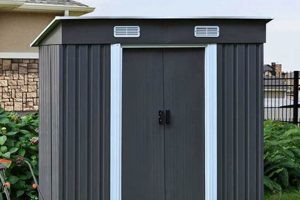
A level, reinforced platform made of hardened cement, aggregate, and water provides a stable and durable foundation for a backyard storage structure. This solid base distributes the weight of the building evenly, preventing settling and potential structural damage. For instance, a properly constructed base will ensure the walls remain plumb and the roof stays secure, extending the lifespan of the entire construction.
Such a groundwork is essential for several reasons. It offers protection from ground moisture, inhibiting rot and pest infestation. Historically, even rudimentary storage solutions benefited from raised platforms to preserve contents and maintain structural integrity. The advantages of this approach include increased longevity of the structure, minimized maintenance needs, and a heightened sense of security for stored items. A well-prepared base also offers a consistent surface, simplifying assembly and ensuring a professional-looking finish.
Therefore, understanding the specifics of preparing a robust foundation for such structures is vital. Subsequent sections will delve into critical aspects such as site preparation, proper formwork construction, concrete mixing and pouring techniques, and necessary curing processes to achieve optimal strength and durability. These considerations will guide the construction process and ensure a long-lasting and reliable foundation.
Essential Considerations for a Durable Foundation
Constructing a solid platform for a garden shed requires careful planning and execution. These tips emphasize critical factors to ensure long-term stability and prevent common issues.
Tip 1: Site Selection and Preparation: Prior to any construction, the chosen location must be level and well-drained. Remove all vegetation, topsoil, and debris. A compacted gravel base beneath the base provides enhanced drainage and prevents soil erosion that could undermine the structure.
Tip 2: Accurate Formwork Construction: Precise formwork is paramount. Use durable lumber and ensure the forms are square and securely braced. Inaccurate formwork results in an uneven surface and compromised structural integrity.
Tip 3: Reinforcement with Wire Mesh or Rebar: Embed wire mesh or rebar within the base to increase its tensile strength and resistance to cracking. The reinforcement should be positioned strategically within the concrete mix, typically in the middle third of the slab’s thickness.
Tip 4: Proper Concrete Mix Ratio: Adhere to recommended mix ratios of cement, aggregate, and water. Too much water weakens the concrete, while insufficient water hinders proper hydration. A 1:2:4 ratio (cement:sand:gravel) is often suitable for this type of application.
Tip 5: Leveling and Screeding: Immediately after pouring, use a screed board to level the surface. This process ensures a uniform thickness and a smooth, even top. Variations in thickness can lead to stress points and potential cracking.
Tip 6: Curing Process: Curing is essential for achieving maximum strength. Keep the surface moist for at least seven days using wet burlap, plastic sheeting, or regular sprinkling. Premature drying leads to weak, brittle concrete.
Tip 7: Control Joints: Cut control joints into the surface to manage cracking. These joints create predetermined weak points, allowing the concrete to crack along these lines rather than randomly across the slab. Joints should be cut within 24 hours of pouring.
Implementing these practices will significantly improve the longevity and performance of the foundation, minimizing maintenance and maximizing the utility of the storage structure.
The following sections will provide further details on specific techniques and best practices to ensure a successful construction project.
1. Level Site Preparation

The preparation of a level site is a fundamental prerequisite for the successful installation of a base for a garden shed. An uneven surface compromises the structural integrity of the cement platform, leading to potential issues that diminish the lifespan of the structure.
- Load Distribution and Structural Integrity
Uneven ground causes unequal load distribution across the platform. Areas with insufficient support are prone to cracking and settling. This compromises the structural integrity of the shed, potentially causing warping of walls, roof instability, and door or window misalignment. A level surface ensures uniform weight distribution, preventing these problems and extending the life of the structure.
- Drainage and Moisture Control
A slope or unevenness can create areas where water pools. Trapped moisture can penetrate the cement, leading to freeze-thaw damage in colder climates. Additionally, moisture promotes rot in the shed’s wooden components. Leveling facilitates proper drainage away from the structure, protecting both the cement foundation and the shed itself.
- Ease of Construction and Accurate Alignment
A level surface simplifies formwork construction. Forms must be precisely aligned to create a uniform thickness and a square perimeter. Attempting to construct forms on uneven ground introduces errors that translate into an irregular and structurally unsound base. A level starting point ensures accurate form placement and simplifies the pouring and leveling process.
- Prevention of Subgrade Erosion
Uneven surfaces often lack proper compaction. Rainfall and runoff can erode the subgrade beneath the concrete, creating voids and further destabilizing the structure. Leveling typically involves compacting the soil or adding a compacted gravel base. This prevents erosion and provides a stable, well-drained subgrade for the foundation.
In conclusion, meticulous site preparation is not merely a preliminary step but an integral component of a durable and reliable base for a garden shed. Neglecting this crucial stage introduces a cascade of potential problems that can significantly reduce the structure’s lifespan and functionality. Therefore, investing time and effort into achieving a perfectly level and well-compacted site is essential for a successful and long-lasting installation.
2. Formwork Precision

Formwork precision is critical in the construction of a stable and durable platform for a garden shed. The accuracy of the formwork directly influences the dimensions, shape, and overall structural integrity of the finished product. Deviations from specified dimensions can compromise the load-bearing capacity and aesthetics.
- Dimensional Accuracy and Load Distribution
Accurate formwork ensures the resulting cement base conforms precisely to the planned dimensions. Dimensional inaccuracies can lead to uneven load distribution, concentrating stress in certain areas and increasing the risk of cracking or settling. For example, if the formwork is not square, the resulting base will exert uneven pressure on the shed’s frame, potentially leading to structural damage over time.
- Surface Levelness and Water Drainage
Precise formwork is essential for achieving a level surface. A level surface guarantees proper drainage and prevents water from pooling on the platform. Accumulated water can seep into the concrete, leading to freeze-thaw damage in colder climates. Furthermore, it can contribute to the growth of mold and mildew, affecting the shed’s contents and structural components. Formwork must be constructed to maintain a slight slope for efficient water runoff.
- Structural Integrity and Reinforcement Placement
The formwork determines the correct placement of reinforcement materials, such as wire mesh or rebar. Precise positioning of these reinforcements is crucial for maximizing tensile strength and preventing cracking. Inaccurate formwork can result in improper embedment depth or misalignment of the reinforcement, reducing its effectiveness and compromising the overall structural integrity of the cement foundation.
- Cost-Effectiveness and Material Usage
Precise formwork minimizes waste and ensures cost-effective material usage. Accurate formwork dimensions prevent over-pouring of concrete and reduce the need for corrective measures, such as grinding or patching. Poorly constructed formwork can lead to material wastage and increased labor costs associated with correcting dimensional errors.
Formwork, when executed with precision, offers a foundation that supports a shed structurally and protects the shed from environmental elements. Therefore, precise construction is not just about aesthetics. Rather, it is an essential aspect of creating a functional and long-lasting structure.
3. Reinforcement inclusion

The incorporation of reinforcement, typically in the form of wire mesh or steel rebar, within a cement base fundamentally enhances its structural properties and longevity. In the specific context of bases for garden sheds, reinforcement mitigates the inherent tensile weakness of concrete, a characteristic that makes it susceptible to cracking under stress. The absence of reinforcement results in a brittle base that is prone to failure due to ground movement, temperature fluctuations, or the weight of the structure and its contents. A common example illustrates this point: A shed placed on an unreinforced platform frequently exhibits cracks within a year or two, necessitating costly repairs or complete replacement. In contrast, a reinforced platform can withstand these stresses for decades, providing a stable and secure foundation.
The practical application of this understanding is evident in building codes and best practices for cement construction. Reinforcement inclusion is not merely an optional upgrade; it is a standard requirement in most regions to ensure structural integrity and safety. The spacing, size, and placement of reinforcement materials are carefully calculated based on factors such as the anticipated load, soil conditions, and climate. These calculations are crucial for determining the appropriate level of reinforcement needed to prevent cracking and ensure the base’s long-term performance. For example, regions with expansive soils or frequent freeze-thaw cycles demand more robust reinforcement strategies than areas with stable ground and moderate climates.
In summary, reinforcement inclusion is an indispensable component of a well-constructed platform for a garden shed. It directly addresses the limitations of concrete, providing the necessary tensile strength to resist cracking and ensure long-term stability. While the initial cost may be slightly higher than that of an unreinforced base, the long-term benefits in terms of durability, reduced maintenance, and structural integrity far outweigh the investment. Neglecting reinforcement introduces a significant risk of premature failure, leading to costly repairs and potential damage to the shed and its contents.
4. Correct mix ratio

The proportion of cement, aggregate (sand and gravel), and water in a cement mixture directly dictates its strength, durability, and workability. For a base supporting a garden shed, adherence to a correct mix ratio is not merely preferential but fundamentally crucial for structural integrity and longevity.
- Achieving Compressive Strength
The cement-to-aggregate ratio primarily governs the compressive strength of the base. An insufficient cement content weakens the structure, making it prone to cracking under the shed’s weight or environmental stressors. Conversely, excessive cement increases costs without proportionally enhancing strength and can lead to shrinkage cracks. A proper balance ensures the base can withstand the intended load without failure.
- Ensuring Workability and Placement
The water-to-cement ratio influences the mix’s workability during pouring and leveling. Too little water results in a stiff, unmanageable mix that is difficult to spread and consolidate, leading to voids and weak spots. Excess water, while increasing workability, significantly reduces the cured cement’s strength. The correct water-to-cement ratio ensures a workable mix that can be easily placed, leveled, and compacted, while maintaining the desired strength characteristics upon curing.
- Minimizing Shrinkage and Cracking
An improperly balanced mix ratio can exacerbate shrinkage during the curing process, leading to cracks. Excessive water, in particular, increases shrinkage as it evaporates, creating internal stresses that cause cracking. The correct mix ratio, combined with proper curing techniques, minimizes shrinkage and reduces the likelihood of cracking, enhancing the base’s long-term durability.
- Durability and Resistance to Environmental Factors
The mix design significantly affects the resistance to the elements such as freeze-thaw cycles. A low water-cement ratio makes the slab less permeable. This reduces the risk of damage from freeze-thaw cycles and increases overall life span of the base. A well proportioned mixture is better suited to resist environmental stressors compared to one mixed poorly.
In summary, selecting and adhering to the correct mix ratio is paramount for constructing a foundation for a garden shed. Deviations from the recommended proportions can lead to a weaker, more prone-to-cracking structure that is unable to withstand the intended load and environmental stressors. A well-executed mix ratio ensures a durable, stable, and long-lasting foundation that effectively supports the shed for years to come.
5. Thorough leveling

Thorough leveling represents a critical stage in the construction of a foundation for a garden shed, directly influencing the structure’s stability and longevity. The process involves ensuring a completely horizontal and even surface before and during the cement pouring, screeding, and curing phases. Failure to achieve this introduces several structural risks. Uneven load distribution becomes inevitable, placing undue stress on certain areas of the slab, leading to premature cracking. Proper distribution of weight, facilitated by precise leveling, is a cornerstone of stable structure construction. A real-world example of this is a shed placed on a poorly leveled base experiencing door and window misalignment within a short time frame, a direct consequence of the foundation shifting due to uneven stress.
The practical implications of thorough leveling extend beyond mere structural stability. An uneven foundation also impedes proper water drainage, creating areas where moisture can accumulate. This moisture infiltration can lead to freeze-thaw damage in colder climates and promote rot and decay in the shed’s wooden components. Furthermore, precise leveling significantly simplifies the shed assembly process. A level surface allows for accurate alignment of walls, roof, and other structural elements, ensuring a secure and aesthetically pleasing finished product. Proper levelling before pouring the concrete ensure even thickness across the slab. If not, there may be thinner section that prone to crack due to load.
In conclusion, thorough leveling is not merely a preparatory step, but a fundamental requirement for a durable and reliable base for a garden shed. It mitigates the risk of uneven load distribution, prevents moisture accumulation, and simplifies the construction process. While seemingly basic, diligent execution of this step is essential for ensuring the long-term stability, functionality, and aesthetic appeal of the entire structure. Investing time and resources into meticulous leveling ultimately translates to a more robust, long-lasting shed that requires less maintenance and provides better protection for its contents.
6. Proper curing
Proper curing is an indispensable component in the creation of a durable base. Curing refers to maintaining adequate moisture content and temperature in freshly poured cement, enabling the cement hydration process to proceed fully. Without proper curing, the resulting slab exhibits reduced strength, increased permeability, and a heightened susceptibility to cracking and surface defects. The connection between curing and durability is causal: insufficient moisture prevents complete hydration, thus compromising the material’s fundamental properties. A real-life example involves two identical cement slabs; one cured meticulously and the other left to dry rapidly. The latter displays surface cracks and dusting within months, while the former remains intact for years. For example, concrete with correct water cement ratio can increase life span and prevent environment stress like freeze-thaw cycles to degrade easily compared to poorly cured concrete slab.
The practical significance of proper curing manifests in several ways. Firstly, it maximizes the compressive strength of the foundation, ensuring it can withstand the imposed loads from the shed and its contents. Secondly, it reduces permeability, minimizing the ingress of water and chemicals that can degrade the cement over time. Thirdly, it minimizes shrinkage, thus reducing the risk of cracking. Techniques for proper curing include keeping the cement surface continuously moist through methods such as water ponding, wet burlap coverings, or the application of a curing compound. The choice of method depends on factors such as environmental conditions and the size of the slab. Consistent monitoring of surface moisture is essential for effective curing. Concrete with control joints are less likely to have shrinkage and easy to manage.
In conclusion, proper curing is not a mere afterthought but a fundamental element in the successful construction of a cement base. Its absence significantly compromises the strength, durability, and lifespan. The challenges associated with curing, such as maintaining consistent moisture and temperature control, are manageable with proper planning and execution. Addressing this aspect is directly linked to the broader theme of constructing resilient and long-lasting structures. Neglecting proper curing introduces a high risk of premature failure, necessitating costly repairs or replacement, and undermining the entire investment in the garden shed. Concrete surface like broom finish can have more grip and less slippery compared to smooth surface.
7. Control Joints

Control joints are intentionally created lines of weakness within a cement base that dictate where cracking occurs. Their presence is essential for mitigating the effects of cement shrinkage and thermal expansion, particularly in foundations for garden sheds. Without control joints, random, uncontrolled cracking is likely, compromising the base’s structural integrity and aesthetic appeal.
- Purpose of Planned Weakness
Control joints are strategically placed to induce cracking along predetermined lines. This controlled cracking relieves internal stresses caused by volume changes in the base. By allowing the base to crack in designated areas, control joints prevent unsightly and potentially damaging random cracks from forming across the surface. For example, in a 10-foot by 10-foot base, control joints might be placed at 5-foot intervals, dividing the base into four equal squares.
- Timing and Depth of Cuts
The timing and depth of control joint cuts are crucial for their effectiveness. Joints should be cut within 6 to 24 hours after pouring, before significant cracking occurs. The depth of the cut should be approximately one-quarter to one-third of the base’s thickness. This depth creates a sufficient plane of weakness to encourage cracking along the joint line. Delaying the cut or making it too shallow diminishes the joint’s ability to control cracking.
- Types of Control Joints
Several methods exist for creating control joints. Saw-cut joints are made using a power saw equipped with a cement cutting blade. Grooved joints are formed during the pouring process using a grooving tool. Preformed joints involve embedding strips of plastic or fiberboard into the base. The choice of method depends on factors such as the size of the base, the desired appearance, and the available tools. Saw cutting is one of the easiest and cost effective way to perform controlled cuts.
- Impact on base Longevity and Maintenance
Properly implemented control joints contribute significantly to the longevity and reduce maintenance requirements. By directing cracks to controlled locations, the risk of spalling, water infiltration, and further deterioration is minimized. A base with well-defined control joints is less susceptible to damage from freeze-thaw cycles and ground movement. Regular inspection of control joints can help identify potential problems early, allowing for timely repairs.
The strategic implementation of control joints is an integral aspect of constructing a durable cement base for a garden shed. Their purpose is to manage cracking effectively, prolonging the base’s service life and minimizing maintenance efforts. Without control joints, the risks to structural integrity and aesthetic appeal are significantly elevated.
Frequently Asked Questions
The following questions address common concerns regarding the use of a hardened cement platform as a foundation for garden sheds. These answers provide concise information to aid in planning and construction.
Question 1: Is a hardened cement platform truly necessary for a garden shed?
While not always legally mandated, a cement base provides a stable, level, and durable surface that extends the lifespan of the shed. It protects against moisture, pests, and ground movement, preventing structural issues that can arise from setting the shed directly on the ground.
Question 2: How thick should a base be for a typical garden shed?
A thickness of 4 inches is generally sufficient for small to medium-sized garden sheds. For larger sheds or those storing heavy items, a 6-inch thickness may be necessary to provide adequate support and prevent cracking.
Question 3: What type of reinforcement is recommended for a cement base?
Wire mesh or rebar is commonly used to reinforce. Wire mesh (6×6 – 10/10) is suitable for lighter loads, while rebar (typically #3 or #4) is recommended for heavier applications. Proper placement within the slab is crucial for maximizing effectiveness.
Question 4: How much does constructing a platform typically cost?
The cost varies depending on the size of the slab, the thickness required, the type of reinforcement used, and local material and labor costs. Obtaining multiple quotes from local contractors is recommended for accurate budgeting.
Question 5: Can a base be poured directly on topsoil?
No. Topsoil contains organic matter that decomposes over time, leading to settling and cracking. All topsoil must be removed, and the subgrade should be compacted before pouring the cement.
Question 6: How long must the base cure before the shed can be constructed?
The base should cure for a minimum of seven days, and ideally 28 days, before placing the shed on top. This allows the cement to achieve its full strength and prevents damage from premature loading.
Proper planning and construction are essential for a durable and long-lasting base for a garden shed. Adhering to best practices ensures a stable foundation that protects the structure for years to come.
The subsequent section will delve into advanced techniques for optimizing foundation performance in challenging environments.
Concrete Slab for Garden Shed
This exploration has detailed the critical aspects of a properly constructed base for garden sheds. From site preparation and formwork precision to reinforcement, mix ratios, leveling, curing, and control joints, each element contributes significantly to the structural integrity and longevity of the foundation. Adherence to these principles ensures a stable, durable, and reliable platform capable of withstanding environmental stresses and supporting the shed’s intended use.
The investment in a well-engineered platform is an investment in the future of the structure. By prioritizing sound construction practices, the risks of premature failure, costly repairs, and structural damage are minimized. Continued diligence in maintaining the foundation will further ensure its long-term performance, safeguarding the shed and its contents for years to come.