



Heavy-duty watering implements designed for professional or intensive use differ significantly from those found in residential settings. These robust devices are typically constructed with superior materials, offering enhanced durability and longevity. Examples include hoses used in landscaping businesses, agricultural operations, or municipal parks maintenance.
The benefits of employing such durable implements are numerous. They withstand harsher conditions, resist kinking and bursting under pressure, and offer a longer service life, resulting in reduced replacement costs. Historically, these robust fluid conduits represent an evolution from simpler, less resilient watering solutions, driven by the demands of large-scale irrigation and maintenance.
The subsequent sections will detail material composition, pressure ratings, coupling types, and appropriate selection criteria for these professional-grade fluid transfer tools. Furthermore, proper storage and maintenance techniques to maximize the operational lifespan will be addressed.
Commercial Garden Hose Utilization
The effective and prolonged utilization of robust watering equipment requires adherence to specific guidelines. Implementing these practices maximizes performance and minimizes equipment degradation.
Tip 1: Material Selection. Prioritize reinforced rubber or polyurethane models for enhanced resistance to abrasion, ultraviolet radiation, and chemical exposure. Consider specific operational requirements such as hot water or oil resistance during selection.
Tip 2: Pressure Rating Compliance. Adhere strictly to the manufacturer’s specified pressure limits. Exceeding these limits significantly increases the risk of bursting and premature failure. Utilize pressure regulators when necessary.
Tip 3: Proper Storage Techniques. Avoid leaving equipment exposed to direct sunlight for extended periods. Store in a cool, dry location, ideally on a hose reel or hanger, to prevent kinking and deformation.
Tip 4: Regular Inspection and Maintenance. Routinely inspect the implement for signs of wear, cuts, or leaks. Address minor issues promptly to prevent escalation into major failures. Replace damaged couplings immediately.
Tip 5: Winterization Procedures. Before the onset of freezing temperatures, thoroughly drain all fluid from the apparatus. Disconnect from the water source and store indoors to prevent damage from ice expansion.
Tip 6: Appropriate Nozzle Selection. Choose nozzles appropriate for the specific task. High-pressure nozzles may cause damage to delicate plants or surfaces. Adjustable nozzles offer greater versatility.
Tip 7: Secure Coupling Connections. Ensure that all couplings are properly tightened to prevent leaks and maintain optimal water pressure. Utilize thread sealant or Teflon tape on threaded connections for enhanced sealing.
These guidelines ensure the sustained performance and longevity of watering systems, minimizing operational disruptions and reducing the overall cost of ownership.
The subsequent section will address common troubleshooting scenarios and repair procedures associated with this equipment.
1. Durability

Durability constitutes a critical performance attribute for robust watering implements intended for professional applications. It directly impacts lifespan, operational efficiency, and overall cost-effectiveness.
- Material Composition and Construction
The selection of materials significantly influences the device’s ability to withstand demanding conditions. Reinforced rubber, polyurethane, and other high-strength polymers are employed to resist abrasion, punctures, and degradation from ultraviolet radiation. The layering and construction techniques further contribute to structural integrity.
- Resistance to Environmental Factors
Professional-grade watering implements are frequently exposed to diverse environmental stressors, including extreme temperatures, direct sunlight, and chemical exposure. Durable designs incorporate protective coatings and materials that resist cracking, fading, and degradation under prolonged exposure.
- Kink Resistance and Flexibility
Frequent kinking can compromise water flow and weaken the structure. Durable designs often incorporate spiral reinforcement or specialized polymers to maintain flexibility while minimizing the risk of kinks and bends that restrict flow or cause structural damage.
- Coupling Strength and Integrity
The couplings represent a critical point of potential failure. Durable couplings are constructed from corrosion-resistant metals or reinforced polymers, and are designed to withstand repeated connection and disconnection without leakage or thread damage. Secure, leak-proof connections are essential for efficient operation and preventing water wastage.
These facets of durability collectively ensure that professional-grade watering implements can withstand the rigors of frequent, intensive use, providing a reliable and long-lasting solution for commercial landscaping, agricultural irrigation, and other demanding applications. The enhanced durability translates to reduced replacement costs and minimized downtime, ultimately contributing to improved operational efficiency.
2. Pressure Rating

The pressure rating of a robust watering implement is a critical specification that dictates its operational limits and safety parameters. This rating, typically expressed in pounds per square inch (PSI), indicates the maximum internal pressure the device can withstand without risk of rupture or failure. Selection of equipment with an appropriate pressure rating is paramount for ensuring efficient operation and preventing potential hazards in professional environments. Exceeding the specified pressure can lead to catastrophic failure, resulting in property damage, personal injury, and operational downtime.
Practical applications underscore the importance of adhering to pressure ratings. For instance, in agricultural irrigation systems with long runs and elevation changes, higher pressure may be necessary to achieve adequate water distribution. Conversely, delicate plant beds or seedling nurseries require lower pressure to prevent damage. Mismatched pressure can lead to inefficiencies such as uneven watering patterns, excessive water consumption, and damage to irrigation components. Furthermore, the pressure rating must be compatible with the water source’s pressure output; booster pumps may be needed to achieve optimal pressure levels, while pressure regulators may be required to prevent exceeding the capacity of the watering equipment.
In summary, the pressure rating is an indispensable consideration when selecting watering implements for any commercial application. Understanding the relationship betw
een the source pressure, the device’s pressure tolerance, and the application requirements is essential for safe, efficient, and reliable performance. Neglecting this aspect can lead to operational inefficiencies, increased costs, and potential safety risks. Proper selection and adherence to pressure specifications are fundamental for maximizing the lifespan and utility of professional-grade watering equipment.
3. Material Composition
The material composition of a robust watering implement directly influences its performance characteristics, longevity, and suitability for specific applications. Selecting the appropriate materials is crucial for optimizing operational efficiency and minimizing maintenance costs in demanding commercial environments.
- Rubber Compounds
Rubber formulations, including EPDM and SBR, offer flexibility and resistance to abrasion and weathering. Reinforced rubber models are prevalent in landscaping and construction due to their ability to withstand rough handling and exposure to the elements. However, some rubber compounds may be susceptible to degradation from certain chemicals or oils.
- Thermoplastics (PVC, Polyurethane)
Polyvinyl chloride (PVC) provides rigidity and affordability, while polyurethane offers superior flexibility and resistance to kinks and abrasion. PVC models are commonly used for general-purpose watering, while polyurethane variants find applications in environments requiring high flexibility and durability. The specific formulation impacts the pressure rating and chemical resistance.
- Reinforcement Layers
Braided or spiral reinforcement layers, typically composed of synthetic fibers like polyester or nylon, enhance the pressure-bearing capacity and burst strength. These layers prevent expansion and deformation under pressure, ensuring consistent flow rates and minimizing the risk of failure. The type and density of the reinforcement directly correlate with the pressure rating.
- Coupling Materials
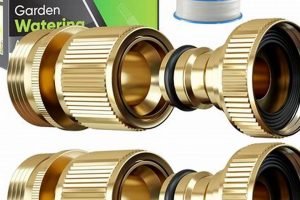
The composition of couplings, typically brass, aluminum, or reinforced polymers, influences their corrosion resistance and durability. Brass couplings offer excellent corrosion resistance but can be susceptible to dezincification. Aluminum couplings are lightweight but may be vulnerable to galvanic corrosion. Reinforced polymer couplings provide a balance of strength, corrosion resistance, and cost-effectiveness.
The interplay of these material components dictates the overall performance profile of the robust watering implement. A well-chosen material composition ensures optimal resistance to abrasion, pressure, chemicals, and environmental factors, thereby maximizing lifespan and minimizing operational disruptions in diverse commercial settings.
4. Coupling Strength

Coupling strength represents a critical performance characteristic of implements employed in commercial watering applications. The integrity of these connections dictates operational efficiency, prevents water loss, and ensures user safety, particularly under high-pressure conditions. Failure of couplings can lead to significant disruptions and potential hazards in demanding commercial environments.
- Material Composition and Corrosion Resistance
The selection of materials, such as brass, stainless steel, or reinforced polymers, directly affects coupling strength and resistance to corrosion. Brass offers high tensile strength but can be susceptible to dezincification in certain water conditions. Stainless steel provides superior corrosion resistance but may be more costly. Reinforced polymers offer a balance of strength and corrosion resistance while reducing weight. The chosen material must withstand prolonged exposure to water, chemicals, and environmental factors without degradation that compromises structural integrity.
- Thread Design and Sealing Mechanism
The thread design and sealing mechanism influence the ability of the coupling to maintain a leak-proof connection under pressure. Deeper, more precisely machined threads provide greater surface area for engagement and enhanced resistance to stripping. Sealing mechanisms, such as O-rings or Teflon tape, create a watertight barrier between the mating surfaces. The effectiveness of these mechanisms is critical for preventing leaks and maintaining consistent water pressure throughout the system.
- Clamping Force and Retention Mechanism
For implements utilizing clamp-style couplings, the clamping force and retention mechanism are paramount for secure attachment. The clamp must exert sufficient force to compress the hose material against the fitting, creating a friction-based seal. The retention mechanism, such as barbs or serrations on the fitting, prevents the from slipping off under pressure or tension. The design and material of the clamp must withstand repeated cycles of tightening and loosening without loss of clamping force.
- Impact Resistance and Mechanical Stress
Couplings in commercial environments are frequently subjected to mechanical stress and impact from dragging, dropping, or being run over by equipment. The coupling design must incorporate features that resist deformation, cracking, or breakage under these conditions. Reinforced construction, impact-resistant materials, and protective shrouds can enhance the coupling’s ability to withstand mechanical stress and maintain structural integrity.
The robust performance of watering systems hinges on the selection of couplings with adequate strength and durability. Properly designed and manufactured couplings ensure reliable connections, minimize water loss, and enhance the safety and efficiency of watering operations in diverse commercial settings. Ignoring coupling strength considerations can lead to frequent failures, increased maintenance costs, and potential safety hazards.
5. Abrasion Resistance

Abrasion resistance is a critical performance characteristic for robust watering implements utilized in commercial settings. Frequent dragging across abrasive surfaces such as concrete, gravel, and soil subjects the exterior to significant wear. The ability to withstand this wear directly impacts the implement’s lifespan and overall value.
- Material Selection for Enhanced Durability
The choice of materials directly influences abrasion resistance. Polyurethane and reinforced rubber compounds exhibit superior resistance compared to standard PVC. The incorporation of specialized additives and surface treatments further enhances the material’s ability to withstand abrasive forces. Examples include polyurethane coatings on rubber models or the inclusion of wear-resistant particles within the polymer matrix. Landscaping businesses operating on rocky terrain often specify models constructed from these materials to minimize wear and prevent premature failure.
- Reinforcement Layer Integration
The integration of reinforcement layers, typically composed of high-tenacity fibers, contributes significantly to abrasion resistance. These layers
provide a protective barrier against surface damage, preventing cuts and tears that can compromise the implement’s structural integrity. The density and weave pattern of the reinforcement influence its effectiveness. For instance, a tightly woven nylon braid offers greater protection than a loosely woven polyester alternative. Agricultural applications, where the implement is frequently dragged across cultivated fields, benefit substantially from this reinforcement. - Surface Texture and Profile
The surface texture and profile can influence the coefficient of friction and reduce the likelihood of abrasive damage. Smooth, low-friction surfaces minimize contact with abrasive particles, while textured surfaces can trap debris and accelerate wear. The optimal surface profile depends on the specific application. For example, a smooth surface is preferable for dragging across concrete, while a slightly textured surface may be advantageous in muddy conditions to improve grip and prevent slippage. Municipal parks departments often consider surface texture when selecting implements for use in diverse environments.
- Testing Standards and Performance Metrics
Standardized testing methods, such as the Taber abrasion test, provide quantitative metrics for evaluating abrasion resistance. These tests simulate real-world wear conditions and generate data that allows for comparing the performance of different materials and designs. Performance metrics, such as the weight loss after a specified number of abrasion cycles, provide a basis for selecting implements that meet specific durability requirements. Manufacturers of professional-grade watering implements often provide abrasion resistance data to facilitate informed purchasing decisions.
In conclusion, abrasion resistance is a multifaceted characteristic influenced by material selection, reinforcement, surface properties, and rigorous testing. Prioritizing implements with high abrasion resistance translates to extended service life, reduced replacement costs, and improved operational efficiency in demanding commercial applications. The selection process should consider the specific environmental conditions and anticipated wear patterns to ensure optimal performance and longevity.
6. Temperature Tolerance

Temperature tolerance is a critical performance parameter for professional-grade watering implements. These devices are often subjected to extreme environmental conditions, ranging from sub-freezing temperatures to intense solar radiation. The ability to withstand these temperature fluctuations without degradation is essential for maintaining functionality and preventing premature failure.
- Material Degradation at Temperature Extremes
Exposure to extreme temperatures can induce significant material changes in the implements. Low temperatures can cause polymers to become brittle and prone to cracking, while high temperatures can lead to softening, deformation, and accelerated degradation. The specific temperature sensitivity depends on the chemical composition and molecular structure of the materials. For example, certain PVC compounds become rigid and brittle at temperatures below freezing, increasing the risk of damage from bending or impact. Conversely, some rubber compounds may swell or soften at elevated temperatures, compromising their structural integrity and pressure-bearing capacity. This is a primary consideration for landscaping companies operating in regions with harsh winters or intense summer heat.
- Impact on Flexibility and Handling
Temperature influences the flexibility and handling characteristics of the implement. Low temperatures can reduce flexibility, making the implement difficult to maneuver and increasing the risk of kinking. High temperatures can increase flexibility to the point of making the implement unwieldy and prone to collapsing under its own weight. Maintaining optimal flexibility across a wide temperature range is crucial for efficient and safe operation. Construction sites that need the hose to stretch across long distance should consider this factor.
- Coupling Integrity and Thermal Expansion
Temperature fluctuations can induce thermal expansion and contraction in both the implement material and the coupling fittings. Differential expansion rates between dissimilar materials can create stress at the coupling interface, potentially leading to leaks or joint failure. Couplings constructed from materials with low thermal expansion coefficients, or designed with expansion joints, mitigate this risk. Proper selection of coupling materials and installation techniques are essential for maintaining joint integrity across a wide temperature range. Agricultural systems employing quick-connect couplings require careful consideration of thermal expansion effects.
- Pressure Rating and Temperature Dependency
The pressure rating of the equipment is often temperature-dependent. As temperature increases, the material’s tensile strength typically decreases, reducing its ability to withstand internal pressure. Manufacturers often provide derating curves that specify the maximum allowable pressure at different temperatures. Operating the device above its derated pressure limit can lead to bursting and catastrophic failure. Irrigation systems operating in direct sunlight may experience significant temperature increases, necessitating pressure derating to ensure safe operation.
In summary, temperature tolerance is a multifaceted characteristic that significantly impacts the performance and lifespan of implements employed in commercial watering applications. Understanding the material properties, thermal expansion effects, and pressure derating requirements is essential for selecting appropriate equipment and ensuring safe and efficient operation across a wide range of environmental conditions. Neglecting these considerations can lead to premature failure, increased maintenance costs, and potential safety hazards. Municipal water departments in varied climates need to factor in this considerations in operations.
7. Flexibility

Flexibility, as a property, directly influences the operational efficiency and longevity of fluid conduits utilized in professional environments. Decreased pliability increases the propensity for kinking, which restricts or completely blocks water flow, thereby reducing operational effectiveness. Moreover, repeated kinking weakens the structural integrity of the material, leading to premature failure and necessitating frequent replacement. This is particularly relevant in landscaping, where maneuvering around obstacles is commonplace, and in agricultural settings, where long runs are often required across uneven terrain.
Material composition and construction methods significantly affect this characteristic. Hoses constructed from reinforced rubber or thermoplastic elastomers generally exhibit greater flexibility than those made from rigid PVC. Furthermore, incorporating spiral reinforcement layers or specialized braiding patterns enhances resistance to kinking while maintaining pliability. In applications such as construction sites, where dragging and frequent repositioning are necessary, higher levels of flexibility translate to reduced user fatigue and improved productivity. The use of swivel fittings can further alleviate torsional stress, preventing kinking near connection po
ints.
In summary, the degree of flexibility is a crucial determinant of its suitability for demanding commercial applications. Prioritizing implements with adequate pliability minimizes flow restrictions, reduces the risk of structural damage, and enhances operational efficiency. Choosing the appropriate material composition and construction techniques allows users to optimize flexibility while maintaining the necessary durability and pressure rating. Therefore, considering its flexibility ensures an efficient and cost-effective implementation.
Frequently Asked Questions
The following addresses common inquiries regarding robust fluid conduits designed for professional applications. It provides factual answers to improve understanding and inform appropriate usage.
Question 1: What differentiates a watering implement designed for commercial use from a standard residential model?
Commercial-grade implements are constructed from superior materials, possess higher pressure ratings, and exhibit enhanced durability compared to residential models. They are designed to withstand the rigors of frequent, intensive use in demanding environments.
Question 2: How does the material composition impact performance?
The material composition determines resistance to abrasion, chemical exposure, ultraviolet radiation, and temperature extremes. Reinforced rubber and thermoplastic elastomers offer enhanced durability and longevity compared to standard PVC.
Question 3: What pressure rating is appropriate for various applications?
The appropriate pressure rating depends on the water source pressure and the application requirements. High-pressure systems necessitate implements with correspondingly high ratings. Exceeding the specified pressure limits can lead to bursting and failure.
Question 4: How does one properly store the apparatus to maximize lifespan?
Proper storage involves draining all fluid, protecting from direct sunlight, and storing in a cool, dry location, ideally on a reel or hanger. This prevents kinking, degradation, and premature failure.
Question 5: What are common signs of wear or damage that require attention?
Common signs of wear include cuts, abrasions, leaks, and weakened couplings. Addressing these issues promptly prevents escalation into major failures and extends the service life.
Question 6: How can the apparatus be effectively winterized?
Winterization involves thoroughly draining all fluid before the onset of freezing temperatures. Disconnecting from the water source and storing indoors prevents damage from ice expansion.
Understanding these key aspects ensures informed selection, proper usage, and extended lifespan of robust fluid conduits, minimizing operational disruptions and reducing overall costs.
The subsequent article section will delve into comparative analyses of different brands and models, highlighting their respective strengths and weaknesses.
Commercial Garden Hose
This exploration into commercial garden hose functionality has underscored critical aspects governing performance and longevity in demanding environments. Material composition, pressure ratings, coupling strength, abrasion resistance, temperature tolerance, and flexibility represent crucial selection criteria. Understanding these factors directly influences operational efficiency and mitigates potential failures.
Proper implementation of these guidelines ensures optimized usage and extended lifespan. Neglecting these considerations may lead to premature degradation, increased replacement costs, and compromised operational safety. Therefore, careful assessment and adherence to these principles are paramount for successful deployment in professional applications.
![Best 2 Inch Garden Hose For [X] & Reviews | The Ultimate Gardening Guide: Grow a Thriving Garden Year-Round](https://MyGardenPatch.com/wp-content/uploads/2025/07/th-5631-300x200.jpg "Best 2 Inch Garden Hose For [X] & Reviews The Ultimate Gardening Guide: Grow a Thriving Garden Year-Round")